Neurology
Latest news
579 articles · 20 / page

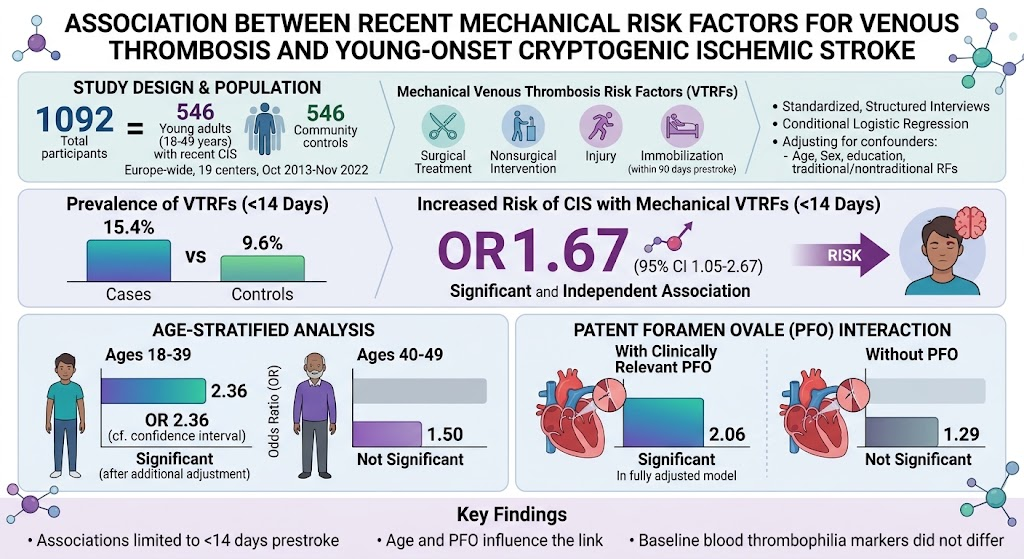
Recent Infections Act as a Transient Trigger for Cryptogenic Stroke in Young Adults via Thromboinflammatory Pathways
The SECRETO study demonstrates that infections within the preceding week increase the odds of cryptogenic ischemic stroke by 2.6-fold in young adults, primarily driven by transient increases in von Willebrand Factor and Factor VIII levels.

Navigating the Diagnostic Overlap: Why 24 Percent of Patients Meeting Minimal MS Criteria for Optic Neuritis Require Antibody Testing
A multicenter study reveals that nearly one-quarter of patients meeting the newest multiple sclerosis criteria for optic neuritis actually have MOGAD or NMOSD, emphasizing the critical role of antibody screening and detailed orbital MRI in

PrimeC Shows Significant Long-term Functional Benefit and Reduced Mortality in ALS: Insights from the PARADIGM Trial
The Phase 2b PARADIGM trial reveals that PrimeC, a novel oral combination therapy, is safe and significantly slows functional decline and reduces the risk of death or hospitalization in ALS patients over 18 months.

The NIHSS Bias: Why Right-Sided Middle Cerebral Artery Strokes Carry Higher Mortality and Complication Risks
A retrospective study of 489,360 patients reveals that right-sided middle cerebral artery strokes are associated with significantly higher inpatient mortality and complications compared to left-sided strokes, likely due to inherent scoring

Disentangling Cognitive Decline: The Interplay of White Matter Hyperintensities and Cortical Metabolism in Amyloid-Negative Patients
This review synthesizes findings on how periventricular white matter hyperintensities (PWMHs) drive cognitive impairment in Aβ-negative individuals through distinct metabolic mediation and direct structural pathways, highlighting the clinic

High-Frequency TENS Shows Promise for Nociplastic Ocular Pain in Randomized Pilot Trial
This randomized pilot study demonstrates that high-frequency TENS significantly improves specific neuropathic ocular pain symptoms over three months, offering a non-invasive, non-pharmacological alternative for patients with refractory ocul

Exoskeleton-Assisted Therapy for Upper Limb Motor Recovery in Early Subacute Stroke: Evidence from a Multicenter Randomized Controlled Trial
A comprehensive review of a multicenter RCT (Morone et al., 2026) demonstrating that exoskeleton-based robot-assisted therapy significantly improves upper limb motor impairment and clinical outcomes in the early subacute phase of stroke rec

Somatic Mosaicism in the Motor Cortex: A New Frontier in Understanding Sporadic ALS Pathogenesis
This study identifies somatic gene mutations in excitatory neurons of the motor cortex as a potential driver of sporadic ALS, challenging the traditional view of the disease’s genetic origins.

Beyond Aging: Traumatic Brain Injury and Depression Emerge as Leading Predictors of Dementia in US Veterans
A large-scale analysis of the VA Million Veteran Program reveals that TBI, depression, and specific military environmental exposures significantly elevate the 10-year risk of Alzheimer’s and related dementias, highlighting critical targets

Optimizing Prehospital Pathways: Impact of the Iranian Comprehensive Code Stroke Management Program (ICSM Phase III) on Thrombolysis Rates
This review analyzes the ICSM Phase III study, highlighting how a structured empowerment program and standardized protocols in EMS significantly reduced prehospital delays and tripled alteplase administration rates for acute ischemic stroke

Sport-Related Head Exposure Characteristics and Health Outcomes in Former Collegiate Athletes: A CARE Consortium Study
A study of 3,910 former college athletes found that a history of multiple concussions is significantly linked to worse mental health and sleep quality within five years of retirement, though most remain within normal clinical ranges.

High-Level EBNA-1 Antibodies: A Precise Biomarker for Differentiating Multiple Sclerosis From MOGAD and NMOSD
A large-scale multicenter study reveals that persistent high-level Epstein-Barr nuclear antigen 1 (EBNA-1) peptide antibody titers serve as a highly specific biomarker, effectively distinguishing Multiple Sclerosis from other neuroinflammat

Distinctive Endocrine Profiles and Hyperphagia in Rare Genetic Neurodevelopmental Disorders: Beyond the Prader-Willi Paradigm
This review synthesizes findings from a national multicenter study identifying that hyperghrelinemia is a specific biomarker for Prader-Willi Syndrome, whereas other rare neurodevelopmental disorders exhibit normal ghrelin levels despite se

Revascularization Strategies in Isolated Vertebral Artery Occlusion: Clinical Implications of the BRAVO Study
The BRAVO study provides critical evidence that while IV thrombolysis improves recovery in isolated vertebral artery occlusion, endovascular treatment may increase risks unless reserved for severe cases.

Purine Biosynthetic Enzyme PAICS as a Central Mediator of DNA Damage and Cerebellar Atrophy in C9orf72-ALS
This review synthesizes recent evidence identifying PAICS downregulation as a critical link between C9orf72 loss-of-function, DNA repair failure, and cerebellar neurodegeneration, highlighting its potential as a therapeutic target.

Motor Vehicle Accidents vs. Falls: Does the Mechanism of TBI Predict Long-Term Recovery?
A large-scale longitudinal study reveals that motor vehicle accidents cause significantly worse acute traumatic brain injury outcomes compared to falls. However, by one year post-injury, disability levels and community participation converg

Spinal Cord Tau and Protein Copathologies Associated With Chronic Traumatic Encephalopathy: A Detailed Clinical-Pathological Analysis
This retrospective study identifies a high prevalence of spinal cord p-tau and protein copathologies in patients with Chronic Traumatic Encephalopathy (CTE), suggesting the existence of a ‘trauma-related encephalomyelopathy’ linked to repet

Impact of the FKBP5 Gene on Stroke Recovery: A Comparative Study in Mice and Humans
This translational study demonstrates that the FKBP5 protein, a regulator of the stress response, significantly influences stroke outcomes. Lower FKBP5 levels correlate with smaller brain lesions in mice, while high-expression genetic varia

Beyond Recanalization: Understanding the Dynamic Evolution of the No-Reflow Phenomenon After Stroke Thrombectomy
A prospective multicenter study reveals that the no-reflow phenomenon is a dynamic, evolving pathology following successful thrombectomy. It is significantly associated with infarct growth and poor functional outcomes, suggesting that achie

The Prognostic Significance of Paramagnetic Rim Lesions in Radiologically Isolated Syndrome: A New Paradigm for Early Multiple Sclerosis Diagnosis
This review explores how paramagnetic rim lesions (PRLs), as markers of chronic active demyelination, serve as powerful predictors for clinical Multiple Sclerosis conversion in individuals with radiologically isolated syndrome.
Browse by specialty
Open language-specific specialty feeds and department pages.