Introduction
Traumatic brain injury (TBI) is a significant cause of disability among older adults, often resulting in lasting difficulties with self-care and mobility. After acute hospital care, many older adults require inpatient rehabilitation to regain functionality. However, the transition from inpatient rehabilitation facilities (IRFs) to community-based or home care presents challenges, especially in accessing continued occupational therapy (OT) and physical therapy (PT). These services are crucial in addressing self-care and mobility limitations to promote independence and improve quality of life. Despite the known benefits of OT and PT, access and utilization patterns after discharge remain poorly understood, particularly when non-clinical factors come into play.
Objective
This study aimed to evaluate whether clinical need at discharge from IRFs, characterized by limitations in self-care and mobility, correlates with the use of community rehabilitation services. Additionally, it sought to identify how non-clinical factors such as age, ethnicity, rural versus urban residence, marital status, and Medicaid eligibility influence post-discharge rehabilitation utilization.
Methodology
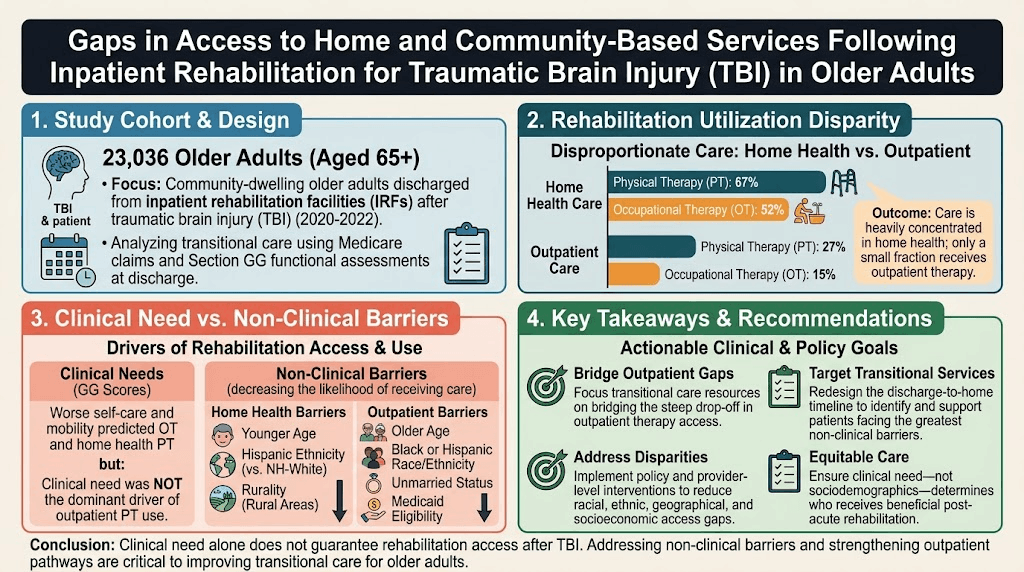
We conducted a cohort study analyzing Medicare claims linked with patient assessments for older adults who underwent inpatient rehabilitation for TBI from 2020 to 2022, involving 23,036 individuals living in the community. Modified Poisson regression models estimated likelihoods of receiving home health OT, home health PT, outpatient OT, and outpatient PT within 90 days after discharge. Clinical need was defined using Section GG scores, which assess self-care and mobility performance at discharge. Non-clinical variables were also incorporated to examine their independent effects.
Findings
Our results show that the majority of rehabilitation services occurred through home health agencies, with 52% of patients receiving OT and 67% receiving PT at home. Outpatient rehabilitation utilization was lower, with 15% receiving OT and 27% PT in outpatient settings.
Worse self-care abilities at discharge predicted higher use of both home health and outpatient OT services. In contrast, limited mobility was strongly associated with home health PT but did not significantly predict outpatient PT usage. These findings suggest outpatient therapy utilization may be influenced by factors beyond physical abilities.
Non-clinical factors independently affected access to rehabilitation. Younger patients, those identifying as Hispanic compared to White non-Hispanic individuals, and patients residing in rural areas were less likely to receive home health services. For outpatient rehabilitation, patients who were older, identified as Black or Hispanic, unmarried, or eligible for Medicaid were less likely to engage in these services.
Clinical Implications
The concentration of rehabilitation services in home health settings reflects a potential preference or necessity for care delivery in familiar environments, possibly due to mobility barriers or transportation issues in older populations. However, outpatient rehabilitation also plays a vital role, and underutilization may represent missed opportunities for recovery enhancement.
Importantly, clinical need alone did not fully drive rehabilitation service utilization, highlighting systemic barriers and disparities affecting access. Ethnic minorities, rural residents, and socioeconomically disadvantaged groups experienced reduced access despite potential clinical indications.
Recommendations for Practice and Policy
Efforts to improve transitional care following inpatient rehabilitation for TBI should address identified gaps by:
– Enhancing outreach and referral mechanisms to ensure patients with clinical needs receive timely community rehabilitation.
– Developing culturally sensitive programs and language-accessible services to mitigate ethnic disparities.
– Improving transportation options and tele-rehabilitation services for rural residents.
– Aligning insurance coverage and reimbursement policies to facilitate equitable access across diverse patient groups.
Multidisciplinary collaboration among rehabilitation professionals, social workers, primary care providers, and policymakers is essential to design interventions that close existing gaps.
Conclusion
While community-based rehabilitation after inpatient TBI rehabilitation is common among older adults, access remains disproportionately influenced by non-clinical factors rather than clinical need alone. These disparities underscore the necessity for targeted efforts to ensure all patients receive rehabilitation care essential for optimal recovery and long-term independence. Future research should explore strategies to overcome barriers and monitor the effectiveness of interventions aimed at equitable rehabilitation access.
Reference
Kinney AR, Forster JE, Schneider AL, Brenner LA, Kumar RG, Falvey JR, Graham JE, Holliday R, Bahraini NH. Gaps in Access to Home and Community-Based Services Following Inpatient Rehabilitation for Traumatic Brain Injury in Older Adults. J Gen Intern Med. 2026 Oct 13. doi: 10.1007/s11606-026-10844-2. Epub ahead of print. PMID: 42870188.