Highlight
– Loneliness in persons with spinal cord injury (SCI) correlates significantly with environmental barriers and depressive symptoms.
– Increased environmental obstacles exacerbate feelings of loneliness and worsen mental health outcomes.
– Psychosocial interventions targeting both internal mood states and external environmental factors may help reduce loneliness in SCI.
Study Background
Traumatic spinal cord injury (SCI) results in profound physical disability, often accompanied by substantial psychosocial challenges. Among these challenges, loneliness—a subjective feeling of social isolation—has emerged as a serious concern. Loneliness not only diminishes quality of life but also portends adverse mental health outcomes including depression and anxiety. Persons with SCI frequently face unique environmental barriers including limited accessibility and social participation restrictions, which may compound feelings of loneliness. However, systematic investigation of the psychosocial correlates of loneliness specifically in this population remains limited. Understanding these correlates is vital to inform targeted interventions that improve mental health and social integration.
Study Design
This study employed a convergent parallel mixed-methods design combining virtual structured interviews with quantitative questionnaires. Participants included 20 individuals with a traumatic SCI sustained more than one year prior, providing data representative of chronic phase adjustment. Key psychosocial instruments included the Three-Item Loneliness Scale to measure perceived loneliness, the Craig Hospital Inventory of Environmental Factors (CHIEF) assessing environmental barriers, the Patient Health Questionnaire (PHQ-9) for depressive symptom severity, and the Short Form-12 (SF-12) with a focus on the Mental Component Score (MCS) to evaluate overall mental health.
Key Findings
Analysis revealed statistically significant and clinically meaningful correlations between loneliness and several psychosocial variables. Specifically:
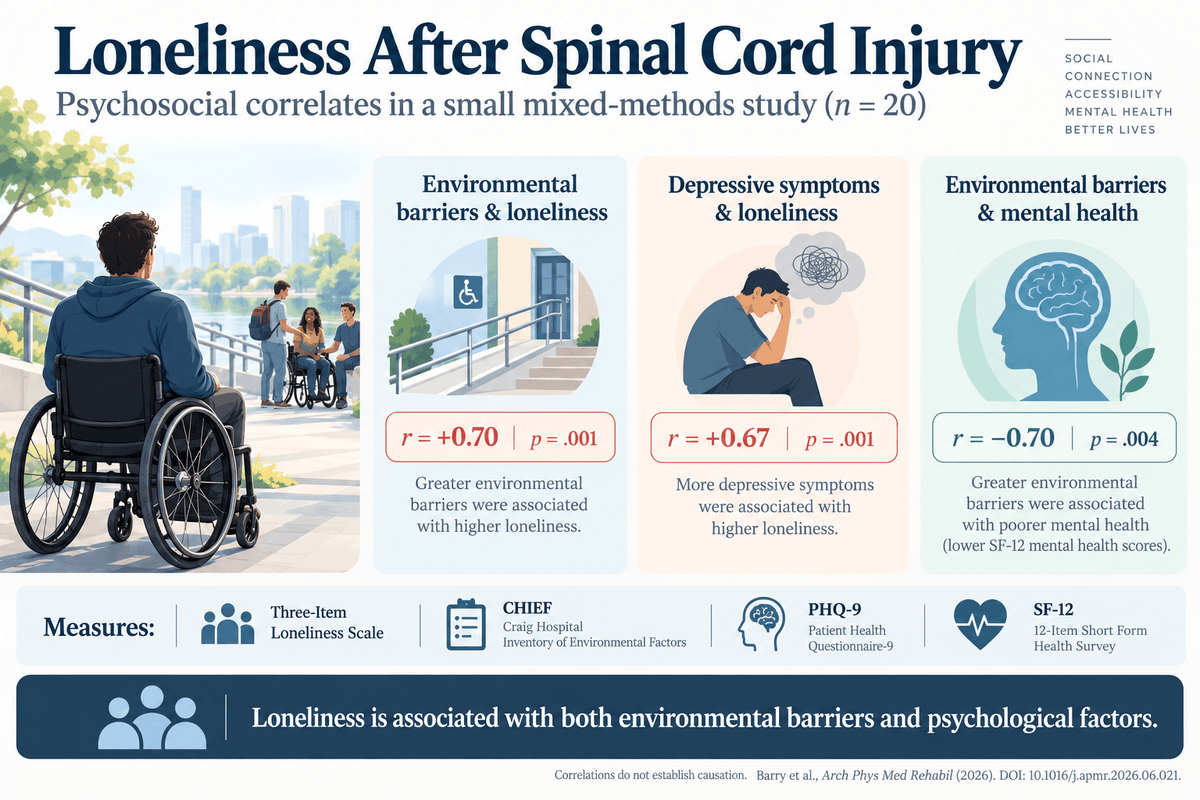
– Loneliness had a strong positive correlation with environmental barriers as measured by CHIEF (r=0.7, P=.001), indicating that greater perceived external obstacles coincide with increased feelings of being lonely.
– Depressive symptoms measured by PHQ-9 also correlated closely with loneliness (r=0.67, P=.001), underscoring the interplay between mood disorders and social isolation in SCI.
– Environmental barriers independently related to worsened mental health outcomes, reflected in a negative correlation with SF-12 Mental Component Scores (MCS) (r=–0.7, P=.004). This relationship suggests external hindrances affect broader psychological well-being beyond loneliness alone.
The convergence of results from different scales highlights the multifactorial nature of loneliness involving both internal mood states and external environmental factors.
Expert Commentary
The study by Barry et al. provides important insights into how loneliness in SCI extends beyond a mere internal emotional state to include significant interaction with environmental challenges. Previous literature has recognized depressive symptoms as common after SCI, but fewer studies have systematically quantified environmental contributions. The robust correlation between environmental barriers and mental health metrics indicates that physical and social contexts are pivotal targets for rehabilitation efforts.
Limitations of the study include a relatively small sample size and cross-sectional design, which limits causal inference. However, the mixed-methods approach and use of validated instruments strengthen the clinical relevance of findings. Future longitudinal studies with larger cohorts are needed to confirm these associations and explore mechanisms.
From a biological plausibility standpoint, isolation induced by physical and social barriers could exacerbate depression via neuroendocrine and inflammatory pathways known to be involved in mood disorders.
Conclusion
Loneliness in persons living with traumatic spinal cord injury is intricately linked to both internal depressive symptoms and external environmental barriers. Addressing loneliness in this population requires comprehensive interventions that encompass:
– Psychological support to identify and treat depression.
– Environmental modifications and policy changes to reduce accessibility and participation barriers.
– Social integration programs fostering meaningful connections.
This holistic approach holds promise to improve mental health outcomes and quality of life for this vulnerable population. Clinicians and rehabilitation specialists should incorporate assessment of loneliness and environmental factors into routine care protocols. Research efforts should prioritize development and evaluation of multifaceted interventions targeting these interrelated correlates of loneliness in SCI.
Funding and Clinical Trials
The original study does not report funding sources or clinical trial registration.
References
Barry A, Lovell L, Roth E. Correlates of Loneliness in Persons With Spinal Cord Injury. Arch Phys Med Rehabil. 2026 Oct;107(10):3013-3015. doi: 10.1016/j.apmr.2026.06.021. Epub 2026 Jul 2. PMID: 42392244.