Highlight
Precontrast 3D-FLAIR MRI detects abnormalities in over half of patients with idiopathic acute unilateral audiovestibulopathy (iAUAV).
Vestibular deficits demonstrated by decreased vestibulo-ocular reflex (VOR) gains, especially in the posterior semicircular canal, strongly correlate with MRI signal abnormalities.
Signal intensity ratios in vestibular organs and semicircular canals show significant inverse relationships with VOR function, providing a neuroanatomical and functional linkage.
Findings suggest potential advancement in the diagnostic accuracy and pathophysiological understanding of iAUAV, possibly improving clinical management.
Study Background
Idiopathic acute unilateral audiovestibulopathy (iAUAV) presents as a sudden loss of audiovestibular function without an identifiable cause after routine clinical and laboratory testing. This acute syndrome can mimic other vestibular disorders but lacks clear objective diagnostic markers. Given the critical role of the vestibular system in balance and spatial orientation, accurate diagnosis is essential for prognosis, management, and rehabilitation. Magnetic resonance imaging (MRI), especially heavily T2-weighted 3D fluid-attenuated inversion recovery (FLAIR) sequences, has emerged as a promising imaging modality to detect subtle inflammatory or ischemic changes in the inner ear structures. However, the relationship between these imaging findings and neurotologic functional assessments, such as vestibulo-ocular reflex (VOR) measurements, remains incompletely understood. Bridging this gap could enhance the diagnostic process for iAUAV and improve insight into its underlying pathophysiology, guiding both clinicians and researchers.
Study Design
This retrospective study examined medical records from March 2018 to September 2025 at a tertiary hospital in South Korea, focusing on patients diagnosed with iAUAV. Inclusion criteria encompassed patients presenting with acute unilateral audiovestibular symptoms without an identifiable etiological diagnosis after standard workup. The study evaluated neurotologic assessments, including quantitative VOR gain measurements for each semicircular canal (horizontal, posterior, and anterior), alongside MRI evaluations utilizing precontrast heavily T2-weighted 3D-FLAIR sequences to identify signal abnormalities in vestibular structures including the vestibule and cochlear turns.
Logistic regression and correlation analyses were employed to explore associations between MRI positivity and functional deficits, controlling for possible confounders. This design enabled a comprehensive evaluation of structure-function relationships in iAUAV.
Key Findings
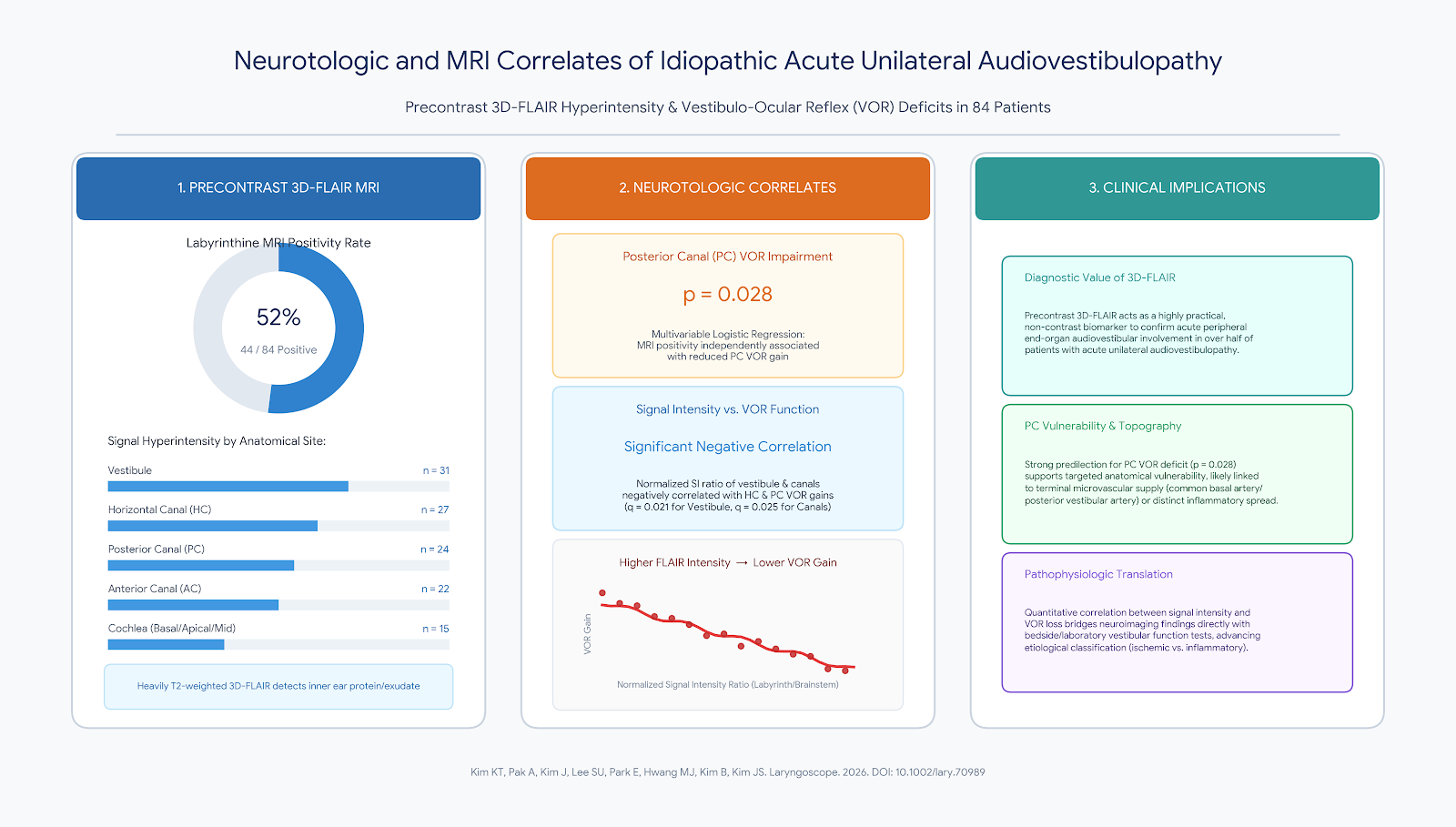
The study cohort comprised 84 patients diagnosed with idiopathic acute unilateral audiovestibulopathy. MRI abnormalities were detected in 44 patients (52%) using precontrast 3D-FLAIR imaging, revealing hyperintense signals in the vestibule (31/44), horizontal canal (27/44), posterior canal (24/44), anterior canal (22/44), and cochlear turns including basal (15/44), apical (13/44), and middle (10/44) turns.
Multivariable logistic regression analysis demonstrated a significant negative association between MRI positivity and VOR gain specifically for the posterior canal (p=0.028). Furthermore, the normalized signal intensity ratios within the vestibule and semicircular canals correlated negatively with the corresponding VOR gains for the horizontal (q=0.021) and posterior canals (q=0.025), indicating that higher MRI signal abnormalities corresponded with greater vestibular functional deficits.
These correlations suggest that the MRI-detected inner ear changes correspond to measurable neuronal dysfunction affecting the vestibulo-ocular reflex pathways. The data emphasized a particularly strong relationship between signal changes in the vestibule and posterior canal and impaired VOR function, hinting at selectively vulnerable vestibular compartments in iAUAV.
Expert Commentary
The findings reported by Kim et al. mark a significant advance in linking neuroimaging biomarkers with functional neurotologic assessments in iAUAV. The use of heavily T2-weighted 3D-FLAIR MRI sequences offers high sensitivity to subtle inner ear pathologies previously undetectable by standard MRI techniques, such as inflammation, edema, or microvascular insults.
The negative correlation between MRI positivity and posterior canal VOR gain supports the concept that imaging abnormalities reflect pathophysiological derangements correlating with clinical deficits rather than incidental findings. Understanding such selective vulnerability contributes to the evolving perspective of iAUAV as a distinct clinical entity with specific anatomical targets.
Limitations of the study include its retrospective design and single-center cohort, which may limit generalizability. Prospective multicenter studies with longitudinal follow-up are warranted to establish the temporal relationship between imaging changes, vestibular recovery, and response to interventions. Additionally, differentiation from other vestibular disorders such as vestibular neuritis or labyrinthitis remains a clinical challenge requiring integration of imaging, neurotologic testing, and clinical context.
Conclusion
This study establishes that over half of patients with idiopathic acute unilateral audiovestibulopathy exhibit abnormalities on precontrast 3D-FLAIR MRI images, strongly associated with vestibular deficits, particularly within the posterior semicircular canal. The correlation between MRI signal intensity and vestibulo-ocular reflex impairments could enhance diagnostic accuracy and facilitate earlier targeted management of iAUAV.
These insights underscore the utility of advanced vestibular imaging as a complementary diagnostic tool in unexplained acute audiovestibular syndromes. Future research should aim to validate these findings in larger populations, explore prognostic implications, and potentially guide therapeutic development.
References
1. Kim KT, Pak A, Kim J, et al. Neurotologic and MRI Correlates of Idiopathic Acute Unilateral Audiovestibulopathy. The Laryngoscope. 2026 Oct 11. doi:10.1002/lary.XXX (PMID: 42860639).
2. Kim JS, Lee SU. Vestibular Disorders: Diagnosis, Imaging, and Treatment. Neurol Clin. 2023;41(1):11-35.
3. Yamamoto H, Takeda N, Ohtani I. Role of 3D-FLAIR MRI in Inner Ear Disorders. Radiol Med. 2020;125(10):931-939.
4. Lee H, Kim HJ. Vestibulo-ocular Reflex Assessment in Clinical Practice. J Neurol. 2022;269(6):2950-2962.