Exploring Reticulospinal Tract Plasticity: Effects of Short-Term Isometric Resistance Training on Neural Adaptations
Highlight
– Four weeks of unilateral isometric elbow flexion resistance training increased maximal voluntary torque (MVT) by 12.8% in healthy adults.
– Multiple indirect assessments of reticulospinal tract (RST) excitability and function showed no significant adaptations post-training.
– Corticospinal tract (CST) excitability and intracortical inhibition properties remained unchanged after short-term resistance training.
– The findings suggest that short-term isometric resistance training does not modulate RST neural pathways despite increased muscle strength.
Background
The reticulospinal tract (RST) is a descending motor pathway originating from the reticular formation in the brainstem. It plays a crucial role in coordinating posture and voluntary movements, particularly contributing to gross motor function and recovery of motor control after neurological injuries such as stroke. Despite its recognized importance, the capacity for neuroplastic adaptation of the human RST following resistance training (RT) is not well-established. Resistance training is known to induce neural and muscular adaptations that enhance strength and motor control, predominantly mediated via corticospinal tract (CST) pathways. However, some animal studies and indirect human evidence have implicated potential RST involvement in strength gains, warranting investigation into whether human RST properties adapt following RT.
Study Design
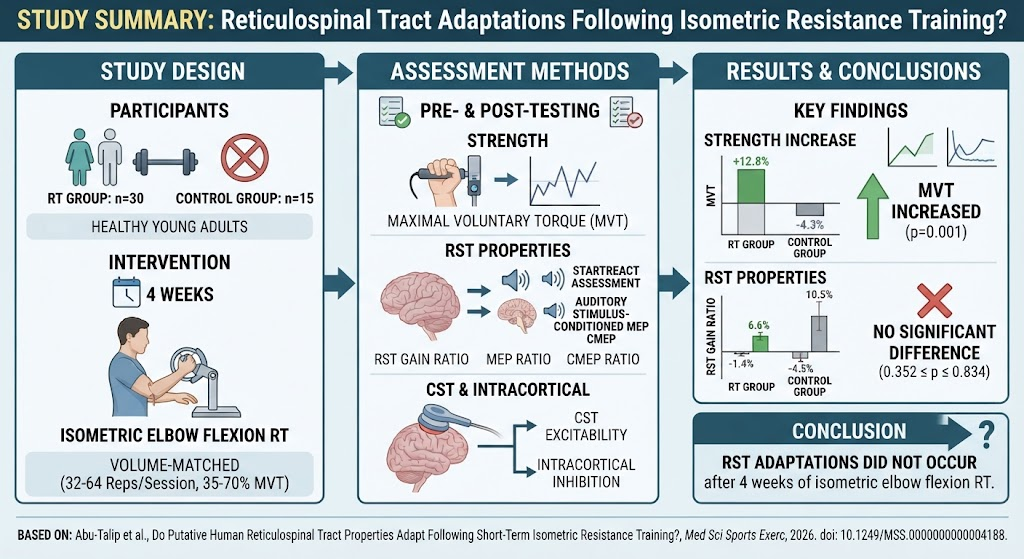
This interventional study included 45 healthy young adults divided into two groups: a resistance training group (RT, n=30) and a control group (CON, n=15). The RT group completed 15 unilateral elbow flexion resistance training sessions over 4 weeks. Training loads were volume-matched but consisted of either high load (32 repetitions at 70% maximal voluntary torque [MVT]) or low load (64 repetitions at 35% MVT) protocols. The CON group did not perform training. Pre- and post-intervention assessments included measures of maximal voluntary torque (MVT) and multiple indirect neurophysiological markers of RST excitability and function: the RST gain ratio derived from the StartReact paradigm, the ratio of motor evoked potentials (MEPs) conditioned by startling auditory stimuli to control MEPs, and the analogous ratio of cervicomedullary MEPs (CMEPs). Additionally, corticospinal tract excitability and intracortical inhibition were assessed using transcranial magnetic stimulation (TMS).
Key Findings
The resistance training group showed a statistically significant increase in maximal voluntary torque, with a mean improvement of 12.8%, contrasting with a 4.3% decrease in the control group (group × time interaction p = 0.001). This confirms the efficacy of the RT protocol in enhancing voluntary strength in elbow flexors.
In contrast, changes across a battery of indirect RST property measures were not statistically significant between groups post-intervention. Specifically, RST gain ratio changes ranged from -1.4% to +6.6% in RT subjects and -4.5% to +10.5% in controls, with all group × time interaction p-values between 0.352 and 0.834. Similarly, startling auditory stimulus-conditioned MEP and CMEP ratios did not differ significantly between groups after training.
Measures of corticospinal excitability and intracortical inhibition showed no meaningful alterations attributable to the training program, indicating that short-term isometric resistance exercise targeted at the elbow flexors did not induce detectable neural plasticity within these pathways.
Expert Commentary
This study provides valuable insight into the neural substrates of muscle strength gains following short-term RT by robustly examining the putative involvement of the RST. The absence of detectable RST adaptations despite meaningful strength increases suggests that early-phase strength improvements from isometric RT in healthy young adults primarily occur through mechanisms outside the reticulospinal system. These mechanisms may include enhanced motor unit recruitment and firing rates mediated by corticospinal pathways and peripheral muscle adaptations.
Methodologically, the study utilized multiple complementary indirect electrophysiological markers of RST function, including the StartReact paradigm and conditioned MEP/CMEP ratios, strengthening the reliability of the negative findings. However, indirect measures inherently limit direct conclusions about tract-specific plasticity due to overlapping neural contributions and variability in stimulus responses.
The four-week training duration, while sufficient for strength gains, may be too short to elicit significant neuroplasticity within subcortical descending tracts. Longer interventions or different resistance training modalities, including dynamic or multi-joint exercises, may be necessary to induce reticulospinal adaptations. Moreover, the participants were neurologically intact young adults; neural plasticity might differ in aging populations or patients with neurological impairments, where RST compensation is more prominent.
Conclusion
This study concludes that short-term unilateral isometric resistance training of the elbow flexors significantly increases muscle strength but does not induce measurable neuroplastic adaptations in reticulospinal tract properties as assessed by indirect electrophysiological paradigms in healthy young adults. These findings inform clinical rehabilitation and strength training paradigms by highlighting that early strength improvements may not involve the RST but are more likely mediated by corticospinal and peripheral muscular mechanisms. Future research should explore longer-duration training, dynamic exercises, and patient populations to delineate the conditions under which RST plasticity might be modulated.
Funding and Trial Registration
The publication did not specify funding sources or clinical trial registration numbers.
References
Abu-Talip K, Škarabot J, Wei D, Balshaw TG. Do Putative Human Reticulospinal Tract Properties Adapt Following Short-Term Isometric Resistance Training? Medicine and science in sports and exercise. 2026 Oct 13. PMID: 42868231.
Rothwell JC. The contributions of descending pathways to motor control in humans. Prog Brain Res. 2011;194:67-77. doi:10.1016/B978-0-444-53355-5.00005-5
Fisher KM, Zaaimi B, Baker SN. Reticular formation responses to active shoulder movement in the primate. J Neurophysiol. 2012;108(6):1722-1733. doi:10.1152/jn.00082.2012
Yang JF, Gorassini M. Spinal and brain control of human walking: implications for retraining of walking. Neuroscientist. 2006;12(5):379-389. doi:10.1177/1073858406290359
This article was created using several editorial tools, including AI, as part of the process. Human editors reviewed this content before publication.