Highlight
– A telehealth-delivered behaviour change intervention is feasible for post-stroke patients.
– The addition of a physical activity monitor (Smartwatch Mi Band 7®) showed greater within-group improvements in physical activity levels than behaviour change alone.
– Both interventions produced increases exceeding the minimal detectable change in physical activity.
– Participant retention and follow-up strategies require enhancement for future definitive trials.
Study Background
Stroke survivors commonly experience reduced physical activity, which contributes to secondary complications such as cardiovascular deconditioning, recurrent stroke risk, and poor functional recovery. Traditional stroke rehabilitation often faces barriers including geographic limitations, transportation challenges, and resource constraints. Telehealth interventions have emerged as promising strategies to deliver rehabilitation remotely, improving access and adherence. Moreover, wearable physical activity monitors may offer objective feedback and motivation to encourage sustained behavioural change. However, data on the feasibility and effect size of combining telehealth with physical activity monitors specifically in post-stroke populations remain limited. This study addresses the critical gap in evaluating whether such an integrated approach is practical and preliminarily effective for increasing physical activity post-stroke.
Study Design
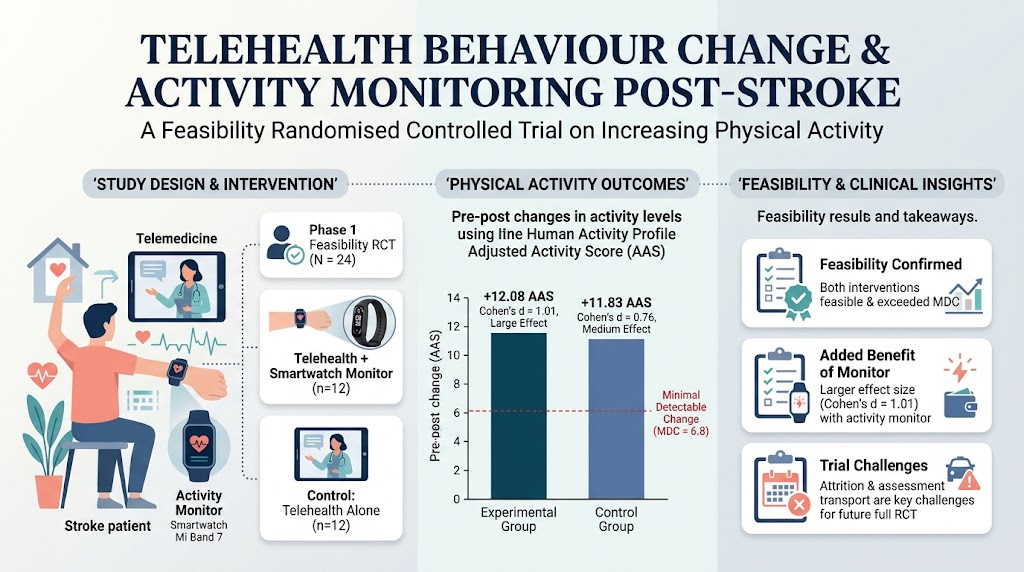
This was a Phase 1 feasibility randomised controlled trial conducted at a university setting, designed to evaluate delivery and preliminary efficacy of a behaviour change intervention targeting physical activity in adults post-stroke. The study enrolled approximately 24 participants who had experienced a stroke, randomised into two groups: the experimental group receiving the behaviour change intervention via telehealth combined with a physical activity monitor (Smartwatch Mi Band 7®), and the control group receiving the same behaviour change intervention via telehealth only. Allocation was concealed and assessments were blinded to group assignment. The primary focus was on feasibility outcomes including recruitment, retention, intervention delivery, and cost metrics. Secondary outcomes assessed clinical changes in physical activity levels measured by the Adjusted Activity Score of the Human Activity Profile.
Key Findings and Results
The trial demonstrated that recruitment and delivery of telehealth-based interventions were feasible with acceptable adherence. However, participant attrition was identified as a notable challenge, highlighting the need to enhance retention strategies in future studies.
Cost analysis revealed that the major expenditure was linked to transportation needed for in-person baseline and follow-up assessments, despite the telehealth intervention where appropriate, suggesting room for greater cost-efficiency if assessments can also be conducted remotely.
Clinically, both intervention arms exhibited increases in physical activity levels exceeding the minimal detectable change of 6.8 on the Adjusted Activity Score: the experimental group improved by 12.08 ± 12.01 while the control group improved by 11.83 ± 15.51. Effect size analysis indicated a large within-group effect in the experimental group (Cohen’s d = 1.01) compared to a medium effect in the control group (Cohen’s d = 0.76), suggesting a potentially clinically meaningful advantage of incorporating the physical activity monitor.
No adverse events or safety concerns related to intervention delivery were reported, supporting the safety of telehealth and wearable device use in this population.
Expert Commentary
The study presents compelling preliminary evidence that combining behaviour change strategies delivered via telehealth with wearable activity monitors can enhance physical activity post-stroke more effectively than behaviour change interventions alone. This aligns with growing recognition that objective self-monitoring and real-time feedback foster motivation and sustained engagement in rehabilitation activities.
Nevertheless, as a Phase 1 feasibility trial with a modest sample size, findings should be interpreted cautiously. Attrition and follow-up completeness will require robust strategies such as increased participant engagement, flexible scheduling, or a hybrid assessment model to improve generalizability in future randomized controlled trials (RCTs). Further, while the Mi Band 7® demonstrated benefit, comparative studies evaluating different device types and their integration into personalised interventions would be valuable.
Mechanistically, increased physical activity supports neuroplasticity and cardiovascular fitness, thereby potentially enhancing stroke recovery and reducing recurrent event risk. Telehealth facilitates continuous support and behavioural reinforcement, which could overcome traditional rehabilitation barriers.
Conclusion
This feasibility RCT confirms that a telehealth-delivered behaviour change intervention, both with and without a physical activity monitor, is feasible and leads to meaningful improvements in physical activity among post-stroke individuals. The addition of a physical activity monitor yielded a larger effect size, underscoring its potential to augment intervention effectiveness. Future larger-scale RCTs should address participant retention, long-term follow-up, and cost-optimization strategies while confirming the added value of physical activity monitors. Ultimately, integrating technology-enabled personalised approaches may enhance post-stroke rehabilitation outcomes, improve quality of life, and reduce the burden of stroke-related disability.
Funding and Trial Registration
The study was conducted as reported in Clinical Rehabilitation (2026) by Peniche et al., with funding details and trial registration information available in the original publication.
References
1. Peniche PDC, Magalhães JP, Lennon O, Ferreira JMDS, Cunha Polese J, Faria CDCM. A Behaviour Change Intervention Delivered Using Telehealth with a Physical Activity Monitor to Increase Physical Activity Post-Stroke: A Feasibility Randomised Controlled Trial. Clinical Rehabilitation. 2026 Oct 9:2692155261493887. PubMed PMID: 42852869.
2. Billinger SA, Arena R, Bernhardt J, et al. Physical activity and exercise recommendations for stroke survivors: a statement for healthcare professionals from the American Heart Association/American Stroke Association. Stroke. 2014 Jun;45(8):2532-53. doi:10.1161/STR.0000000000000022.
3. Dobkin BH. Rehabilitation after Stroke. N Engl J Med. 2005 Mar 3;352(16):1677-84. doi:10.1056/NEJMra044132.
4. Fini NA, Holland AE, Keating J, et al. How physically active are people following stroke? Systematic review and quantitative synthesis. Physical Therapy. 2017;97(7):707-717. doi:10.1093/ptj/pzx041.