Highlight
This double-blind randomized controlled trial demonstrates that repetitive transcranial magnetic stimulation (rTMS) combined with vestibular rehabilitation (VR) significantly improves symptom severity, balance, and postural stability in adult patients with chronic peripheral vestibular dizziness.
Key outcomes such as the Visual Vertigo Analogue Scale (VVAS), Berg Balance Scale (BBS), and computerized dynamic posturography showed large effect sizes and statistically significant improvements supporting clinical relevance.
The study introduces rTMS as a promising adjunct therapy to enhance vestibular rehabilitation outcomes in a clinical outpatient setting.
Study Background
Chronic peripheral vestibular dizziness poses a substantial burden on affected adults due to persistent symptoms of vertigo, imbalance, and increased risk of falls. Conventional vestibular rehabilitation therapy aims to promote central compensation and improve functional stability. However, some patients experience suboptimal recovery, necessitating adjunctive interventions.
Repetitive transcranial magnetic stimulation (rTMS), a non-invasive neuromodulatory technique, has shown potential to modulate neural circuits implicated in vestibular processing. Its therapeutic role in vestibular disorders remains under investigation but represents an appealing method to enhance neuroplasticity and symptom relief.
Study Design
This study was conducted as a double-blind randomized controlled trial in an outpatient clinic involving 56 adult participants diagnosed with chronic peripheral vestibular dizziness, with symptom duration averaging 14.3 months (range 6–28 months).
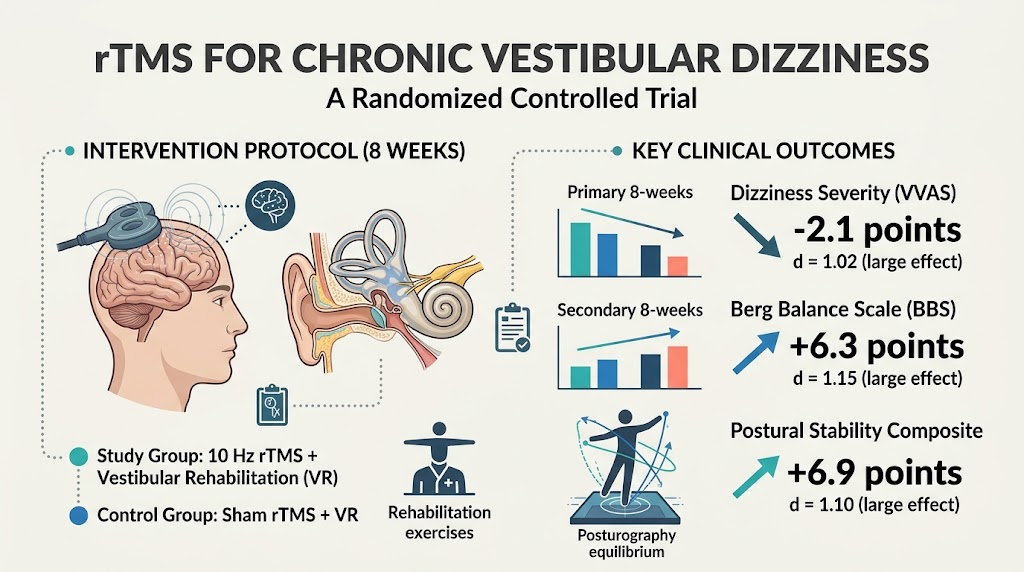
Participants were randomized into two groups: the study group receiving rTMS at 10 Hz frequency at 90% of resting motor threshold combined with vestibular rehabilitation (VR), and the control group receiving sham rTMS plus VR. Both interventions were delivered thrice weekly over 8 weeks, totaling 24 VR sessions per participant.
Primary outcome measures were the Visual Vertigo Analogue Scale (VVAS), assessing dizziness severity, and the Berg Balance Scale (BBS), evaluating functional balance. Secondary outcomes included components of computerized dynamic posturography assessing somatosensory, visual, vestibular, and preference elements of postural control.
Key Findings
After the 8-week intervention, the study group demonstrated significantly greater improvements across all measured parameters compared with the control group (P<.05).
Notably, the Visual Vertigo Analogue Scale showed a mean reduction of 2.1 points (95% CI -2.8 to -1.4; Cohen’s d=1.02), indicating a large effect in reducing dizziness severity. The Berg Balance Scale improved by 6.3 points (95% CI 4.2 to 8.4; d=1.15), reflecting enhanced balance performance. Furthermore, total equilibrium composite scores on computerized dynamic posturography increased by 6.9 points (95% CI 4.7 to 9.1; d=1.10), signifying improved postural stability.
Secondary outcome components – somatosensory, visual, vestibular, and preference – also showed statistically significant gains in the intervention group, underscoring multisensory integration improvements.
The large effect sizes and confidence intervals provide compelling evidence for the clinical significance of rTMS in augmenting vestibular rehabilitation therapy effectiveness.
Adverse events were not reported as significant, suggesting that rTMS is a safe adjunctive modality for this patient population.
Expert Commentary
These findings align with emerging data that non-invasive brain stimulation can modulate cortical excitability and facilitate central vestibular compensation. The application of 10 Hz stimulation at 90% motor threshold likely enhanced neuroplasticity within vestibular pathways, enabling better sensory integration and motor control relevant to balance and dizziness symptoms.
While promising, considerations regarding optimal stimulation parameters, long-term durability, and patient selection criteria remain to be elucidated. The study’s outpatient setting and robust methodology bolster generalizability, but further multi-center trials with longer follow-up are warranted.
Current vestibular disorder guidelines do not yet incorporate rTMS; however, this trial supports its potential translational role as an advanced therapeutic adjunct.
Conclusion
Repetitive transcranial magnetic stimulation combined with vestibular rehabilitation significantly improves dizziness severity, functional balance, and postural stability in adults suffering from chronic peripheral vestibular dizziness. This intervention may enhance neuroplasticity and vestibular compensation mechanisms beyond standard rehabilitation alone.
Given the large clinical effects demonstrated, rTMS represents a promising, safe, and non-invasive therapeutic option to address the unmet medical need in refractory vestibular dizziness. Future research should aim to optimize protocols, delineate mechanisms, and evaluate long-term benefits to support integration into clinical practice.
Funding and Clinical Trials Registration
The referenced study was published by Ahmed RAM et al. in 2026 in Archives of Physical Medicine and Rehabilitation. Specific funding sources and clinical trial registration details were not indicated in the abstract available.
References
Ahmed RAM, Mohamed AA, Youssef A, Fahmy E, Hamdy HS, Nafia H, Fayed IH, El-Din SS. Repetitive Transcranial Magnetic Stimulation for Dizziness, Balance, and Postural Stability in Adult Patients With Chronic Peripheral Vestibular Dizziness. Archives of Physical Medicine and Rehabilitation. 2026 Aug 6;107(10):2637-2646. PMID: 42559786.
Additional references supporting rTMS in vestibular dysfunction and neuroplasticity can be explored in neuro-otology and rehabilitation journals for comprehensive evidence.