Highlight
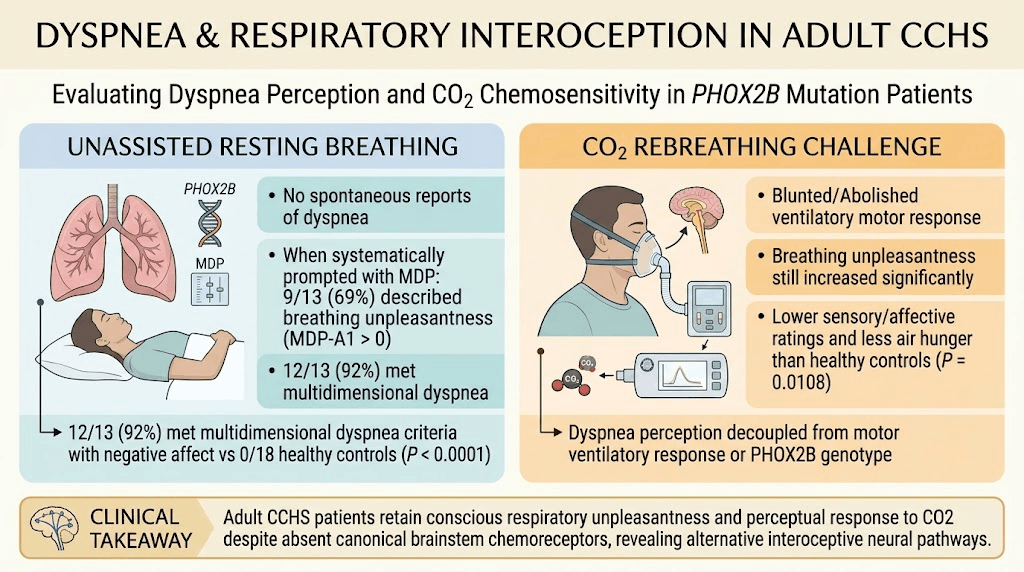
Adult CCHS patients report conscious unpleasant breathing sensations at rest despite lacking spontaneous dyspnea reports.
Multidimensional Dyspnea Profile assessment reveals perceptual respiratory responses during CO2 rebreathing even with impaired ventilatory and central chemosensitivity.
These findings indicate alternative respiratory interoceptive pathways beyond brainstem chemosensitive circuits.
Study Background
Congenital central hypoventilation syndrome (CCHS) is a rare genetic disorder marked by impaired central ventilatory control due to mutations in the PHOX2B gene. Characteristically, patients lack central carbon dioxide (CO2) chemosensitivity, resulting in failure to increase ventilation adequately in response to hypercapnia, typically necessitating lifelong assisted ventilation during sleep. While pediatric experience indicates a general absence of CO2-evoked air hunger or dyspnea, the characterization of respiratory sensations in adults with genetically confirmed CCHS remains poorly understood. This represents an important clinical knowledge gap given that the subjective experience of breathing discomfort (dyspnea) can influence management, quality of life, and may reveal hitherto unrecognized neural pathways involved in respiratory perception.
Study Design and Methods
This prospective controlled observational study enrolled thirteen genetically characterized adult CCHS patients harboring PHOX2B mutations drawn from a national ultrarare disease cohort. The patients underwent assessment of respiratory sensations using the Multidimensional Dyspnea Profile (MDP), a validated tool capturing sensory and affective dimensions of dyspnea, both during unassisted resting breathing and at the end of a standardized CO2 rebreathing challenge. The study included a control group of eighteen healthy adults evaluated under identical conditions to enable comparative analysis. Key endpoints included the presence and intensity of unpleasant breathing sensations at rest, ventilatory responses to CO2 rebreathing, and the relationship of these subjective experiences with ventilatory output and genotype.
Key Findings
Prior to study participation, none of the CCHS patients had spontaneously reported dyspnea or bothersome respiratory sensations. However, during resting breathing when prompted by the MDP, 9 of 13 patients described breathing unpleasantness (MDP-A1 > 0), significantly different from zero reports among controls (p < 0.0001). Notably, 12 of the 13 patients met criteria for dyspnea, defined as conscious breathing awareness combined with a negative emotional affect.
During CO2 rebreathing, ventilatory responses in patients were profoundly blunted compared to controls, consistent with abolished central CO2 chemosensitivity. Despite this, patients reported an increase in breathing unpleasantness during rebreathing. Interestingly, compared with controls, these patients displayed lower sensory and affective dyspnea ratings overall and reported air hunger less frequently (p = 0.0108). Correlation analyses revealed no significant relationship between MDP scores and either ventilatory responsiveness to CO2 or PHOX2B genotype variant.
These results underscore the paradoxical presence of conscious respiratory sensations and an affective response to hypercapnia in patients with essentially absent central chemosensitive drive.
Expert Commentary
This study provides compelling evidence that adult CCHS patients retain a perceptible respiratory discomfort or dyspnea sensation despite near abolition of canonical brainstem CO2 chemoreceptor function. These findings raise intriguing questions about alternative interoceptive pathways mediating respiratory sensations, possibly involving cortical or limbic structures, or peripheral chemoreceptor inputs modulating experiential awareness.
The methodology using the Multidimensional Dyspnea Profile enriches our understanding by separating sensory and affective components, which is crucial since dyspnea is a multidimensional subjective experience. The study’s strengths include genetic characterization of the cohort, the use of a validated dyspnea tool, and appropriate healthy controls.
Limitations include the relatively small sample size inherent to the rarity of CCHS, and the observational design. Further mechanistic studies using neuroimaging or electrophysiological assessments might elucidate the neuroanatomical substrates and pathways responsible for respiratory sensation in this population.
Clinicians should recognize that adult CCHS patients may experience unpleasant respiratory sensations despite abnormal ventilatory control, warranting proactive multidimensional dyspnea assessment during clinical care.
Conclusion
Adult patients with congenital central hypoventilation syndrome experience conscious unpleasant breathing awareness at rest and demonstrate preserved perceptual responses to CO2 elevations, even with abolished or nearly abolished central chemosensitivity. This challenges the conventional understanding that brainstem chemoreceptors exclusively mediate respiratory perception and suggests the existence of compensatory or alternative interoceptive pathways. These insights have important implications for symptom assessment, patient quality of life, and highlight the need for comprehensive multidimensional evaluation of dyspnea in adult CCHS. Future research should focus on delineating the neural circuits underlying these perceptual phenomena and exploring therapeutic approaches to address respiratory discomfort in this population.
Funding and Registration
The original study was conducted within the framework of a national cohort of an ultra-rare disease. No specific funding disclosures were provided. No clinical trial registration was mentioned.
References
1. Bret M, Laveneziana P, Niérat MC, et al. Dyspnea during resting breathing and carbon dioxide rebreathing in adult patients with congenital central hypoventilation syndrome. Chest. 2026; (Published online October 20). PMID: 42901374.
2. Weese-Mayer DE, Berry-Kravis EM, Ceccherini I, et al. Congenital central hypoventilation syndrome: clinical management and long-term outcome–a consensus statement. Am J Respir Crit Care Med. 2010;181(6):626-644.
3. Laveneziana P, Wadgaonkar S, Killian KJ, et al. Central ventilatory control and respiratory sensation: what they teach us about dyspnea and its modulation. Ann Am Thorac Soc. 2018;15(Supplement_1):S81-S90.
4. Parshall MB, Schwartzstein RM, Adams L, et al. An official American Thoracic Society statement: update on the mechanisms, assessment, and management of dyspnea. Am J Respir Crit Care Med. 2012;185(4):435-452.
5. Similowski T, Dejours P. What the brain knows about lung volume and how it uses this information. Implications for the pathophysiology of dyspnea. Am Rev Respir Dis. 1986;134(2):332-340.
6. Onal IK, Newton BW. The neuropsychology of respiratory sensations and dyspnea. Respir Physiol Neurobiol. 2019;265:116-123.