Expert Consensus on Managing Spontaneous Intracranial Hypotension with Spinal Longitudinal Epidural CSF Collections: Key Recommendations from a 2026 Delphi Study
Introduction and Context
Spontaneous intracranial hypotension (SIH) is a treatable cause of disabling orthostatic headache and other neurological symptoms caused by cerebrospinal fluid (CSF) loss through spinal leaks. Management ranges from conservative measures to targeted interventions such as epidural blood patching (EBP) and, in selected cases, surgery or endovascular repair. Despite growing knowledge about imaging and leak types—ventral dural tears, lateral dural tears, and CSF–venous fistulas (CVFs)—clinical practice has varied widely, especially around peri‑EBP care, choice of imaging for leak localization, and timing of invasive procedures.
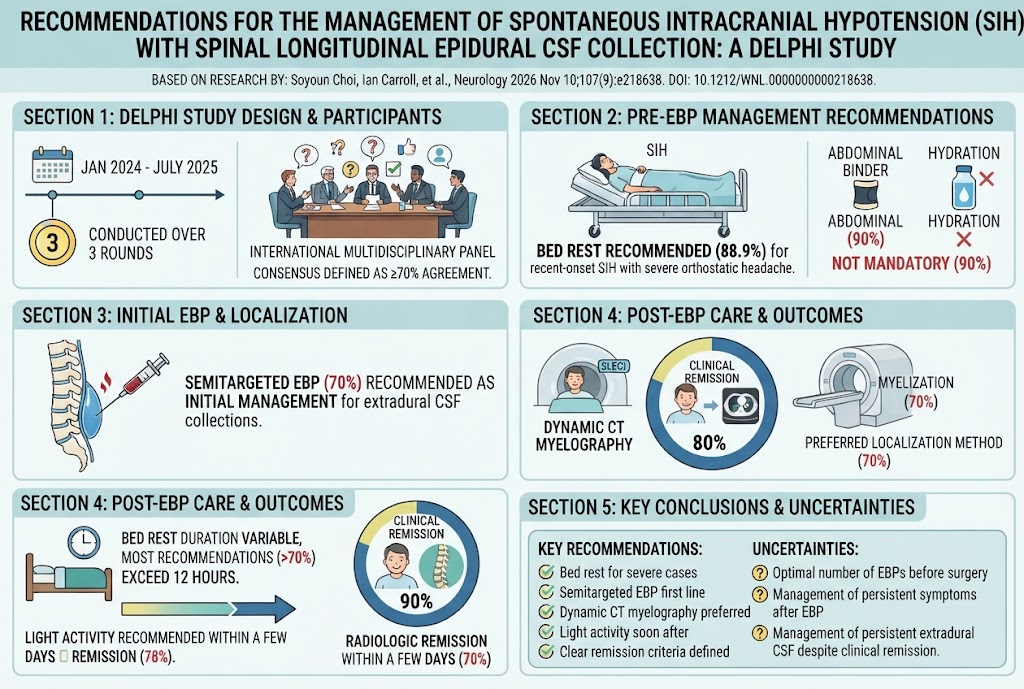
To address these gaps, an international, multidisciplinary panel convened a Delphi process (Jan 2024–July 2025) to produce consensus statements focused on patients with spinal longitudinal epidural CSF collections (SLEC) who may not yet have a fully classified leak type. The full Delphi report was published in Neurology (Choi et al., 2026). This article summarizes core recommendations, the strength of agreement, areas of uncertainty, and practical implications for clinicians and centers treating SIH.
Key references
– Choi S et al. Recommendations for the Management of Spontaneous Intracranial Hypotension With Spinal Longitudinal Epidural CSF Collection: A Delphi Study. Neurology. 2026;107(9):e218638. PMID: 42886874.
– Headache Classification Committee of the International Headache Society (IHS). The International Classification of Headache Disorders, 3rd edition (ICHD-3). Cephalalgia. 2018.
– Schievink WI. Spontaneous spinal cerebrospinal fluid leaks and intracranial hypotension. Lancet Neurol. 2006;5(6):499–508.
Why this Delphi consensus was needed
– Persistent variation in pre‑EBP, intra‑EBP, and post‑EBP practices across disciplines (neurology, neuroradiology, neurosurgery, anesthesiology) was causing inconsistent patient experiences and uncertain outcomes.
– Newer imaging approaches (dynamic CT myelography, digital subtraction myelography) and evolving understanding of leak mechanisms (including CVFs) required practical, multidisciplinary guidance—particularly for patients with SLEC when the precise leak type is not yet known.
– Randomized, high‑quality trial data are lacking for many management questions; a structured expert consensus using the Delphi method provides an interim, pragmatic framework to harmonize practice.
New Guideline Highlights (Top takeaways)
– For patients with SLEC and suspected extradural CSF, semitargeted epidural blood patching (EBP) is recommended as the initial interventional management (strong agreement: 70%).
– Dynamic CT myelography is the preferred first‑line imaging modality for leak localization in this context (70% agreement).
– Bed rest before EBP is recommended for recent‑onset SIH with severe orthostatic headache (strong agreement: 88.9%), but routine measures such as abdominal binders or enforced hydration are not mandatory (90% agreement that they are not required).
– Post‑EBP bed rest durations varied across experts, but most recommended rest exceeding 12 hours (agreement 70%).
– Clear definitions for clinical and radiologic remission were adopted (clinical remission 80% agreement; radiologic remission 90% agreement), and radiologic follow‑up after clinical remission was recommended (78% agreement).
– No consensus on an optimal number of EBPs before proceeding to invasive localization or surgery; decisions should be individualized.
Updated recommendations and how they differ from prior practice
The Delphi statements do not replace formal evidence‑based guidelines but fill practical gaps where randomized data are sparse. Notable shifts:
– Emphasis on semitargeted rather than purely blind (non‑targeted) EBP as initial interventional strategy for SLEC-positive patients, reflecting greater reliance on spinal imaging to guide patch placement.
– Preferential use of dynamic CT myelography for localization in the SLEC setting, acknowledging its higher sensitivity for active leaks compared with static myelography or MRI in many centers.
– Formal adoption of standardized definitions for clinical and radiologic remission to harmonize outcome reporting and follow‑up decisions—helpful for both clinical practice and research comparability.
Topic‑by‑topic recommendations (with consensus strength)
Note on consensus thresholds used by the Delphi group: ≥70% = strong agreement; 60–69% = partial agreement; 12 hours of rest after EBP).
Defining and following remission
– Clinical remission: Panel agreed on a practical definition (80%): sustained resolution or marked reduction in orthostatic symptoms and functional improvement.
– Radiologic remission: Agreement (90%) that radiologic resolution or significant reduction in the epidural CSF collection is meaningful; radiologic follow‑up is recommended even after clinical remission (78%).
– Persistent symptoms with radiologic remission: No consensus on a universal pathway; ‘‘doing nothing’’ was explicitly discouraged—individualized assessment is recommended.
Persistent extradural CSF despite clinical remission
– No consensus: Experts stressed individualized decisions—options include continued observation with imaging surveillance, repeat imaging with dynamic techniques, repeat semitargeted EBP, or advancing to invasive localization/surgical consultation depending on symptom burden, imaging, and local expertise.
When to escalate to invasive localization or surgery
– No single threshold number of EBPs was endorsed. Decision to escalate should consider symptom severity, functional impact, imaging evolution, and local capability to identify and treat specific leak types (eg, lateral dural tear repair or CVF endovascular repair).
Special populations and leak types not fully addressed
– The Delphi primarily addressed SLEC-positive patients and presumed ventral dural tears. Lateral dural tears and CSF–venous fistulas were recognized as important special cases needing separate, focused consensus work.
Expert perspectives, controversies, and panel insights
Consensus strengths
– Experts appreciated the need to standardize peri‑EBP care and to prioritize imaging‑guided (semitargeted) EBP in the SLEC setting. This reflects accumulated clinical experience pointing to better outcomes when the patch is placed near the radiographic collection.
Key controversies and uncertainties
– Imaging choice: While dynamic CT myelography was preferred, accessibility, radiation exposure, and center experience limit universal adoption. Digital subtraction myelography is favored in some centers but was not universally available.
– Number of EBPs before escalation: Practice varies widely; some centers favor multiple semitargeted EBPs, others prefer early invasive localization/surgery when symptoms persist.
– Management of radiologic persistence despite symptom improvement: Some experts argued for watchful waiting with follow‑up imaging, while others favored repeat targeted imaging to rule out occult leak types (eg, CVF).
Research priorities identified by the panel
– Prospective studies comparing semitargeted versus blind EBPs for SLEC-positive SIH.
– Standardized outcome measures using the adopted clinical and radiologic remission definitions.
– Multicenter studies to define optimal timing for invasive localization and surgical repair, and to better define management algorithms for CVFs and lateral dural tears.
Practical implications for clinicians and centers
– Triage and early imaging: For patients with clinical SIH and evidence of SLEC on spine MRI, consider early dynamic CT myelography or equivalent dynamic study if available to plan semitargeted EBP.
– Semitargeted EBP as first interventional step: When extradural CSF collection is present, perform a semitargeted EBP—placing blood near the collection—to maximize therapeutic effect and potentially reduce need for repeated blind lumbar patches.
– Document outcomes consistently: Use the Delphi definitions of clinical and radiologic remission to standardize follow‑up and facilitate audit and research.
– Individualize escalation: There remains no one‑size‑fits‑all rule for how many EBPs to attempt before invasive localization or surgery—decisions should incorporate symptom trajectory, patient preference, and center expertise.
– Multidisciplinary coordination: Optimal care often requires collaboration among headache neurologists, neuroradiologists, neurosurgeons, and interventionalists.
Illustrative vignette
Maria, a 42‑year‑old schoolteacher, develops a severe orthostatic headache over two weeks. Head MRI shows diffuse pachymeningeal enhancement and a thoracic SLEC on spine MRI. After a brief period of bed rest, dynamic CT myelography localizes active egress near the upper thoracic epidural collection. A semitargeted EBP is placed at that level; Maria rests overnight (>12 hours) and notices marked improvement in headaches over the next week. At two weeks she meets the panel’s clinical remission definition; a follow‑up spine MRI at six weeks shows substantial reduction of the epidural collection (radiologic remission). The team documents outcome and plans outpatient activity resumption with light exertion after several days, and individualized surveillance imaging at clinician‑recommended intervals.
Conclusions and next steps
The 2026 international Delphi consensus provides a pragmatic framework to reduce variability in managing SIH with SLEC. Semitargeted EBP and dynamic CT myelography emerged as central recommendations when extradural collections are present. Importantly, the panel standardized definitions of remission and highlighted areas lacking consensus—particularly around persistent radiologic collections, the optimal number of EBPs, and management of CVFs and lateral dural tears. These represent priorities for future research and multidisciplinary guideline development. Clinicians should integrate these consensus statements into local practice while remaining adaptable to individual patient needs and evolving evidence.
References
Choi S, Carroll I, Friedman DI, Kranz PG, Lee E, Matharu M, Parikh S, Schytz HW, Souza MNP, Wang YF, Yuan H, Lee MJ. Recommendations for the Management of Spontaneous Intracranial Hypotension With Spinal Longitudinal Epidural CSF Collection: A Delphi Study. Neurology. 2026 Nov 10;107(9):e218638. doi: 10.1212/WNL.0000000000218638. Epub 2026 Oct 16. PMID: 42886874.
This article was created using several editorial tools, including AI, as part of the process. Human editors reviewed this content before publication.