Cardiology
Latest news
1101 articles · 20 / page

Biventricular Pacing Outperforms Conduction System Pacing in Heart Failure: Key Insights from PhysioSync-HF Trial
PhysioSync-HF trial reveals CSP is inferior to BiVP for HFrEF patients with LBBB, challenging its role as a first-line resynchronization therapy despite cost benefits.

Inflammatory and Cardiac Biomarkers Predict VTE and Bleeding Risks in Cancer Patients
Elevated levels of inflammatory and cardiac biomarkers are linked to higher risks of venous thromboembolism and bleeding in cancer patients, according to a post hoc analysis of the AVERT trial.

Focal vs. Diffuse Coronary Artery Disease: How Disease Pattern Influences PCI’s Placebo-Controlled Symptom Relief in ORBITA-2
ORBITA-2 reveals PCI’s superior placebo-controlled angina relief in focal vs. diffuse coronary artery disease, with physiological disease patterns guiding treatment decisions.

Unraveling the Gut-Heart Connection: How Leaky Gut Fuels Atrial Fibrillation in Aging
Researchers identify JNK2 as a key mediator in gut-heart crosstalk, linking intestinal permeability to atrial fibrillation pathogenesis through inflammatory stress signals, offering new therapeutic targets.

LBBP Outperforms BiVP: 74% Reduction in Death or Heart Failure Hospitalization at 3 Years
The HeartSync-LBBP trial reveals left bundle-branch pacing reduces the composite of death or heart failure hospitalization by 74% compared to biventricular pacing, with significantly higher super-response rates in patients with reduced ejec

Six-Fold Higher Cardiovascular Risk: Eclampsia’s Early Postpartum Threat Demands Urgent Clinical Attention
A nationwide study reveals that eclampsia patients face a 6.9-fold increased risk of cardiovascular disease readmission within the first year postpartum, with stroke risk nearly 13 times higher than normotensive patients. These findings und

No Clear Winner: Real-World Evidence Shows GLP-1RAs and SGLT2 Inhibitors Deliver Comparable Cardiovascular Benefits in Type 2 Diabetes
A large-scale multinational study of over 1.2 million patients reveals that individual GLP-1 receptor agonists and SGLT2 inhibitors offer broadly similar cardiovascular protection in type 2 diabetes, challenging assumptions about meaningful

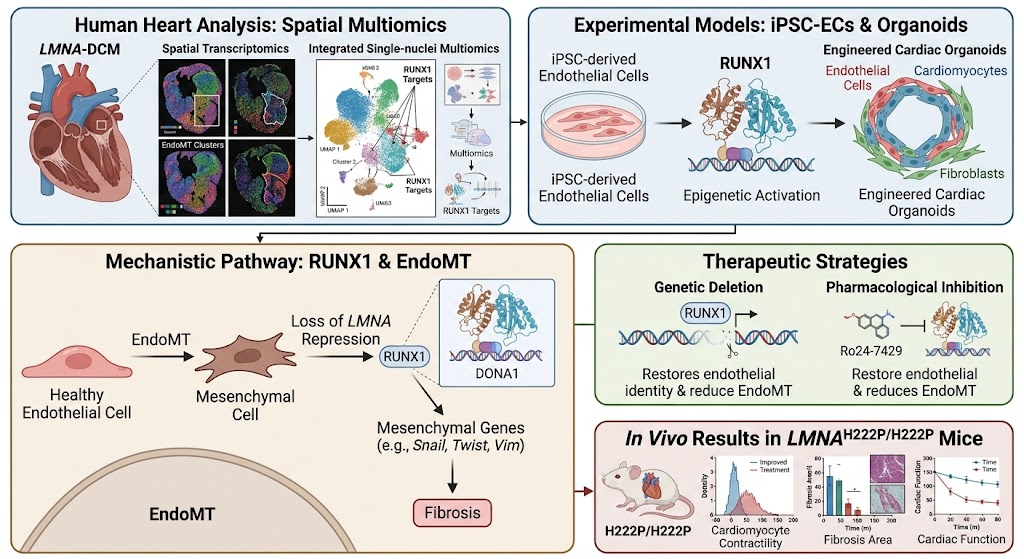
Breakthrough Study Reveals WNT5a-Driven Actin Dysregulation as Core Mechanism in LMNA-Related Cardiac Disease
This groundbreaking research identifies WNT5a-mediated aberrant actin filament dynamics as the novel mechanism driving cardiac pathogenic phenotypes in Emery-Dreifuss muscular dystrophy, opening new therapeutic avenues for this rare but dev

Myocardial Fibrosis Predicts Outcomes in Asymptomatic Severe Aortic Stenosis, But Early Valve Replacement May Not Offer Universal Benefit
The EVOLVED trial reveals that higher myocardial fibrosis burden associates with adverse events in asymptomatic severe aortic stenosis patients, yet early intervention benefits appear nuanced—showing promise for reducing hospitalizations in

Shear Stress-Induced Endothelial HEG1 Signalling: A Novel Pathway Linking Blood Flow to Blood Pressure Regulation
Researchers identify HEG1 as a critical flow-sensitive endothelial protein that regulates blood pressure through CUL3-mediated degradation of PHACTR1, linking reduced shear stress in hypertension to impaired NO production and vascular dysfu

Transfer Before Support: Why Cardiogenic Shock Patients Referred from Regional Centers Face Higher Device-Related Complications
A large observational study reveals that cardiogenic shock patients receiving temporary mechanical circulatory support at regional referral centers before transfer to hub centers experience significantly higher device-related adverse events
![Persistent Fibroblast Activation Predicts Heart Failure Progression: [68Ga]FAPI-46 PET/MRI Reveals Distinct Patterns in Ischemic and Nonischemic Cardiomyopathy](https://news.medxy.ai/wp-content/uploads/2026/04/d43c8ff0-6629-4944-bc15-78efd79810d7-600x600.jpg)
Persistent Fibroblast Activation Predicts Heart Failure Progression: [68Ga]FAPI-46 PET/MRI Reveals Distinct Patterns in Ischemic and Nonischemic Cardiomyopathy
A prospective case-control study demonstrates that myocardial fibroblast activation persists in heart failure patients and follows distinct spatial patterns depending on etiology. Using [68Ga]FAPI-46 PET/MRI, researchers found that higher b

Even ‘Elevated’ Blood Pressure Raises Dementia Risk: Insights from 2.8 Million Adults Over 8 Years
A landmark South Korean study of 2.8 million adults reveals that both elevated blood pressure and hypertension significantly increase dementia risk, particularly vascular dementia, with stronger effects observed in midlife adults and women.

AI-Enhanced ECG Screening Pinpoints Atrial Fibrillation Risk in Older Adults: Key Insights from VITAL-AF Trial
A VITAL-AF trial analysis reveals that combining ECG-based artificial intelligence with clinical risk scores significantly improves atrial fibrillation screening efficiency. The study demonstrates that high-risk individuals benefit most fro

Exercise Unmasks Multi-Organ Deficits That Predict Heart Failure Risk: Metabolite Signatures Reveal Shared Pathways Across HFpEF and Its Comorbidities
A landmark study reveals that exercise-induced multi-organ physiologic deficits strongly predict incident heart failure with preserved ejection fraction (HFpEF). Using invasive cardiopulmonary testing, metabolomics, and genomics across over

Longer Wait, Higher Risk? How Timing of Hypertensive Disorder Diagnosis Shapes Women’s Cardiovascular Future
New research reveals that longer latency between hypertensive disorder of pregnancy diagnosis and delivery correlates with subtle inflammatory and lipid changes in young mothers, suggesting subclinical cardiovascular risk elevation years af

Biological Age Outpaces Chronological Age in Predicting Cerebral Small Vessel Disease Progression
This longitudinal cohort study reveals that biomarker-based biological age, particularly KDMAge and PhenoAge residuals, significantly predicts progression of cerebral small vessel disease, including new lacunes and microbleeds, offering pot

Mavacamten Achieves Surgical-Grade Hemodynamic Correction in Obstructive Hypertrophic Cardiomyopathy by Reversing the Anrep Response
A comparative pressure-volume analysis reveals that mavacamten and alcohol septal ablation produce equivalent hemodynamic improvements in obstructive HCM, primarily through reversal of the chronic Anrep response that drives elevated myocard

Ticagrelor Falls Short: TUXEDO-2 Trial Challenges Antiplatelet Choice in Diabetic Patients With Multivessel Disease
The TUXEDO-2 trial reveals that ticagrelor did not meet noninferiority criteria compared with prasugrel in diabetic patients with multivessel coronary artery disease undergoing PCI. At 1 year, the primary composite endpoint of death, MI, st

Why Exercise Blood Pressure Alone May Miss Cardiovascular Risk—and What Combining It With Fitness Reveals
The EXERTION study of 12,743 individuals demonstrates that exercise systolic blood pressure relative to aerobic fitness (SBP/METPeak) is a powerful predictor of cardiovascular events, whereas exercise BP alone provides no prognostic value.
Browse by specialty
Open language-specific specialty feeds and department pages.