Cardiology
Latest news
974 articles · 20 / page

GnRH Antagonists May Spare the Heart: Evidence of Reduced Coronary Plaque Progression in Prostate Cancer Patients
A randomized clinical trial indicates that the GnRH agonist leuprolide significantly accelerates coronary plaque progression compared to the antagonist relugolix in men with prostate cancer, suggesting a potential biological mechanism for d

Semaglutide Drives Vascular Regeneration: The SEMA-VR CardioLink-15 Trial Reveals a Shift in Progenitor Cell Flux
The SEMA-VR CardioLink-15 trial demonstrates that semaglutide shifts bone marrow-derived progenitor cells toward an anti-inflammatory, pro-regenerative profile, potentially enhancing endogenous vessel repair in high-risk cardiovascular pati

Varenicline and Ventricular Ectopy After Myocardial Infarction: A Randomized Phase 2 Study
This phase 2 trial demonstrates that varenicline, a partial nAChR agonist, significantly reduces premature ventricular complexes and nonsustained ventricular tachycardia in post-myocardial infarction patients, offering a novel therapeutic t

From Compensation to Collapse: How Cardiac Myofibroblasts and UCP2 Genetic Variants Dictate Right Ventricular Fate in PAH
This study identifies the transition of cardiac fibroblasts to myofibroblasts as a critical driver of right ventricular failure in PAH, highlighting the role of UCP2 deficiency and the rs659366 SNP as key clinical indicators of decompensati

Beyond the Gradient: Invasive Exercise Hemodynamics Confirm Discordant Low-Gradient Aortic Stenosis as a High-Risk Phenotype
A pivotal study using invasive exercise hemodynamics reveals that discordant low-gradient aortic stenosis behaves similarly to high-gradient severe disease, often masking underlying heart failure with preserved ejection fraction (HFpEF) phy

Low-Dose Rivaroxaban to Prevent Left Ventricular Thrombosis After Anterior Myocardial Infarction: The APERITIF Randomized Clinical Trial
The APERITIF trial explored adding low-dose rivaroxaban to standard dual antiplatelet therapy to prevent heart clots after an anterior heart attack. While the addition did not significantly reduce thrombus formation, it did increase minor b

Taurochenodeoxycholic Acid: A Novel Metabolic Sentinel Reversing Obesity-Induced Endothelial Dysfunction via the FXR-PHB1-ATF4 Axis
This study identifies TCDCA as a key metabolite that restores endothelial function in obesity. By activating the endothelial FXR-PHB1-ATF4 pathway, TCDCA enhances serine metabolism, offering a promising therapeutic strategy to mitigate card

The Ross Procedure Renaissance: Why Surgical Volume is the Critical Determinant of Patient Survival
A comprehensive analysis of North American data reveals a significant resurgence in the Ross procedure for young adults, while highlighting a stark correlation between center volume and operative mortality, suggesting a critical threshold o

Testosterone and Weight Loss: Decoding the Link Between Sex Hormones and Cardiovascular Risk in Men with Type 2 Diabetes
A longitudinal analysis of the Look AHEAD trial demonstrates that baseline testosterone and weight loss-induced changes in SHBG significantly modulate cardiovascular risk in men with type 2 diabetes, highlighting the critical role of hormon

Precision Prediction of Incident Heart Failure: The Clinical Integration of AI-Enabled Electrocardiography
This review evaluates the breakthrough ECG2HF model, a publicly available AI tool that outperforms standard clinical scores in predicting 10-year heart failure risk using 12-lead ECG waveforms.

Long-Term Efficacy and Safety of Transcatheter Patent Foramen Ovale Closure: A 20-Year Follow-Up Study
A 20-year follow-up study of 130 patients demonstrates that transcatheter PFO closure is highly effective in preventing recurrent strokes, though long-term antithrombotic therapy increases bleeding risks, particularly in women.

Inhibiting Myeloid-PlexinD1: A Novel Strategy to Stabilize Atherosclerosis at High-Risk Vascular Bifurcations
Research reveals that PlexinD1 mediates macrophage-driven inflammation in response to disturbed blood flow. By targeting this pathway, scientists have successfully attenuated plaque progression in preclinical models, paving the way for adva

Long-Term Superiority of Intravascular Imaging: 5-Year Results from the RENOVATE-COMPLEX-PCI Trial
A 5-year follow-up of the RENOVATE-COMPLEX-PCI trial demonstrates that intravascular imaging-guided PCI significantly reduces major adverse cardiac events by 32% compared to angiography alone in complex lesions, highlighting the long-term c

Genotype-Phenotype Divergence in Hypertrophic Cardiomyopathy: Deciphering the Trajectories of Sarcomeric and Nonsarcomeric Disease
This review analyzes the SHaRe registry data, revealing that sarcomeric HCM represents a more aggressive clinical phenotype with earlier onset and higher HCM-related mortality compared to nonsarcomeric cases, which are more heavily influenc

Synergistic Protection: Combining GLP-1 Receptor Agonists with Lifestyle Habits Slashes Cardiovascular Risk in Type 2 Diabetes
A massive cohort study of nearly 100,000 veterans reveals that while GLP-1 receptor agonists significantly reduce MACE, the combination with a healthy lifestyle offers a 43% lower risk, emphasizing the need for integrated cardiometabolic ca

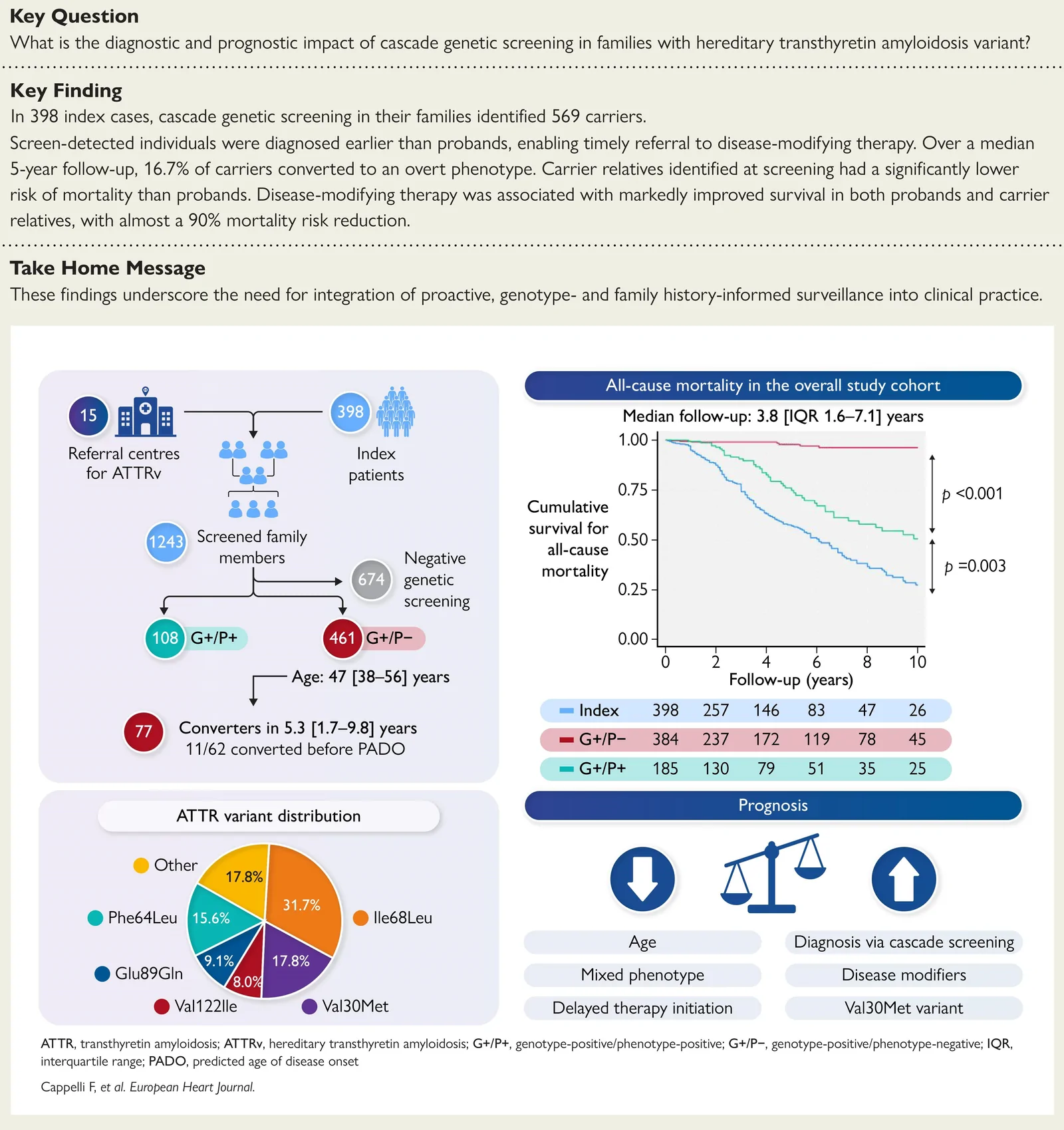
Prevalence and Prognostic Significance of Restriction Versus Systolic Dysfunction in Patients With Transthyretin and Light Chain Cardiac Amyloidosis
This large retrospective study of 820 patients reveals that restrictive ventricular physiology is the most common phenotype in cardiac amyloidosis. While preserved LV function offers better initial survival, the rate of progression to restr

Beyond the Binary: The Evolving Consensus on the Spectrum of Primary Aldosteronism and Cardiovascular Risk
Recent data from the ARIC study and emerging expert consensus are redefining primary aldosteronism. Rather than a rare, all-or-nothing condition, it is now viewed as a broad spectrum where even subclinical elevations significantly increase

Understanding Scar Evolution: How Post-Ablation Cardiac MRI Predicts Long-Term Outcomes in Ventricular Tachycardia
The PAM-VT 2 study reveals that cardiac MRI (LGE-CMR) performed 3 to 6 months after ventricular tachycardia ablation can accurately predict long-term recurrence risks by analyzing scar stability and conducting channels.

MUTTON-HF: Can Reclaiming Indigenous Food Systems Reduce Heart Failure Readmissions?
The MUTTON-HF trial evaluates whether culturally and medically tailored meals, incorporating traditional Diné (Navajo) foods, can improve clinical outcomes and quality of life for Indigenous heart failure patients facing nutrition insecurit

The Silent Genetic Threat: Why Most Patients with Familial Hypercholesterolemia Are Still Falling Through the Clinical Cracks
A massive cohort study of 245,388 US adults reveals that 1 in 287 carries a familial hypercholesterolemia mutation. Despite high risks for premature heart disease, most carriers remain undertreated, with fewer than 20% of those with establi
Browse by specialty
Open language-specific specialty feeds and department pages.