Hematology-Oncology
Latest news
269 articles · 20 / page

TP53 Alterations Emerge as Critical Adverse Prognostic Factor in Pediatric and Young Adult Patients Treated with CD19-CAR T-Cell Therapy for Relapsed/Refractory B-ALL
A single-center retrospective study of 69 pediatric and young adult patients with relapsed/refractory B-cell acute lymphoblastic leukemia reveals that TP53 alterations significantly compromise outcomes following tisagenlecleucel therapy. Pa

Navigating the Decision to Transplant Before Cancer Develops: A New Framework for RUNX1 Familial Platelet Disorder
Researchers present a pioneering preemptive hematopoietic stem cell transplantation approach for RUNX1-FPD, a hereditary disorder carrying a 35-50% lifetime risk of blood cancer, introducing a shared decision-making framework to guide this

When Targeting Becomes a Double-Edged Sword: How Loss of GPRC5D May Fuel Multiple Myeloma Progression
Researchers discovered that loss of GPRC5D, a key immunotherapy target in multiple myeloma, not only confers resistance to targeted therapies but actively promotes cancer cell proliferation and competitive fitness—creating a therapeutic par

Global Disparities in CAR T-Cell Access: HTA Analysis Reveals Only Half of G20 Countries Recommend Reimbursement
A cross-sectional analysis of health technology assessments across G20 nations reveals significant disparities in access to CAR T-cell therapies, with only 48% of approved indications recommended for reimbursement and a median 1.54-year del

New EHR-Based Model PRIME Achieves 0.75 AUC in Predicting Pancreatic Cancer Risk Across 11 Million Patients
Researchers developed PRIME, a parsimonious risk stratification model for pancreatic ductal adenocarcinoma using electronic health record data. Validated across US health systems and the UK Biobank, PRIME retained 19 predictors and achieved

Red Blood Cell Exchange Transfusion for Severe Babesiosis: Evidence for Improved Survival and Clinical Outcomes
Recent multicenter data indicates that red blood cell exchange transfusion (ET) provides a nearly five-fold reduction in mortality and readmission for patients with severe babesiosis, challenging earlier smaller-scale observations.

Limited Success: Third-Line Therapy Yields Modest Responses in Steroid-Refractory aGvHD with GI Involvement
The CHRONOS study reveals that third-line therapy for steroid- and ruxolitinib-refractory aGvHD with GI involvement achieves only 36% overall response at Day 28, with concerning durability issues and high mortality rates in this heavily pre

Oncolytic Bovine Herpesvirus Type 1: A Novel Strategy for Immune Microenvironment Remodeling in Multiple Myeloma
This review explores the breakthrough potential of Bovine Herpesvirus Type 1 (BoHV-1) as an oncolytic agent in Multiple Myeloma, highlighting its ability to induce mitochondrial apoptosis, reprogram the immunosuppressive bone marrow niche,

Ribosome Collisions and the ZAK-Dependent Ribotoxic Stress Response: A Novel Therapeutic Vulnerability in Chronic Myeloid Leukemia
This review synthesizes evidence that BCR::ABL1 inhibitors induce ribosome collisions and ZAK-dependent apoptosis, highlighting the ribotoxic stress response as a critical pathway for TKI efficacy and a potential target to overcome resistan

Enterococcus faecalis Drives MHC-II Expression in Intestinal Epithelium: A Novel Mechanism Linking Gut Microbiome Dysbiosis to Lethal Graft-versus-Host Disease
Research reveals that Enterococcus faecalis colonization induces MHC-II expression in intestinal epithelial cells during graft-versus-host disease, with a lantibiotic-producing Blautia producta strain demonstrating potential to restore colo

Beyond the Clot: Novel Proteomic Markers Reveal New Pathophysiological Pathways for Venous Thromboembolism
A large-scale proteomic meta-analysis across five cohorts identified 15 novel plasma protein markers for venous thromboembolism, highlighting the roles of the extracellular matrix, immunity, and vascular senescence in disease risk and offer

Immunophenotypic Evolution and Clinical Outcomes in R/R AML Treated with Revumenib
A study of 48 patients with R/R AML treated with revumenib revealed that 52% experienced dynamic immunophenotypic changes. Achieving MRD-negative morphologic remission significantly improved overall survival, highlighting the necessity for

Tuberculosis Post-Allogeneic Hematopoietic Stem Cell Transplantation in Low-Incidence Settings: Risk Factors, Clinical Trajectories, and Screening Mandates
This review analyzes a decade-long nationwide study on TB after Allo-HSCT in France, revealing a 60/100,000 incidence rate, high extrapulmonary involvement, and the critical need for screening patients from high-incidence regions.

Beyond the Clot: Novel Proteomic Markers Redefine Venous Thromboembolism Risk
This large-scale proteomic analysis identifies 15 novel protein markers for venous thromboembolism, offering new insights into the roles of immunity and extracellular matrix regulation in VTE pathogenesis beyond traditional coagulation path

Targeting the Sugar Coat: Oncofetal Chondroitin Sulfate Emerges as a Precision ADC Target in AML
Researchers have identified oncofetal chondroitin sulfate (ofCS) as a novel target for antibody-drug conjugates in AML. Unlike traditional targets, ofCS is absent in healthy tissues, potentially reducing hematotoxicity and expanding treatme

Predictive Value of Sex Chromosome Loss in Sex-Mismatched Stem Cell Transplantation
This study identifies late-onset sex chromosome loss as a critical biomarker for predicting relapse and survival outcomes in patients following sex-mismatched stem cell transplantation.

Beyond Genetics: Targeting BMP and TAZ/TEAD Mechanotransduction to Reverse Chemoresistance in Acute Myeloid Leukemia
Recent research identifies BMPR1B and TAZ/TEAD as critical mechanotransduction drivers in relapsed AML. By targeting these pathways, clinicians may overcome the protective effects of bone marrow stiffening and intramedullary pressure, offer

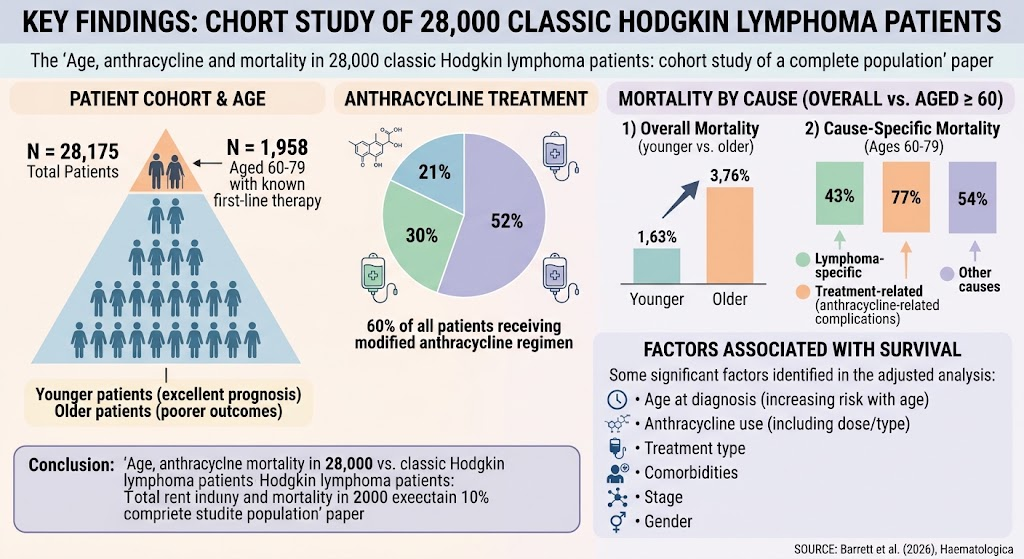
Dose-Dense Stanford V Strategy Safely Spares Radiation in Most Pediatric Patients with Low-Risk Hodgkin Lymphoma
The PHC HOD08 study demonstrates that an 8-week dose-dense modified Stanford V regimen achieves high complete response rates, allowing over 75% of low-risk pediatric Hodgkin lymphoma patients to avoid radiotherapy while maintaining an excep

Ph+ Status and Hyperleukocytosis: Redefining CNS Relapse Risk in Adult ALL Post-Transplant
A large-scale retrospective study identifies Philadelphia chromosome positivity and high initial white blood cell counts as critical risk factors for central nervous system relapse in adult ALL patients following allogeneic HCT, suggesting

Improving Survival in Advanced Proliferative CMML: The Prognostic Impact of Stringent Cytoreduction and Novel Flow Cytometric Biomarkers
This review examines the impact of myeloproliferative control on survival in advanced CMML, highlighting the prognostic value of stringent cytoreduction and novel flow cytometric biomarkers such as classical monocytes and immature granulocy
Browse by specialty
Open language-specific specialty feeds and department pages.