Ultralow-Dose IL-10–Expressing CAR T Cells Show Promising Activity in Relapsed/Refractory DLBCL
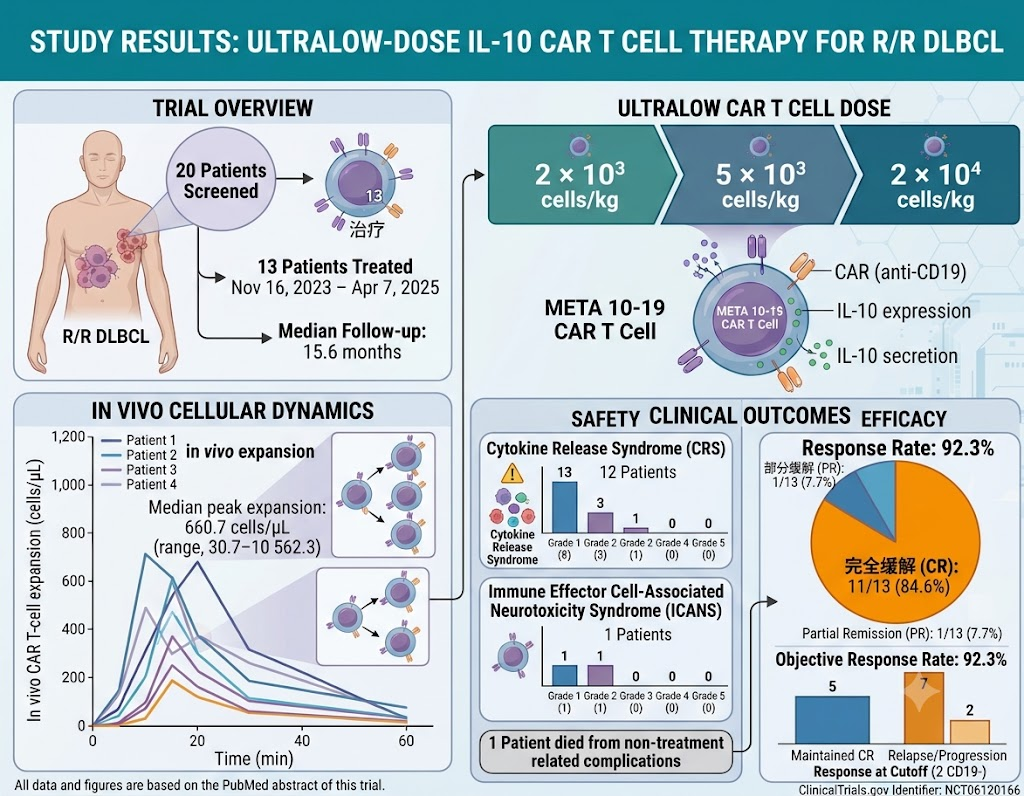
Ultralow-dose META 10-19 CAR T cells (2 × 10³ to 2 × 10⁴ cells/kg) produced an objective response rate of 92.3% in heavily pretreated relapsed/refractory DLBCL.
Complete remission was achieved in 84.6% of patients (11 of 13); 5 maintained remission at a median follow-up of 15.6 months.
Cytokine release syndrome occurred in 12 of 13 patients, predominantly grade 1–2; immune effector cell–associated neurotoxicity syndrome was infrequent (2 patients, grade 1–2).
Robust CAR T-cell expansion was observed across dose levels, with a median peak of 660.7 cells/µL.
These early data from a nonrandomized phase 1 trial support further investigation of this novel IL-10–armed CAR T-cell product.
Study Snapshot
Design: Nonrandomized, phase 1, single-center clinical trial.
Population: 13 patients with relapsed/refractory diffuse large B-cell lymphoma (median age 61 years; 61.5% male).
Intervention: META 10-19 (CD19 CAR T cells expressing interleukin-10) at dose levels of 2 × 10³, 5 × 10³, or 2 × 10⁴ cells/kg after lymphodepletion.
Primary Endpoints: Adverse events, dose-limiting toxic effects, objective response rate.
Key Result: Objective response rate 92.3%; complete remission 84.6%.
Safety: Grade 1–2 cytokine release syndrome in 11 of 13 patients; grade 3 CRS in 1 patient. ICANS in 2 patients (grade 1–2).
Follow-up: Median 15.6 months (range 0.7–25.5).
Registry: ClinicalTrials.gov NCT06120166.
What the Trial Asked
CD19-directed chimeric antigen receptor (CAR) T-cell therapy has transformed the treatment of relapsed/refractory B-cell malignancies, yet a substantial proportion of patients with diffuse large B-cell lymphoma (DLBCL) either do not respond or eventually relapse. Interleukin-10 (IL-10) is a pleiotropic cytokine that can enhance CAR T-cell persistence and effector function. The investigational product META 10-19 — a CD19 CAR T cell engineered to express IL-10 — previously showed encouraging activity in B-cell acute lymphoblastic leukemia. This phase 1 trial aimed to evaluate its safety and efficacy in relapsed/refractory DLBCL at ultralow cell doses.
Why the Question Matters
DLBCL is the most common form of non-Hodgkin lymphoma. While many patients are cured with first-line immunochemotherapy, those with relapsed or refractory disease have limited options and poor outcomes. Approved CAR T-cell products typically require doses in the range of 1–5 × 10⁶ cells/kg and are associated with substantial toxicities, including high-grade cytokine release syndrome (CRS) and immune effector cell–associated neurotoxicity syndrome (ICANS). An ultralow-dose product with a favorable safety profile could expand access and reduce treatment-related morbidity.
How the Study Was Conducted
This nonrandomized, phase 1 clinical trial was conducted at the First Affiliated Hospital of Zhejiang University School of Medicine. Between November 16, 2023, and April 7, 2025, 20 patients were screened, and 13 received at least one infusion of META 10-19. Eligible patients had histologically confirmed DLBCL that had relapsed after or was refractory to at least two prior lines of therapy. Prior CD19-targeted therapy or allogeneic stem cell transplant was not allowed.
Patients underwent lymphodepletion with fludarabine (30 mg/m²/day) and cyclophosphamide (300 mg/m²/day) for 3 days, followed by a single intravenous dose of META 10-19 at one of three dose levels: 2 × 10³, 5 × 10³, or 2 × 10⁴ CAR T cells per kilogram. The primary endpoints were adverse events, dose-limiting toxic effects, and objective response rate (ORR). Secondary endpoints included complete remission (CR) rate and cellular kinetics of META 10-19. Response was assessed per Lugano criteria. The data cutoff was January 20, 2026, with analysis conducted on January 22, 2026.
What the Trial Found
Among the 13 treated patients (median age 61 years; range 35–74; 8 men, 5 women), the objective response rate was 92.3%. Eleven patients (84.6%) achieved a complete remission, and one patient (7.7%) had a partial remission. One patient died before the first response assessment due to disease-related gastrointestinal complications and was not evaluable for response.
At a median follow-up of 15.6 months (range 0.7–25.5), 5 patients maintained a complete remission, while 7 patients experienced disease relapse or progression. Among the relapses, 2 were CD19-negative, suggesting antigen escape. Robust in vivo CAR T-cell expansion was observed across all dose levels, with a median peak expansion of 660.7 cells/µL (range 30.7–10,562.3).
Safety and Tolerability
Cytokine release syndrome occurred in 12 of 13 patients, but the majority were low grade: grade 1 in 8 patients, grade 2 in 3 patients, and grade 3 in 1 patient. No grade 4 or 5 CRS was reported. ICANS occurred in 2 patients (one grade 1, one grade 2). No dose-limiting toxic effects were reported. The safety profile was consistent with that previously observed in acute lymphoblastic leukemia, and no new safety signals emerged.
What the Results Mean
These early findings suggest that ultralow-dose META 10-19 CAR T cells — at doses three to four orders of magnitude lower than approved products — can induce deep responses in heavily pretreated DLBCL. The high complete remission rate (84.6%) and manageable toxicity profile are notable. However, the durability of responses remains a concern, as 7 of 13 patients relapsed or progressed within the follow-up period, and two relapses involved CD19-negative disease, a known mechanism of resistance to CD19-directed therapy. The robust CAR T-cell expansion indicates that IL-10 co-expression may enable potent antitumor activity even at extremely low starting doses.
Important Limitations
This is a nonrandomized, single-center phase 1 trial with a small sample size (13 patients). There was no concurrent control arm, so comparisons with standard CAR T-cell therapy are indirect. The median follow-up of 15.6 months is relatively short, and long-term remission durability is not yet established. Furthermore, the patient population may not be representative of the general R/R DLBCL population, as selection criteria were restrictive. The study was not designed to detect differences between dose levels or to identify predictors of response or resistance. All results should be considered preliminary.
Implications for Patients and Clinicians
If confirmed in larger, randomized studies, an ultralow-dose CAR T-cell product could reduce manufacturing costs, shorten vein-to-vein time, and lower the risk of severe CRS and ICANS — potentially making CAR T therapy available to patients who are currently ineligible due to frailty or comorbidities. However, physicians should interpret these phase 1 data with caution. Patients considering enrollment in ongoing trials of META 10-19 should discuss the risks of relapse, CD19-negative escape, and the uncertainty regarding long-term outcomes with their care team.
Funding and Trial Registration
The study was sponsored by the First Affiliated Hospital of Zhejiang University School of Medicine. The full funding details and conflict of interest disclosures are available in the original publication. The trial is registered at ClinicalTrials.gov under identifier NCT06120166.
References
Hu Y, Zhang M, Gao M, et al. Ultralow-Dose Interleukin 10-Expressing Chimeric Antigen Receptor T Cells in Relapsed/Refractory Diffuse Large B-Cell Lymphoma: A Nonrandomized Clinical Trial. JAMA Oncol. 2026. doi:10.1001/jamaoncol.2026.2490. PMID: 42490071.
This article was created using several editorial tools, including AI, as part of the process. Human editors reviewed this content before publication.