Critical Care
Latest news
195 articles · 20 / page

Beyond a Marker of Severity: Reaffirming the Impact of Ventilator-Associated Events on Mortality
A rigorous multicenter study from Japan utilizes marginal structural modeling to demonstrate that Ventilator-Associated Events (VAEs) are independent drivers of mortality, not just surrogates for patient severity, reinforcing their value as

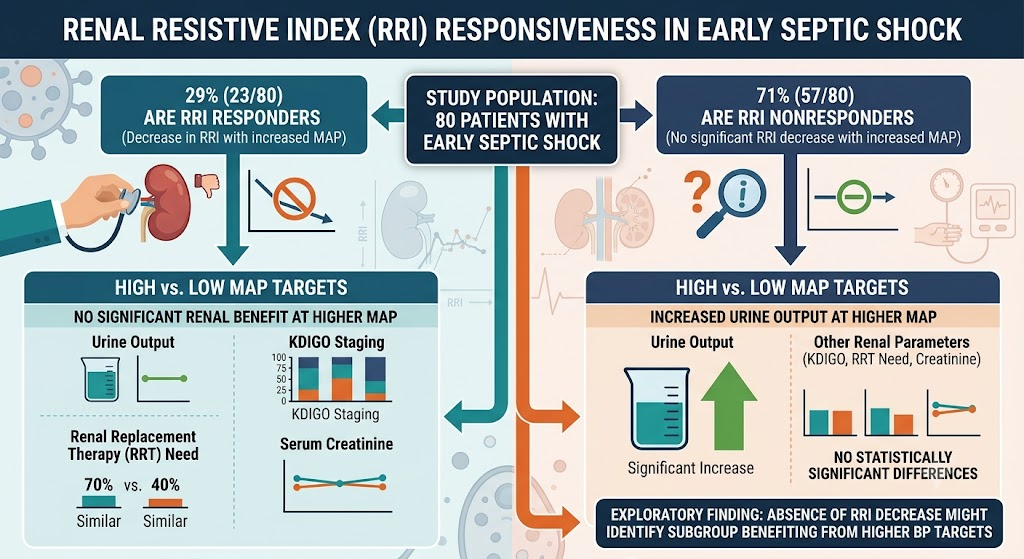
Higher Blood Pressure Targets in Septic Shock: When More Vasopressors Do More Harm than Good
A post-hoc analysis of the SEPSIS-PAM trial reveals that while high MAP targets do not provide a universal survival benefit, they significantly increase mortality risk when requiring high norepinephrine doses or failing to resolve microcirc

Tracking the Immune Pulse: Why mHLA-DR Trajectories Predict Survival in Sepsis and Liver Transplantation
Large-scale cohort and prospective data reveal that monocyte HLA-DR expression is a dynamic predictor of ICU-acquired infections and mortality, offering a roadmap for personalized immunostimulant therapy in septic shock and transplant patie

Survival in Cancer Patients with ARDS: The YELENNA Study Challenges ECMO Utility in Severe Cases
The YELENNA prospective study reveals a 73.2% 90-day mortality rate for cancer patients with ARDS. Crucially, venovenous ECMO provided no survival benefit in severe cases, prompting a re-evaluation of current clinical guidelines and goals-o

Proactive ‘Caregiver Pathway’ Mitigates Long-Term PTSD and Anxiety in Families of ICU Survivors
A 12-month randomized controlled trial reveals that a structured nurse-led intervention, The Caregiver Pathway, significantly reduces symptoms of post-traumatic stress and anxiety among family caregivers of critically ill patients, particul

Delusional ICU Memories: The Hidden Driver of Long-Term Post-Traumatic Stress Disorder
This multicenter longitudinal study reveals that delusional memories, rather than simple amnesia, are the primary predictors of persistent PTSD symptoms following critical illness, highlighting the critical roles of delirium and sedation in

Sepsis Survival in Australia and New Zealand: Analyzing Two Decades of Progress and the Recent Mortality Rebound
A large-scale study of over 300,000 ANZ ICU patients reveals that sepsis mortality plummeted from 28% to 11% between 2000 and 2020, followed by a concerning 0.9% annual increase through 2023, highlighting both clinical triumphs and emerging

Navigating the Long Road: Prolonged Ventilator Weaning and High Reintubation Risk in GBS and Myasthenia Gravis
A large-scale multicenter study reveals that while patients with Guillain-Barré syndrome face significantly longer weaning times and higher tracheostomy rates than those with myasthenia gravis, both groups experience alarmingly high reintub

Impact of Clinical Guidelines: Assessing the Decline in ICU Delirium and Pain Prevalence Over a Decade
A comprehensive meta-analysis of 226 publications involving 183,285 patients reveals a significant reduction in ICU delirium and pain following the 2013 PAD guidelines, though prevalence remains high at approximately 36% and 44%, respective

Alpha-2 Agonists vs. Propofol: The A2B Trial Challenges the Paradigm of Expedited Extubation in the ICU
The A2B randomized clinical trial reveals that dexmedetomidine- or clonidine-based sedation does not significantly reduce the time to successful extubation compared to propofol in critically ill patients, while increasing the risk of bradyc

Dexmedetomidine Reduces Agitation and Accelerates Recovery in Non-Intubated ICU Patients with Hyperactive Delirium: Insights from the 4D Trial
The 4D randomized clinical trial demonstrates that dexmedetomidine significantly reduces agitation duration and improves clinical outcomes in non-intubated ICU patients with hyperactive delirium, providing a safe and effective alternative t

The Long Shadow of the ICU: Identifying High-Risk Functional Trajectories in Older Survivors
A large-scale longitudinal study reveals that ICU survivors aged 60–79 face significantly higher 5-year excess mortality and functional decline compared to the general population, whereas outcomes for nonagenarians converge with their peers

Optimizing Acid-Base Stability in CVVH: Why Lower Bicarbonate Fluids Outperform Standard Concentrations During Regional Citrate Anticoagulation
This randomized controlled trial demonstrates that a lower bicarbonate replacement fluid (22 mmol/l) provides superior acid-base stability compared to a higher concentration (30 mmol/l) during CVVH with citrate anticoagulation, significantl

Precision Rehabilitation: Machine Learning Reveals Why ‘Early Mobilization’ Fails Some ICU Patients While Saving Others
A secondary analysis of the TEAM trial using machine learning demonstrates that enhanced early mobilization in mechanically ventilated patients has highly individualized effects, ranging from a 34% mortality reduction to a 39% increase in r

Safe Stewardship: Antibiotic De-escalation by Day 4 Reduces Hospitalization Length Without Increasing Mortality in Community-Onset Sepsis
A large-scale target trial emulation demonstrates that de-escalating anti-MRSA and anti-pseudomonal therapy on day 4 of sepsis treatment is safe, associated with fewer antibiotic days, and leads to shorter hospital stays compared to continu
Rising Hospital Mortality and Escalating Rates of Life-Sustaining Therapy Withdrawal in Critically Ill TBI Patients: A 15-Year Analysis
A 15-year observational study of over 45,000 TBI patients reveals a significant increase in hospital mortality and a tripling of life-sustaining therapy withdrawal, alongside rising rates of hypoxaemia, raising urgent questions about ethica
Optimizing Caffeine Therapy in Preterm Infants: Does Earlier Initiation Improve Respiratory Outcomes?
This article evaluates the optimal timing and indications for caffeine initiation in preterm neonates, analyzing its impact on chronic lung disease, mortality, and neurodevelopmental outcomes based on the latest 2025 Cochrane evidence.

Ketamine vs. Etomidate: Does Your Choice of Induction Agent Influence Mortality in the Critically Ill?
This article explores recent evidence comparing ketamine and etomidate for rapid sequence intubation. While new cohort data suggests a mortality benefit for ketamine, meta-analyses of randomized trials show clinical equipoise, highlighting

Ketamine or Etomidate for Tracheal Intubation? Unpacking the RSI Trial Findings on Mortality and Hemodynamics
The large-scale RSI randomized trial found no significant difference in 28-day mortality between ketamine and etomidate for intubating critically ill adults, though ketamine was associated with a higher risk of cardiovascular collapse.

Rethinking Oxygen Strategies for Preterm Infant Resuscitation: Evidence from TORPIDO, IPD-MA, and DCC Trials
Recent trials and meta-analyses challenge assumptions about optimal initial oxygen levels for preterm resuscitation.
Browse by specialty
Open language-specific specialty feeds and department pages.