Otorhinolaryngology
Latest news
123 articles · 20 / page

Long-Term Survival Outweighs Short-Term Quality of Life: Why Esophagectomy Remains the Gold Standard for Esophageal Cancer Responders
A decision analytical model reveals that while active surveillance offers short-term quality-of-life benefits, standard esophagectomy provides superior 5-year survival and quality-adjusted life-years (QALYs) for esophageal cancer patients a

Targeted Postoperative Exercises Significantly Accelerate Swallowing Recovery and Enhance Quality of Life After Thyroidectomy
A randomized controlled trial demonstrates that a 3-month standardized neck and orofacial rehabilitation program significantly improves swallowing-related quality of life and functional recovery in post-thyroidectomy patients, effectively a

Long-Term Survival Gains with Tislelizumab: Redefining First-Line Therapy for Metastatic Nasopharyngeal Carcinoma
The 3-year follow-up of the RATIONALE-309 trial demonstrates that first-line tislelizumab plus chemotherapy significantly improves overall survival (45.3 months) in recurrent or metastatic nasopharyngeal carcinoma, identifying B-cell signat

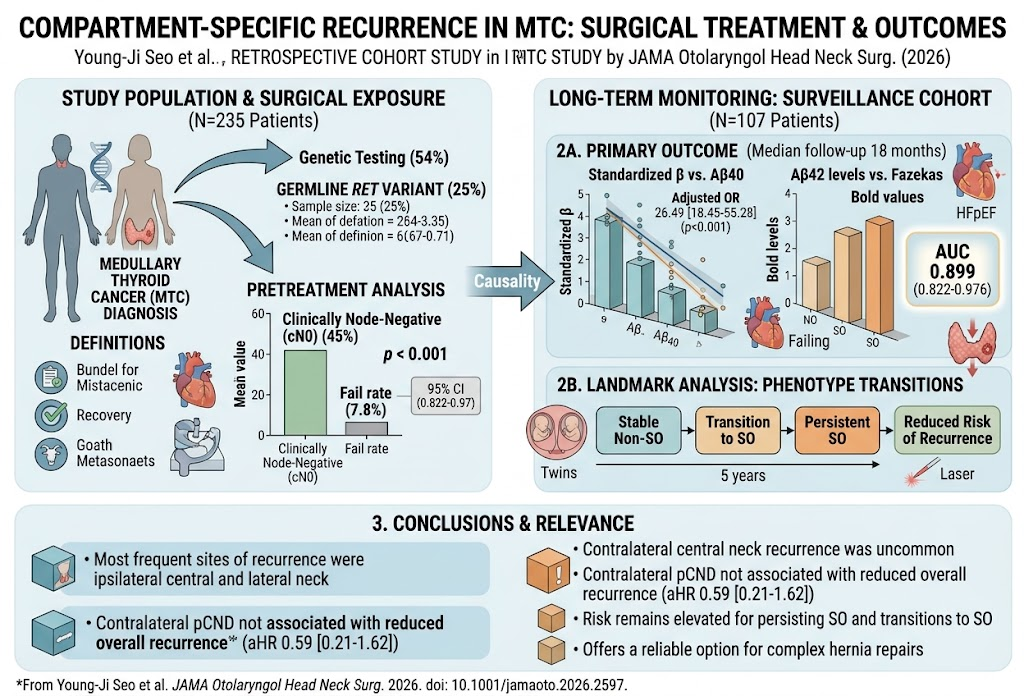
Surgical Management of Sporadic Medullary Thyroid Cancer: Evidence-Based Comparison of Total Thyroidectomy vs Lobectomy
This systematic review and meta-analysis suggests that thyroid lobectomy may offer comparable oncologic outcomes to total thyroidectomy for selected patients with sporadic medullary thyroid cancer, while significantly reducing postoperative

Beyond Objective Responses: Amivantamab Demonstrates Significant Clinical Benefit in Recurrent Adenoid Cystic Carcinoma
A Phase 2 clinical trial of amivantamab, an EGFR-MET bispecific antibody, in recurrent or metastatic adenoid cystic carcinoma (ACC) showed a 72.2% clinical benefit rate. While the primary objective response rate was low, the high rate of di

Three-Year RATIONALE-309 Data Confirm Sustained Survival Benefit of First-Line Tislelizumab in Nasopharyngeal Carcinoma
Long-term results from the RATIONALE-309 trial show tislelizumab plus chemotherapy significantly improves survival in recurrent or metastatic nasopharyngeal carcinoma, establishing a durable therapeutic standard and identifying B-cell signa

Redefining the Standard of Care in High-Risk Resected SCCHN: Insights from the GORTEC 2018-01 NIVOPOST-OP Trial
This review analyzes the Phase 3 NIVOPOST-OP trial, demonstrating that adding nivolumab to postoperative chemoradiotherapy significantly improves disease-free survival in high-risk SCCHN patients, establishing a potential new therapeutic st

Optimizing Prognosis: The New AJCC Version 9 Staging for Salivary Gland Carcinoma
The proposed AJCC/UICC Version 9 staging for salivary gland carcinoma shifts toward a unified, specific system using lymph node count and extranodal extension, significantly improving prognostic accuracy for both major and minor salivary gl

Pembrolizumab Dominates the HNC Market While Immune-Related Adverse Events Persist in Real-World Practice
A large-scale cohort study of 47,365 head and neck cancer patients reveals a significant market shift toward pembrolizumab and a 41.2% incidence of immune-related adverse events, though severe toxicities remain rare and are linked to specif

PTH-Guided Selective Calcium Supplementation After Total Thyroidectomy: Is Routine Prophylaxis Still Necessary?
A multicenter randomized clinical trial demonstrates that selective calcium supplementation based on early postoperative PTH levels is as effective as routine prophylaxis in preventing hypocalcemia after total thyroidectomy, offering a stra

Thyroidectomy in Older Adults: Are Increased Relative Risks a Barrier to Surgical Safety?
A systematic review and meta-analysis of over 400,000 patients reveals that while older adults face higher relative risks for nerve injury and hematoma following thyroidectomy, the absolute risk remains low, confirming the procedure’s overa

Camrelizumab Plus Chemotherapy Sets a New Five-Year Survival Benchmark in Recurrent or Metastatic Nasopharyngeal Carcinoma
A secondary analysis of the CAPTAIN-1st trial reveals that adding camrelizumab to first-line chemotherapy significantly improves five-year overall survival in RM-NPC, with a 37.8% survival rate and notable benefits linked to rapid EBV DNA c

The Precision Gap: Evaluating Sentinel Lymph Node Biopsy in Head and Neck Merkel Cell Carcinoma
This article examines the clinical accuracy of Sentinel Lymph Node Biopsy for head and neck Merkel cell carcinoma, highlighting a significant false-negative rate and identifying risk factors that necessitate more personalized treatment stra

Optimizing the Surgical Field: Diltiazem and Esmolol Excel in Controlled Hypotension for Endoscopic Sinus Surgery
This systematic review and network meta-analysis of 52 randomized trials evaluates pharmacological agents for controlled hypotension in ESS, identifying diltiazem, esmolol, and dexmedetomidine as the most effective for reducing intraoperati

Intensity-Modulated Proton Therapy Reduces Acute Toxicity While Maintaining Oncologic Equivalence in Nasopharyngeal Carcinoma: A Five-Year Case-Control Analysis
A case-control study comparing IMPT and IMRT for nasopharyngeal carcinoma shows that IMPT significantly reduces grade 2+ acute toxicities without compromising long-term survival or local-regional control, suggesting a superior therapeutic i

Beyond the Binary: A New 4-Stage Stratification System Revolutionizes Cochlear Implant Candidacy Assessment
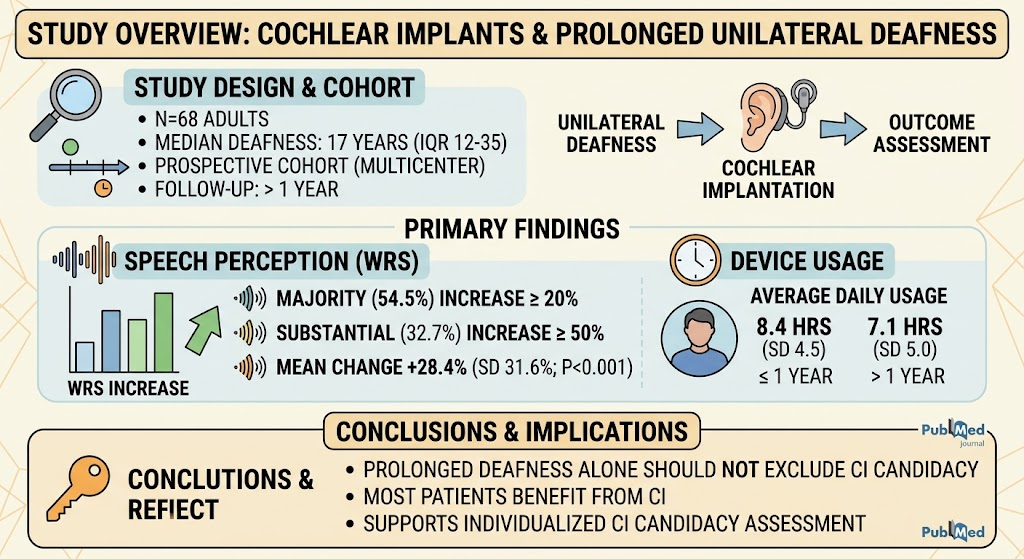
Researchers have developed a 4-level classification system using routine audiometric data to estimate cochlear implant candidacy likelihood. This tool moves beyond traditional binary screening, providing a probability gradient that enhances

Intranasal Saline Matches Steroids in Pediatric Sleep-Disordered Breathing: Rethinking the First-Line Approach
The MIST+ trial demonstrates that intranasal saline is as effective as mometasone for pediatric sleep-disordered breathing, suggesting a conservative 3-month saline trial can resolve symptoms in half of patients and potentially reduce the n

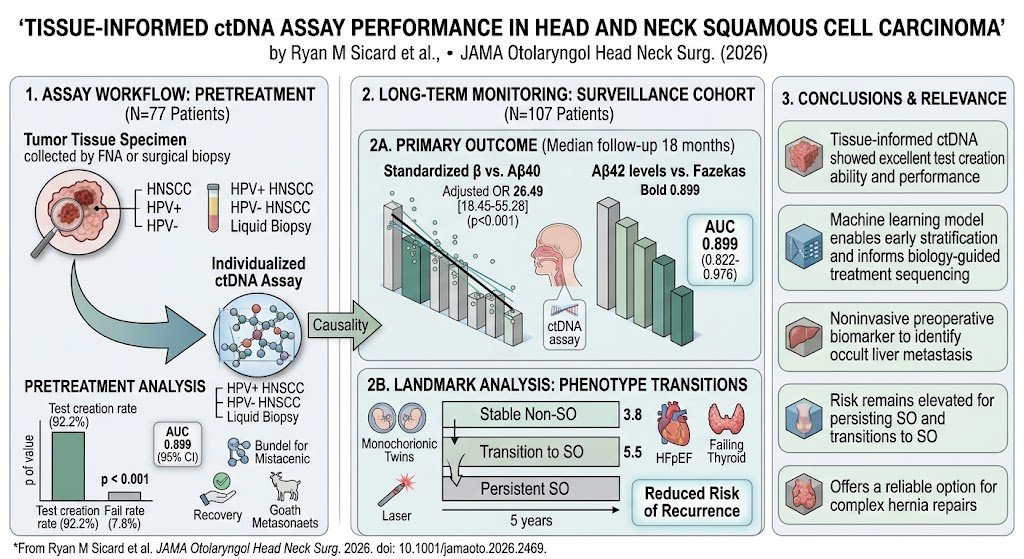
Beyond the Scalpel: How ctDNA Blood Tests are Revolutionizing Head and Neck Cancer Monitoring
A new study reveals that ‘tumor-informed’ blood tests can detect recurring head and neck cancer months before traditional scans, offering a critical window for intervention in high-risk patients.

The Changing Landscape of Acute Invasive Fungal Rhinosinusitis: Rising Detection and Declining Mortality
A landmark systematic review of over 48,000 patients reveals that while the proportion of AIFRS in immunocompromised populations is increasing, mortality rates have dropped significantly since 2013 due to diagnostic and therapeutic advancem

AIFRS Mortality Drops as Detection Rates Climb: New Insights into Acute Invasive Fungal Rhinosinusitis
A comprehensive meta-analysis reveals that while the proportion of AIFRS in immunocompromised patients has risen to 16.6% in recent years, mortality has significantly decreased to 28.2% due to improved diagnostic and therapeutic strategies.
Browse by specialty
Open language-specific specialty feeds and department pages.