Hematology-Oncology
Latest news
269 articles · 20 / page

B-Cell Depletion Meets TPO-RA: Ianalumab and Eltrombopag Redefine Treatment Success in Immune Thrombocytopenia
The Phase 3 VAYHIT2 trial reveals that combining ianalumab with eltrombopag significantly extends freedom from treatment failure and increases stable response rates in patients with second-line immune thrombocytopenia, potentially offering

Teclistamab plus Daratumumab Redefines Outcomes in Relapsed or Refractory Multiple Myeloma: A Paradigm Shift in Early-Line Intervention
The phase 3 MajesTEC-3 trial demonstrates that combining teclistamab with daratumumab significantly extends progression-free survival compared to standard therapies in patients with relapsed or refractory multiple myeloma, achieving high ra

Validated PRESEV Score Identifies Adults with Sickle Cell VOC at Low Risk for Acute Chest Syndrome — Implications for Safer Outpatient Management
An international prospective validation confirms the PRESEV score reliably identifies adult sickle cell patients hospitalized for vaso-occlusive crisis (VOC) who are at low risk for acute chest syndrome (ACS), enabling safer outpatient mana

Rising Immunotherapy Use at Cancer End of Life Is Linked to More Hospital-Based Care: What Clinicians Need to Know
In a population-based Ontario study, use of systemic anticancer therapy (SACT) in the last 30 days of life increased—driven by immunotherapy—and was associated with higher emergency visits, hospitalizations, ICU admissions, and hospital dea

Rising Use of Novel Systemic Anticancer Therapies at End of Life Is Associated With More Hospital-Based Care
Use of systemic anticancer therapy in the last 30 days of life rose from 2015–2020, mainly due to immunotherapy; any SACT was linked to more than twofold higher odds of multiple ED visits, hospitalizations, ICU admission, and in-hospital de

Systemic Anticancer Therapy in the Last 30 Days of Life Is Tied to More Acute Care and Less Hospice Use in Older Adults: A SEER–Medicare Analysis
A SEER–Medicare study of 315,089 older adults found that systemic anticancer therapy within 30 days of death—whether cytotoxic, targeted, immunotherapy, or combinations—was associated with substantially higher acute care use and lower hospi

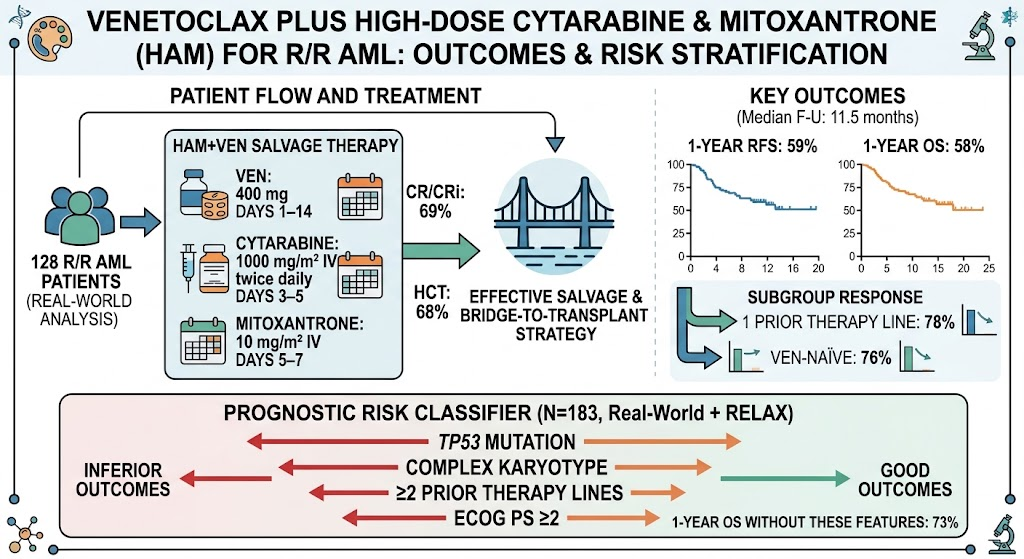
Ziftomenib Shows Clinically Meaningful Activity in Heavily Pretreated NPM1‑Mutated AML — A Targeted Option for a Molecularly Defined Relapse Population
In the phase II registration cohort of KOMET‑001, oral menin inhibitor ziftomenib achieved a CR/CRh rate of 22% (61% MRD negativity) and an ORR of 33% in relapsed/refractory NPM1‑mutated AML with manageable toxicity, supporting further stud

Restrictive versus Liberal Transfusion Thresholds in Very Low Birthweight Infants: Fewer Transfusions Without Harm to Survival or Early Neurodevelopment
A Cochrane meta-analysis of six RCTs (3,451 infants) finds restrictive hemoglobin thresholds reduce transfusion exposure modestly with no detectable effect on mortality or neurodevelopmental impairment at 18–26 months.

Donor-Search Prognosis Strategy Yields Comparable 2-Year Survival After Alternative-Donor Allogeneic Transplantation
BMT CTN 1702 shows that prioritizing alternative donors for patients unlikely to find a matched unrelated donor achieves similar 2‑year survival and transplant outcomes versus patients likely to find a matched unrelated donor.

Platelet Transfusion in the ICU: Rare But Variable — A 30-Country Prospective Cohort Reveals Wide Practice Differences
An international prospective cohort found platelet transfusions were used in 6% of ICU patients, mostly for bleeding or prophylaxis, with wide variation in thresholds and adherence across geo-economic regions, highlighting need for stewards

RBC Transfusions in Early Sepsis Resuscitation: Common, Complex, and Potentially Harmful Above a 10 g/dL Threshold
In a multicenter Korean sepsis cohort, early RBC transfusions were frequent and driven by illness severity. No overall 60‑day mortality difference was seen after propensity matching, but transfusion was associated with harm at hemoglobin ≥1

Five-Year POLARIX Follow-Up: Polatuzumab-R-CHP Improves Long-Term PFS in Frontline DLBCL — What Clinicians Need to Know
At five years, pola‑R‑CHP showed a sustained progression‑free survival benefit versus R‑CHOP in newly diagnosed intermediate‑/high‑risk DLBCL (HR 0.77), with similar long‑term tolerability and no statistically significant overall survival d

Mosunetuzumab + Polatuzumab Vedotin Outperforms R‑GemOx in Transplant‑Ineligible Relapsed/Refractory Large B‑Cell Lymphoma: Primary Results of the Phase III SUNMO Trial
In the randomized phase III SUNMO trial, mosunetuzumab plus polatuzumab vedotin significantly improved response rates and progression‑free survival versus R‑GemOx in transplant‑ineligible relapsed/refractory large B‑cell lymphoma, with low

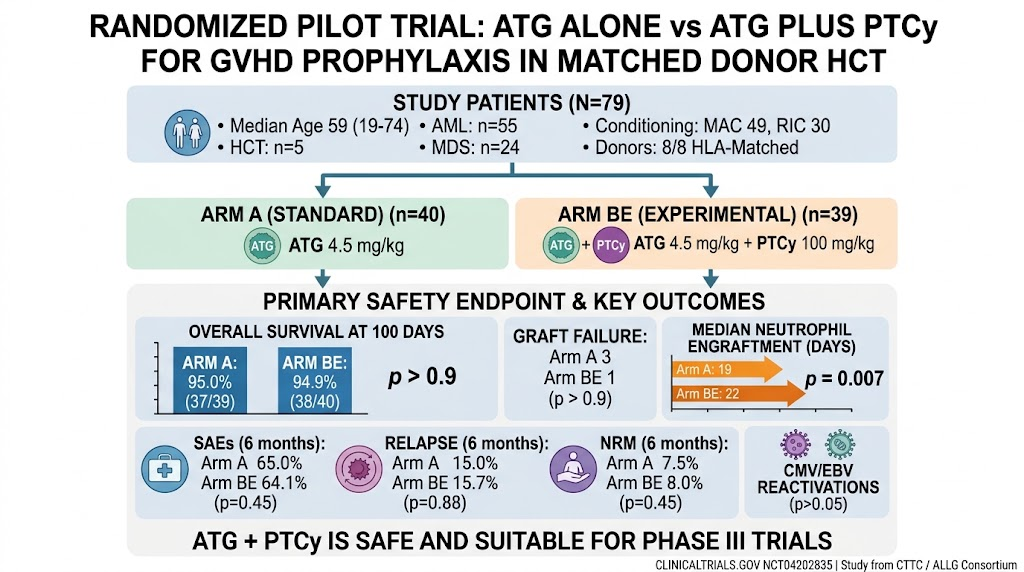
Post‑transplant Cyclophosphamide with Sirolimus/Cyclosporine Dramatically Lowers Chronic GVHD After Unrelated Donor PBSC Transplant Without Raising Relapse Risk
In a randomized Phase II trial, replacing MMF with post‑transplant cyclophosphamide (PTCy) alongside sirolimus and cyclosporine in unrelated donor PBSC transplants markedly lowered chronic GVHD and improved 1‑year chronic GVHD‑free relapse‑

Quizartinib Added to Standard Chemotherapy Improves Event-Free and Overall Survival in Newly Diagnosed FLT3‑ITD–Negative AML: Findings from the Phase II QUIWI Trial
In the randomized, double‑blind phase II QUIWI trial, adding quizartinib to standard induction/consolidation chemotherapy and single‑agent maintenance significantly improved event‑free survival and overall survival for adults 18–70 years wi

Ruxolitinib Improves Failure-Free and Overall Survival Versus Best Available Therapy in Steroid-Refractory Acute GVHD: Final 24‑Month REACH2 Analysis
The 24‑month final analysis of the phase III REACH2 trial shows ruxolitinib produced longer failure‑free survival, improved median overall and event‑free survival, and a longer duration of response versus best available therapy (BAT) in pat

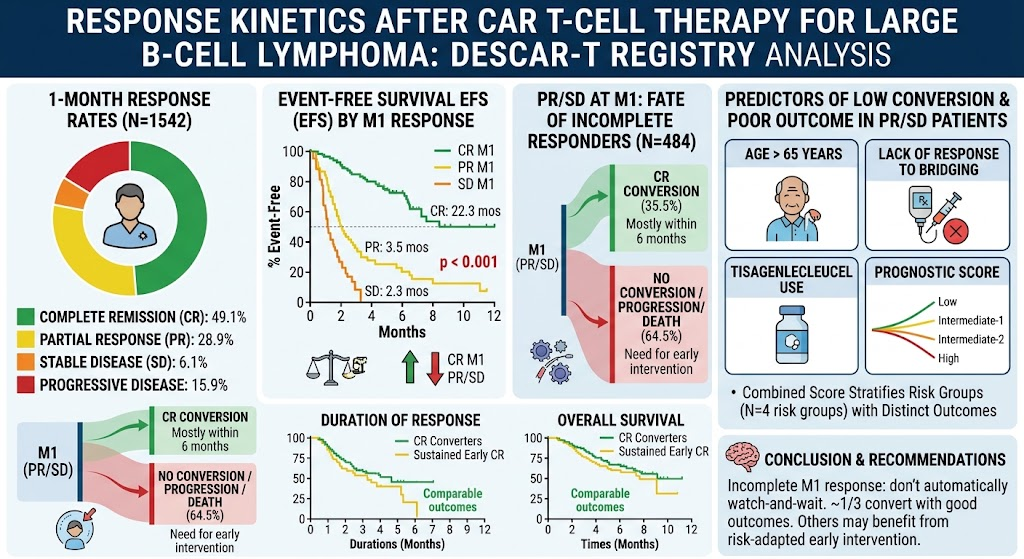
Five-Year ZUMA-5 Follow-Up: Durable Remissions and Potential for Cure with Axicabtagene Ciloleucel in Relapsed/Refractory Follicular Lymphoma
Five-year outcomes from ZUMA-5 show axi-cel produces high response rates in relapsed/refractory indolent NHL, with 75% CR, median PFS ~62 months, durable remissions linked to early CAR T expansion and naïve T-cell product phenotype, and an

AZD0120 (GC012F) Dual-Target BCMA/CD19 CAR‑T Shows Promising Early Activity and Favorable Safety in RRMM: Interpreting ASH 2025 Ib Data
Early Ib results from AstraZeneca’s AZD0120 (GC012F), a FasTCAR-derived BCMA/CD19 dual-target CAR‑T, reported 100% ORR in evaluable RRMM patients with low-grade CRS and no ICANS. Findings are encouraging but limited by small numbers and sho

Long-Term Nirogacestat for Progressive Desmoid Tumors: Durable Responses, Continued Tumor Shrinkage, and a Manageable Safety Profile
Extended follow-up from the phase III DeFi trial shows that continuous nirogacestat yields further tumor shrinkage, durable objective responses (ORR 45.7% at up to 4 years), sustained patient-reported benefits, and a consistent, manageable

Withholding Two Daunorubicin Doses in Induction Preserves Outcomes and Lowers Fungal Risk in Favorable-Risk Pediatric B-ALL
In children with favorable B-lineage ALL, omission of two daunorubicin doses late in induction was noninferior for 5-year EFS and OS and associated with fewer invasive fungal infections, supporting reduced anthracycline exposure in selected
Browse by specialty
Open language-specific specialty feeds and department pages.