We use cookies

Our website uses essential cookies and, with your consent, additional cookies to measure performance and improve our services. Cookie Policy.

You can change your choice at any time.

MMedXYNews
HomeVideos
MedXY AI/MedXY News/Section: Hematology-Oncology

Distinct Roles of PD-L1 and PD-L2 in Primary Mediastinal Large B-Cell Lymphoma: Implications for Immune Therapeutics
MedXY Editorial Team•Sep 21, 2026•Hematology-Oncology
immunotherapyPMBCLPD-L2PD-L1

Highlight

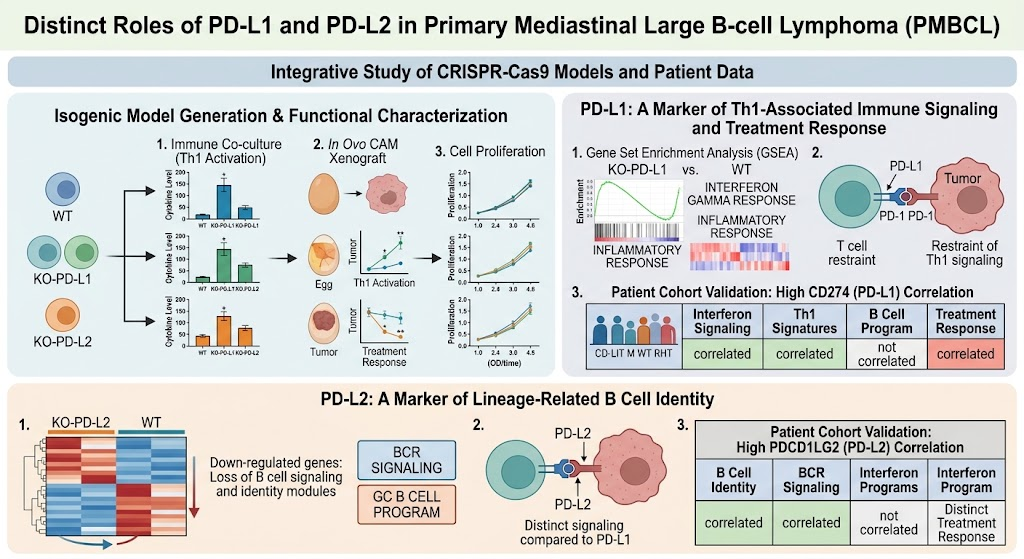
Primary mediastinal large B-cell lymphoma (PMBCL) features frequent 9p24.1 genetic alterations driving overexpression of PD-1 ligands PD-L1 and PD-L2. PD-L1 predominantly suppresses Th1 immune signaling and predicts response to PD-1 blockade, while PD-L2 maintains B-cell lineage transcriptional programs and associates with distinct treatment responses. Combined targeting of both ligands enhances Th1 activation and modulates lymphoma transcriptional states.

Study Background

MedXY registered readers

Sign in free to continue reading

Create or use your MedXY account to unlock the complete article.

This article was created using several editorial tools, including AI, as part of the process. Human editors reviewed this content before publication.

Related articles

Open language-specific specialty feeds and department pages.

Decoding Cellular Interactions to Enhance Neoadjuvant PD-L1 Blockade Response in Esophageal Squamous Cell CarcinomaThis study reveals coordinated cellular programs underlying response and resistance to neoadjuvant PD-L1 blockade in ESCC, highlighting potential combinatorial immunotherapy targets for personalized treatment strategies.Sep 22, 2026Dapirolizumab Pegol Improves Disease Activity in Systemic Lupus Erythematosus: Evidence from Phase 3 PHOENYCS GO Trial and Prior StudiesDapirolizumab pegol, a CD40 ligand inhibitor, significantly improves disease activity in moderate-to-severe SLE over 48 weeks when added to standard care, supported by robust phase 3 trial data and pharmacokinetic findings.Sep 22, 2026Dynamic Gut Microbiome Changes Enhance Immunotherapy Outcomes in Advanced Liver CancerThis longitudinal study reveals that gut microbiome remodeling during immune checkpoint inhibitor therapy in advanced liver cancer patients predicts clinical benefit, improving biomarker accuracy and survival stratification.Sep 21, 2026
Loading comments...
MedXY briefing

Get the free newsletter

Evidence-led clinical news, trends, and analysis—delivered to your inbox.

Ask MedXY AI

Most popular

Intimate Health
Five Benefits for Women Continuing Sexual Activity After Menopause
Intimate Health
Why Some Women Have a Strong Sex Drive—And Why Men Shouldn't Worry About It
Nursing & care
How often should a couple have sex?
General Surgery
Optimizing Postoperative Opioid Prescriptions After Intra-Abdominal Cancer Surgery: Comparing the 5x-Multiplier and 3-Tier Models
Intimate Health
Classic Intimacy Recommendations: How to Help Women Reach Orgasm and Enjoy Mutual Pleasure
© 2026 MedXY
Contact usAbout usPrivacy PolicyMedXY story
Novel Immunotherapy Combination Shows Promise in HPV16-Positive R/M Head and Neck Cancer: Insights from the VERSATILE-002 Phase 2 Trial
PDS0101 combined with pembrolizumab demonstrated encouraging efficacy and safety in immune checkpoint inhibitor-naive HPV16-positive recurrent/metastatic head and neck squamous cell carcinoma, supporting further first-line evaluation.
Sep 21, 2026
Immunotherapy in Head and Neck Squamous Cell Carcinoma with Low PD-L1 Expression: A Meta-Analytic Insight into Survival OutcomesA meta-analysis reveals immune checkpoint inhibitors may reduce survival in head and neck squamous cell carcinoma patients with PD-L1 combined positive scores less than 1, signaling caution in this subgroup’s treatment.Sep 21, 2026
Pembrolizumab Plus Chemotherapy for Cervical Cancer: Five-Year Exploratory Analysis from the KEYNOTE-826 Randomized Clinical TrialFive-year data from KEYNOTE-826 confirm pembrolizumab combined with chemotherapy as a durable, first-line treatment improving survival in persistent, recurrent, or metastatic cervical cancer without new safety concerns.Sep 15, 2026