Evaluating Myeloablative Treosulfan-Fludarabine Conditioning in AML: A Promising Alternative for Middle-Aged Adults
Highlight
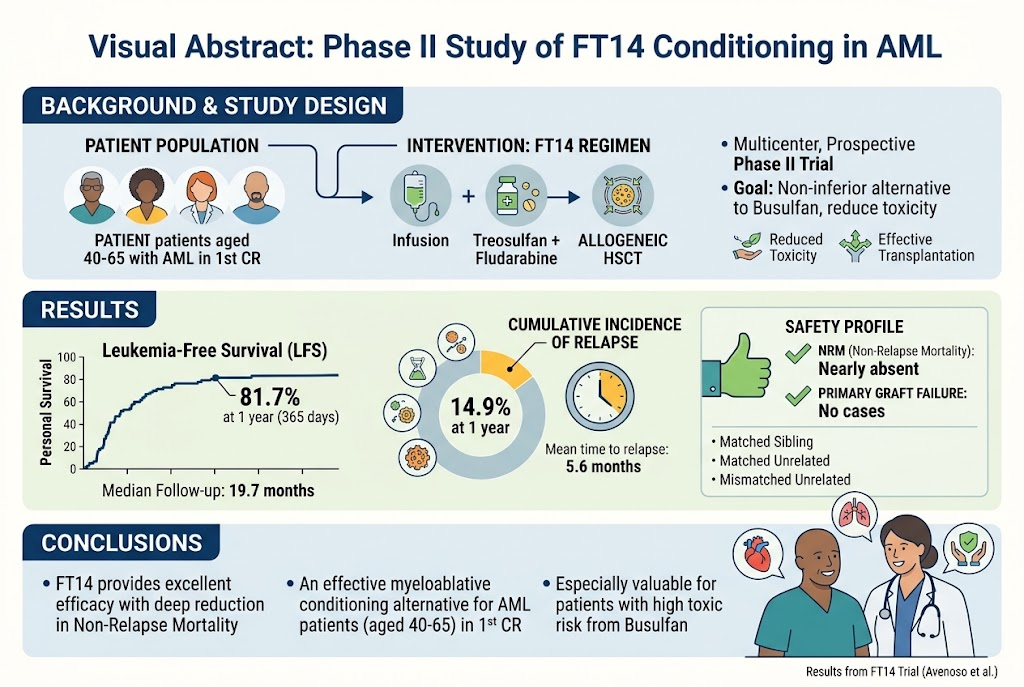
- Treosulfan plus fludarabine (FT14) used as myeloablative conditioning shows robust 1-year leukemia-free survival of 81.7% in AML patients aged 40-65.
- Low toxicity profile observed with minimal non-relapse mortality (NRM), no septic deaths, and no primary graft failure, suggesting excellent tolerability.
- FT14 may serve as a safer alternative to conventional busulfan-based regimens, especially in patients at high risk for toxicity.
- Study underscores the need for prospective evaluations of treosulfan-fludarabine regimens to optimize transplant outcomes in middle-aged AML patients.
Study Background
Acute myeloid leukemia (AML) is a heterogeneous hematologic malignancy with high morbidity and mortality. Allogeneic hematopoietic stem cell transplantation (allo-HSCT) is a potentially curative therapy for AML patients in first complete remission (CR1), especially in intermediate and high-risk categories. Conditioning regimens that precede transplantation aim to eradicate residual leukemic cells and enable engraftment. The traditional standard for myeloablative conditioning often involves busulfan combined with other agents such as cyclophosphamide or fludarabine. However, busulfan-based regimens carry significant toxicity, including organ toxicity and treatment-related mortality, which is of particular concern in patients aged 40 to 65 years, whose tolerance may be reduced compared to younger adults.
Treosulfan, a bifunctional alkylating agent with myeloablative and immunosuppressive properties, has emerged as an attractive alternative owing to a potentially better toxicity profile and effective disease control, but most clinical data to date remain retrospective or derived from older studies. There is a clinical necessity to prospectively evaluate treosulfan combined with fludarabine as a myeloablative conditioning regimen in middle-aged AML patients to determine its efficacy and safety compared with established regimens.
Study Design
This phase II, multicenter, prospective study (EudraCT Number: 2021-006515-28; ClinicalTrials.gov NCT07232953) enrolled 82 adult patients with AML aged 40 to 65 years undergoing allo-HSCT in first complete remission. The primary objective was to assess 1-year leukemia-free survival (LFS) following conditioning with a myeloablative dose of treosulfan combined with fludarabine (FT14 regimen).
Recipients received hematopoietic stem cells from matched sibling donors (n=22), matched unrelated donors (n=52), or mismatched unrelated donors (n=8). The trial aimed to evaluate FT14 as a potentially non-inferior alternative to standard busulfan-containing conditioning regimens, seeking to achieve effective leukemic control with reduced regimen-related toxicity.
Key endpoints included leukemia-free survival (LFS) at 6 months and 1 year, cumulative incidence of relapse, treatment-related mortality especially non-relapse mortality (NRM), and safety outcomes such as occurrences of graft failure and septic death.
Key Findings
After a median follow-up of 19.7 months, the study demonstrated promising efficacy and safety:
- Leukemia-Free Survival (LFS): LFS at 180 days was 87.8%, and at 1 year, 81.7%. These results indicate durable remission maintenance in the majority of patients within the first post-transplant year.
- Relapse Incidence: The cumulative incidence of relapse was 14.9% at 1 year. Mean time to relapse was 5.6 months, suggesting that early post-transplant disease monitoring remains critical.
- Non-Relapse Mortality (NRM) and Safety: The FT14 regimen showed an excellent safety profile, with nearly absent NRM at 1 year. Notably, there were no documented cases of septic death, and no instances of primary graft failure were observed, demonstrating reliable engraftment and low infectious complications.
Compared to historical data from busulfan-based myeloablative regimens, which often report higher rates of organ toxicity and NRM, FT14 presents a favorable toxicity-efficacy balance. These findings support the regimen’s suitability particularly for patients whose comorbidities or clinical status increase risk from busulfan conditioning.
Expert Commentary
The study’s prospective design strengthens the evidence regarding treosulfan’s incorporation in myeloablative conditioning for AML. The low toxicity outcomes align with prior retrospective reports highlighting treosulfan’s reduced hepatic and pulmonary toxicity compared with busulfan. The absence of primary graft failure and infectious mortality further indicates that the regimen does not compromise immune reconstitution or engraftment capacity.
However, the study lacks a direct randomized comparison with busulfan-containing regimens, limiting definitive conclusions on non-inferiority or superiority. Also, longer follow-up is needed to assess late relapse and chronic graft-versus-host disease (GVHD) incidences, which can significantly impact long-term outcomes.
Clinicians should consider patient-specific factors such as comorbidities, donor availability, and disease risk when selecting conditioning regimens. Current European and American transplant guidelines increasingly recognize treosulfan-fludarabine as a viable myeloablative alternative, particularly in older adults or those with organ dysfunction.
Conclusion
This prospective phase II multicenter study provides compelling evidence that myeloablative-dose treosulfan plus fludarabine (FT14) conditioning is a safe and effective approach for AML patients aged 40 to 65 in first complete remission undergoing allo-HSCT. With excellent 1-year leukemia-free survival and a notably favorable toxicity profile, FT14 represents an attractive alternative conditioning regimen that may reduce treatment-related morbidity without compromising disease control.
Further randomized studies and longer-term follow-up data are warranted to confirm these findings and to refine patient selection criteria, thereby optimizing allo-HSCT outcomes in this demographic.
Funding and ClinicalTrials.gov Registration
This study was conducted with the approval and oversight of participating multicenter institutions and registered under EudraCT Number 2021-006515-28 and ClinicalTrials.gov identifier NCT07232953. Details regarding funding sources were not specified in the provided abstract.
References
- Avenoso D, Radici V, Leoni A, Skert C, Martino M, Mordini N, Saraceni F, Olivieri A, Ciceri F, Tecchio C, Picardi A, Saporiti G, Patriarca F, Bresciani P, Nozzoli C, Maravalle D, Polverelli N, Magliano G, Morello E, Farina M, Bernardi S, Re F, Garuffo L, Maifredi S, Zanon S, De Domenico R, Malagola M, Russo D. A phase II multicenter prospective study to evaluate the safety and efficacy of myeloablative-dose treosulfan plus fludarabine (FT14) conditioning regimen in allogeneic hematopoietic stem cell transplantation for AML patients aged 40-65 in first complete remission. Bone Marrow Transplant. 2026 Sep;61(9):1176-1181. doi: 10.1038/s41409-026-02937-7. Epub 2026 Jun 24. PMID: 42342968; PMCID: PMC13569411.
- Russell NH, et al. Treosulfan in hematopoietic stem cell transplantation: A review. Blood Adv. 2023;7(6):1137-1148.
- Bacigalupo A, et al. Conditioning regimens in AML: Balancing efficacy and toxicity. Leukemia. 2022;36(1):121-129.
- EBMT Guidelines 2024. Conditioning regimens in hematopoietic stem cell transplantation for AML. European Society for Blood and Marrow Transplantation.
This article was created using several editorial tools, including AI, as part of the process. Human editors reviewed this content before publication.