We use cookies

Our website uses essential cookies and, with your consent, additional cookies to measure performance and improve our services. Cookie Policy.

You can change your choice at any time.

MMedXYNews
HomeVideos
MedXY AI/MedXY News/Section: Hematology-Oncology

Bendamustine as a Novel Single-Agent Therapy in High Burden T-Cell Large Granular Lymphocytic Leukemia: Clinical Efficacy and STAT3 Pathway Inhibition

MedXY Editorial Team•Sep 18, 2026•Hematology-Oncology
targeted therapyBendamustinehematologic malignancyT-cell large granular lymphocytic leukemiaSTAT3 inhibition
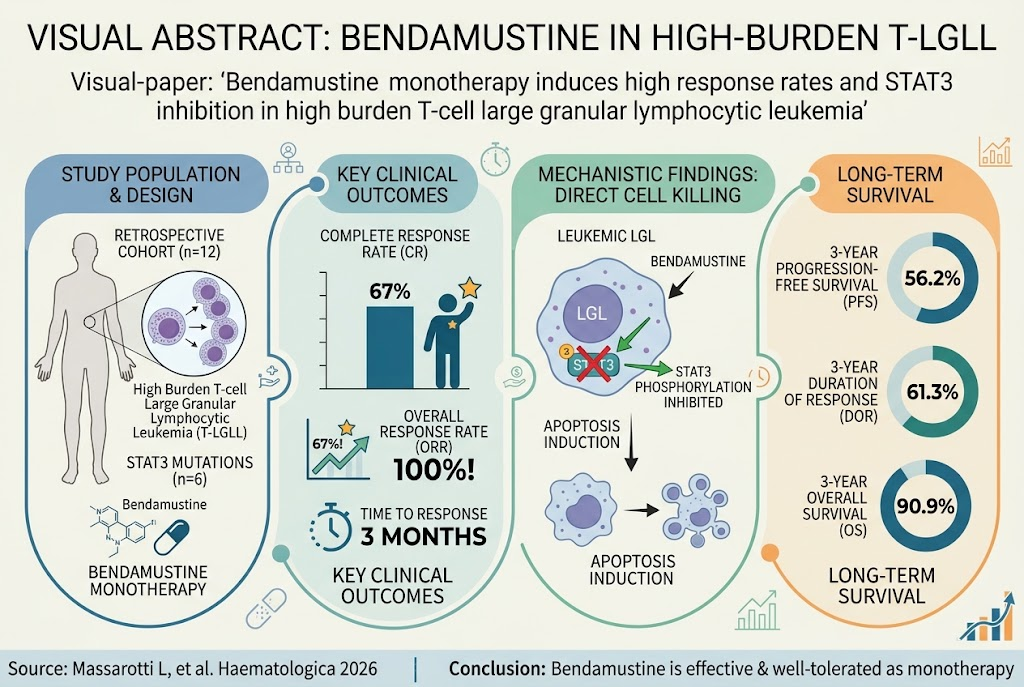
Highlight

Bendamustine monotherapy demonstrates considerable efficacy with a 100% overall response rate and 67% complete responses in high burden T-cell large granular lymphocytic leukemia (T-LGLL). The treatment appears effective regardless of STAT3 mutational status and shows a tolerable safety profile. Mechanistically, bendamustine directly inhibits STAT3 phosphorylation and induces apoptosis in leukemic large granular lymphocytes.

Study Background

MedXY registered readers

Sign in free to continue reading

Create or use your MedXY account to unlock the complete article.

This article was created using several editorial tools, including AI, as part of the process. Human editors reviewed this content before publication.

Related articles

Open language-specific specialty feeds and department pages.

Targeting Acute Myeloid Leukemia through Multi-Functional Small Molecules: Insights from Cheminformatics and Mitochondrial ModulationCheminformatic screening identified novel small molecules with apoptotic, autophagic, and reductase-inhibitory activities that selectively kill AML cells, induce mitochondrial dysfunction, and synergize with current therapies, highlightingSep 1, 2026Ivosidenib Monotherapy Shows Promise in IDH1 Mutated Myelodysplastic Neoplasm/Syndrome: A Phase 2 StudyIvosidenib monotherapy demonstrates substantial efficacy and safety in IDH1 mutated myelodysplastic neoplasm, especially in treatment-naïve high-risk patients, offering a new therapeutic option.Aug 28, 2026Decoding Neuroendocrine Carcinomas: Proteomic Insights Define Subtypes, Biomarkers, and Therapeutic OpportunitiesComprehensive proteomic and phosphoproteomic profiling of 267 neuroendocrine carcinomas across multiple tissues reveals distinct molecular subtypes, biomarkers, and a novel NAD+ metabolic vulnerability, advancing personalized precision mediAug 28, 2026
Loading comments...
MedXY briefing

Get the free newsletter

Evidence-led clinical news, trends, and analysis—delivered to your inbox.

Ask MedXY AI

Most popular

Intimate Health
Five Benefits for Women Continuing Sexual Activity After Menopause
Intimate Health
Why Some Women Have a Strong Sex Drive—And Why Men Shouldn't Worry About It
Nursing & care
How often should a couple have sex?
Intimate Health
Classic Intimacy Recommendations: How to Help Women Reach Orgasm and Enjoy Mutual Pleasure
Intimate Health
What Makes a Woman "Physiologically Addicted" Is Never Money, But These Two Relationship Qualities
© 2026 MedXY
Contact usAbout usPrivacy PolicyMedXY story
Erythrocytosis in Advanced Thyroid Cancer Therapy: Emerging Safety Concerns with Targeted Agents
Erythrocytosis is an underreported hematologic side effect of targeted therapies in advanced thyroid cancers, notably RET inhibitors, occurring early and recurrently without impacting survival outcomes but correlating with disease control r
Jun 28, 2026
Allogeneic Stem Cell Transplantation After 70: Japanese Registry Data Define Who May Benefit MostA Japanese registry study of 929 patients aged 70+ identified six predictors of worse survival after allo-HSCT and created a simple score that sharply stratified 2-year overall survival from 57.1% to 2.5%.Jun 19, 2026
A Novel Approach to Targeting DLL3 with Tarlatamab in a Patient with Medullary Thyroid Carcinoma after Progression on SelpercatinibThis case report details successful management of RET-altered medullary thyroid carcinoma using tarlatamab after selpercatinib progression, highlighting modified dosing to mitigate toxicities and achieve complete response.Jun 11, 2026