Cardiovascular Risks of CAR-T Therapy in Older Adults: Insights from US Medicare Data
Highlight
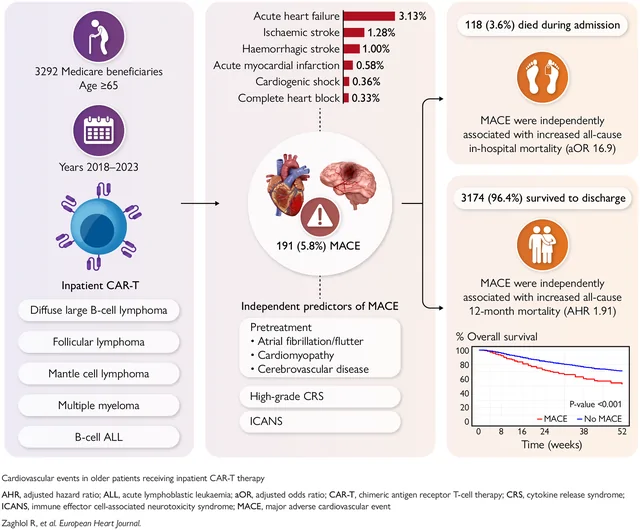
- In a national US cohort of over 3,000 Medicare beneficiaries aged 65 and above undergoing CAR-T therapy, 5.8% experienced major adverse cardiovascular events (MACE).
- Acute heart failure was the most frequent cardiovascular complication, followed by ischemic and hemorrhagic strokes.
- Pre-existing atrial fibrillation/flutter, cardiomyopathy, and cerebrovascular disease were independently associated with higher MACE risk.
- MACE occurrence was linked to significantly increased in-hospital and one-year post-discharge mortality, emphasizing the need for vigilant cardiovascular management.
Study Background
Chimeric antigen receptor T-cell (CAR-T) therapy has revolutionized treatment for relapsed hematologic malignancies, offering improved survival in patients who fail conventional therapies. However, as these cellular immunotherapies become more widely used, especially in older adults with comorbid illnesses, concerns about cardiovascular adverse events have emerged. Prior data on CAR-T associated cardiovascular toxicity remain sparse and mostly from clinical trials, which often underrepresent older and multimorbid patients. Understanding the incidence, risk factors, and outcomes of major adverse cardiovascular events (MACE) post-CAR-T therapy in a real-world older population is crucial for optimizing patient selection and supportive care protocols.
Study Design
This retrospective cohort study analyzed Medicare fee-for-service beneficiaries aged over 65 who underwent inpatient CAR-T therapy between 2018 and 2023 in the United States. Baseline patient characteristics and cardiovascular comorbidities were assessed over the 12 months preceding CAR-T administration. The primary outcomes were major adverse cardiovascular events (MACE), defined as a composite endpoint including acute heart failure, cardiogenic shock, myocardial infarction, cardiac tamponade, ventricular arrhythmia, complete heart block, or stroke (ischemic or hemorrhagic). Multivariable regression models adjusted for demographic factors, hematologic malignancy type, and baseline cardiovascular comorbidities were used to identify independent predictors of MACE. Associations between MACE and mortality both during hospitalization and up to one year after discharge were evaluated.
Key Findings
A total of 3,292 Medicare beneficiaries treated with CAR-T were included. MACE occurred in 191 patients, representing an incidence of 5.8%. The most common MACE event was acute heart failure (3.1%), followed by ischemic stroke (1.3%) and hemorrhagic stroke (1%). The composite endpoint captured a range of serious cardiovascular complications occurring post-infusion.
Multivariable adjustment revealed that pre-treatment atrial fibrillation/flutter was associated with a 52% increased odds of MACE (adjusted odds ratio [aOR] 1.52; 95% CI, 1.08–2.16). Cardiomyopathy conferred the highest risk, with more than a twofold increase in MACE odds (aOR 2.49; 95% CI, 1.75–3.54). Cerebrovascular disease also doubled the risk (aOR 2.40; 95% CI, 1.30–4.43). Notably, in the 2021 to 2023 subcohort, MACE were significantly associated with immune effector cell-associated neurotoxicity syndrome (ICANS) and high-grade cytokine release syndrome (CRS), suggesting interplay between immune toxicity and cardiovascular events.
Patients experiencing MACE had dramatically higher in-hospital mortality (aOR 16.9; 95% CI, 11.0–26.1), reflecting the severity and acute risk posed by cardiovascular complications. Additionally, MACE predicted poorer long-term survival, with a 91% higher hazard of death within one year post-discharge (adjusted hazard ratio 1.91; 95% CI, 1.46–2.49), underscoring cardiovascular events’ impact on overall prognosis.
Expert Commentary
This study provides the largest real-world evidence to date of CAR-T associated cardiovascular toxicity in an older and comorbid population, complementing clinical trial data. The relatively modest incidence of MACE (5.8%) confirms these events are not ubiquitous but clinically significant when they occur. The identification of cardiovascular and cerebrovascular comorbidities as independent risk factors highlights the need for thorough cardiovascular assessment before CAR-T therapy. The association with immune toxicities such as ICANS and CRS suggests systemic inflammation and immune activation may mediate cardiotoxicity, which aligns with mechanistic hypotheses from smaller cohort studies.
Nevertheless, the study has limitations, including reliance on administrative claims data and potential under-coding of nuanced cardiovascular diagnoses. Lack of granular clinical data such as left ventricular function, biomarker levels, or detailed timing of events limits mechanistic insights. Additionally, since the cohort included only Medicare fee-for-service beneficiaries, findings may not generalize to younger populations or those with different insurance arrangements.
Clinically, these results advocate for enhanced cardiovascular monitoring protocols and proactive management strategies, including optimizing heart failure therapy and stroke prevention in vulnerable patients prior to CAR-T. Furthermore, future prospective studies should explore cardiovascular biomarkers, imaging, and interventions to mitigate risk during and after CAR-T treatment.
Conclusion
In summary, this large nationwide study of older adults receiving CAR-T therapy demonstrated a 5.8% incidence of major adverse cardiovascular events, which were associated with substantially increased in-hospital and one-year mortality. Patients with pre-existing atrial fibrillation, cardiomyopathy, or cerebrovascular disease were at greatest risk. The interplay between CAR-T associated systemic immune toxicities and cardiovascular complications merits further research. These findings underscore the importance of integrated cardio-oncology care to optimize outcomes in this expanding patient population undergoing cellular immunotherapy for hematologic malignancies.
Funding and ClinicalTrials.gov
The original study did not specify funding sources or registered trial numbers. Further dedicated prospective studies should consider trial registration and detailed funding disclosures.
References
1. Zaghlol R, et al. Chimeric antigen receptor T-cell therapy and cardiovascular outcomes in US Medicare beneficiaries. Eur Heart J. 2026;47(35):4957-4969. PMID: 42199067.
2. Santomasso BD, et al. Clinical outcomes post CAR-T therapy: immune toxicity and cardiovascular effects. Blood. 2020;136(25):2851-2861.
3. Lefebvre C, et al. Cardiovascular complications following CAR T-cell therapy. J Am Coll Cardiol. 2021;77(7):813-823.
4. Lyon AR, et al. Cardiovascular toxicities of cancer therapies: current understanding and clinical management. Lancet Oncol. 2018;19(9):e321-e333.
This article was created using several editorial tools, including AI, as part of the process. Human editors reviewed this content before publication.