We use cookies

Our website uses essential cookies and, with your consent, additional cookies to measure performance and improve our services. Cookie Policy.

You can change your choice at any time.

MMedXYNews
HomeVideos
MedXY AI/MedXY News/Section: Hematology-Oncology

Unveiling the Systemic Drivers of Blood-Brain Barrier Disruption in Sickle Cell Disease: Insights from Proteomic Profiling
MedXY Editorial Team•Sep 21, 2026•Hematology-Oncology
Brain Injurysickle cell diseaseblood–brain barrierneurovascularproteomics

Highlight

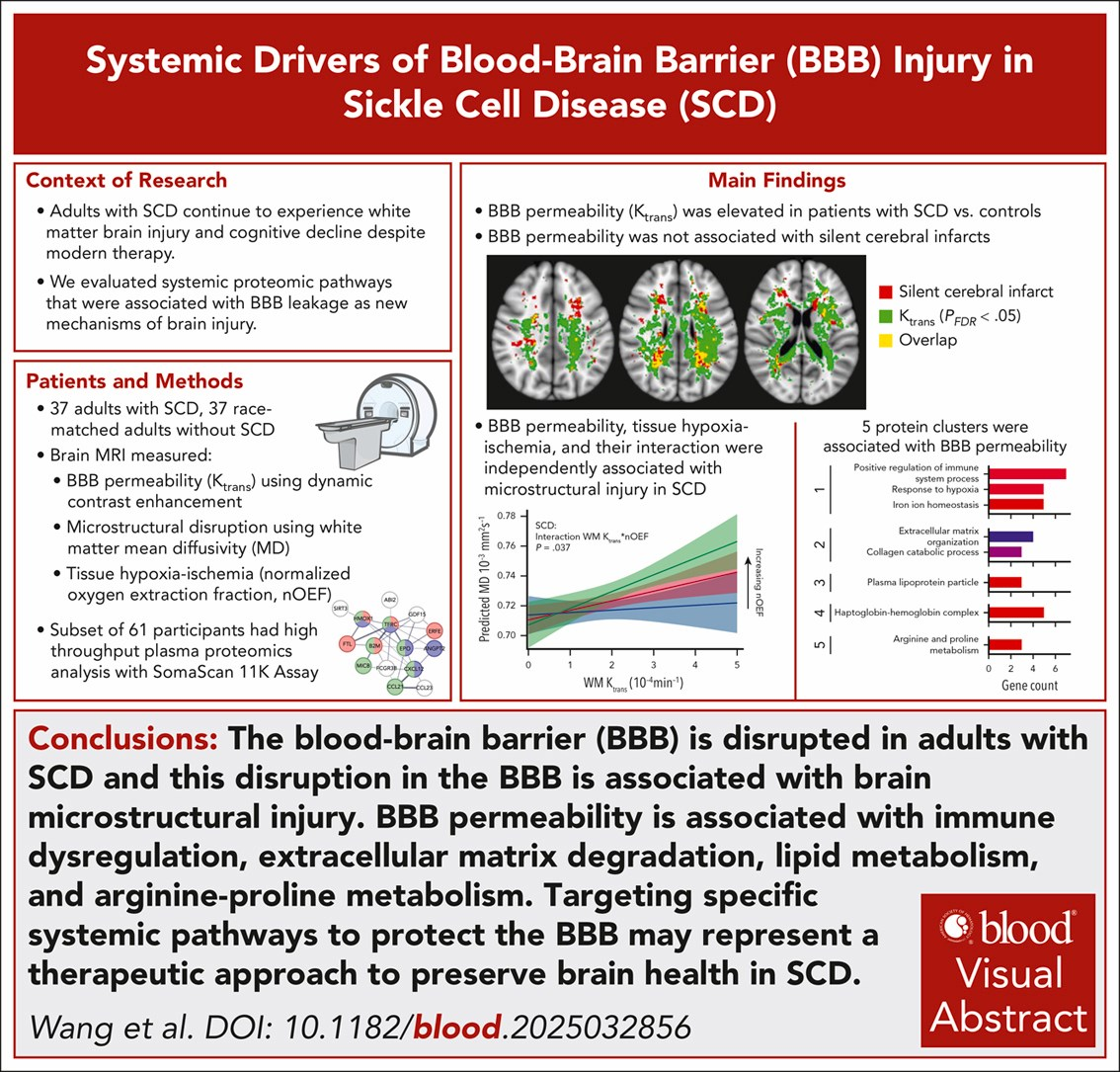
  • This study demonstrates increased blood-brain barrier (BBB) permeability in adults with sickle cell disease (SCD) using dynamic contrast-enhanced MRI.
  • Proteomic analysis identified 79 plasma proteins associated with BBB injury, implicating pathways related to iron homeostasis, hypoxia response, immune dysregulation, extracellular matrix degradation, lipoprotein metabolism, and arginine-proline metabolism.
  • BBB disruption and cerebral hypoxia synergistically contribute to white matter microstructural injury detectable by MRI metrics, correlating with silent cerebral infarcts.
  • Targeting systemic pathways that disrupt the BBB may offer novel strategies to mitigate brain injury and cognitive decline in SCD patients.

Study Background

MedXY registered readers

Sign in free to continue reading

Create or use your MedXY account to unlock the complete article.

This article was created using several editorial tools, including AI, as part of the process. Human editors reviewed this content before publication.

Related articles

Open language-specific specialty feeds and department pages.

Proteomic and Metabolomic Insights into Cardiac Remodeling in Breast Cancer Patients Undergoing Cardiotoxic TherapyThis study identifies novel proteomic and metabolomic biomarkers linked to cardiac dysfunction and remodeling in breast cancer patients treated with cardiotoxic therapies, revealing potential pathways for early detection and intervention.Sep 19, 2026Optimizing Autologous Stem Cell Backup Mobilization with GCSF and Plerixafor in Sickle Cell Disease: Implications for Gene TherapyA retrospective study demonstrates the safety and efficacy of GCSF and plerixafor for CD34+ stem cell mobilization as autologous backup in sickle cell patients undergoing alternate donor HSCT, with insights relevant for gene therapy.Sep 18, 2026Molecular Subtypes in Transthyretin Cardiac Amyloidosis: Insights from Proteomics Profiling and Tafamidis EfficacyComprehensive plasma proteomics reveal three molecular subtypes of transthyretin cardiac amyloidosis linked to distinct prognoses and differential tafamidis treatment responses, highlighting personalized therapeutic opportunities.Sep 13, 2026
Loading comments...
MedXY briefing

Get the free newsletter

Evidence-led clinical news, trends, and analysis—delivered to your inbox.

Ask MedXY AI

Most popular

Intimate Health
Five Benefits for Women Continuing Sexual Activity After Menopause
Intimate Health
Why Some Women Have a Strong Sex Drive—And Why Men Shouldn't Worry About It
Nursing & care
How often should a couple have sex?
General Surgery
Optimizing Postoperative Opioid Prescriptions After Intra-Abdominal Cancer Surgery: Comparing the 5x-Multiplier and 3-Tier Models
Intimate Health
Classic Intimacy Recommendations: How to Help Women Reach Orgasm and Enjoy Mutual Pleasure
© 2026 MedXY
Contact usAbout usPrivacy PolicyMedXY story
Advancing Fetal Death Detection: Identification of Novel Maternal Plasma Biomarkers Through Large-Scale Proteomic Profiling
Large-scale proteomic analysis identifies novel maternal plasma protein biomarkers that improve detection of fetal death beyond established markers, highlighting both shared and unique pathological pathways with preeclampsia.
Sep 12, 2026
Decoding Neuroendocrine Carcinomas: Proteomic Insights Define Subtypes, Biomarkers, and Therapeutic OpportunitiesComprehensive proteomic and phosphoproteomic profiling of 267 neuroendocrine carcinomas across multiple tissues reveals distinct molecular subtypes, biomarkers, and a novel NAD+ metabolic vulnerability, advancing personalized precision mediAug 28, 2026
Unveiling Metabolic Signatures: Glucose and Methionine PET Imaging in Disorders of Consciousness Post-Brain InjuryThis exploratory longitudinal study reveals that alongside decreased glucose metabolism, elevated brainstem methionine uptake correlates with consciousness improvement in brain-injured patients, highlighting novel metabolic biomarkers for pAug 26, 2026