semaglutide
39 all articles · 20 / page
Latest news
Tag

Semaglutide and Neovascular Age-Related Macular Degeneration Among Adults with Type 2 Diabetes: An OHDSI Network Study
In a large OHDSI network study of adults with type 2 diabetes, semaglutide was not associated with a higher or lower risk of neovascular age-related macular degeneration.

Cagrilintide-Semaglutide (CagriSema) Lowers HbA1c Better Than Semaglutide Alone in Type 2 Diabetes
REIMAGINE 2 found that once-weekly cagrilintide-semaglutide lowered HbA1c more than semaglutide alone in adults with type 2 diabetes and overweight or obesity, with a safety profile consistent with known gastrointestinal effects.

CagriSema for Early Type 2 Diabetes: Interpreting the Phase 3a REIMAGINE 1 Trial in the Context of Incretin–Amylin Combination Therapy
REIMAGINE 1 shows that once-weekly CagriSema significantly reduced HbA1c and bodyweight versus placebo in early type 2 diabetes, with mainly gastrointestinal adverse events and a mechanistically compelling incretin–amylin profile.

No Signal for Increased Neovascular AMD Risk With Semaglutide in Adults With Type 2 Diabetes: Interpretation of a Large OHDSI Network Study
A multinational OHDSI network analysis found no meaningful association between semaglutide use and neovascular age-related macular degeneration among adults with type 2 diabetes across cohort and self-controlled designs.

Semaglutide Improves Insulin Sensitivity in Patients With Schizophrenia, Prediabetes, and Obesity Treated With Second-Generation Antipsychotics: Findings From the HISTORI Trial
In a 30-week randomized trial, semaglutide improved insulin sensitivity, reduced insulin resistance, lowered fasting glucose, and produced substantial weight loss in patients with schizophrenia and prediabetes taking second-generation antip

Six-Week Native GIP Infusion Does Not Improve Glycaemic Control in Type 2 Diabetes, Alone or With Semaglutide
A six-week native GIP infusion did not improve glucose control in type 2 diabetes, either alone or added to semaglutide, despite raising circulating GIP levels.

GLP-1 Weight-Loss and Diabetes Drugs: What Eye Specialists Say About NAION Risk
A new consensus statement advises cautious, shared decision-making about GLP-1 receptor agonists and NAION risk, noting that current evidence is observational, conflicting, and suggests any absolute risk increase is small.

Semaglutide Reduced Effort Discounting and Improved Motivation Signals in Major Depressive Disorder
In a 16-week randomized trial, adjunctive oral semaglutide improved effort-based decision-making in adults with major depressive disorder and overweight or obesity, suggesting a potential role for GLP-1 receptor agonism in reward-related dy

Semaglutide Shows Promise in Reducing Mental Illness Worsening in Patients with Depression and Anxiety, Swedish Study Finds
A landmark Swedish cohort study of 95,490 patients reveals that semaglutide is associated with a 42% lower risk of worsening mental illness in people with depression and anxiety, while other GLP-1 receptor agonists show varied effects. The

Semaglutide and Nonarteritic Anterior Ischemic Optic Neuropathy: Synthesizing Evidence from Target Trial Emulations and Global Pharmacovigilance
This review synthesizes recent evidence regarding the association between semaglutide initiation and nonarteritic anterior ischemic optic neuropathy (NAION), contrasting high-risk findings in real-world cohort studies with neutral findings

Is Semaglutide Worth the Cost? Evaluating the Economic Reality of GLP-1s for Heart Disease Prevention
A comprehensive simulation study evaluates the cost-effectiveness of semaglutide for secondary cardiovascular prevention in US adults without diabetes, finding significant health benefits but highlighting the need for price reductions to en

Semaglutide Drives Vascular Regeneration: The SEMA-VR CardioLink-15 Trial Reveals a Shift in Progenitor Cell Flux
The SEMA-VR CardioLink-15 trial demonstrates that semaglutide shifts bone marrow-derived progenitor cells toward an anti-inflammatory, pro-regenerative profile, potentially enhancing endogenous vessel repair in high-risk cardiovascular pati

Semaglutide Mitigates Cardiometabolic Risk in Early-Stage Schizophrenia: Insights from a Randomized Clinical Trial
A landmark RCT demonstrates that adjunctive semaglutide significantly improves glycemic control and induces substantial weight loss in individuals with schizophrenia spectrum disorders treated with second-generation antipsychotics, potentia

Semaglutide for Secondary CVD Prevention: Evaluating the Price of Clinical Success
A simulation study reveals that while semaglutide significantly reduces cardiovascular events in adults with obesity, its current cost exceeds traditional cost-effectiveness thresholds, requiring an 18% price reduction for broader economic

Semaglutide Delivers Consistent Functional Gains in Peripheral Artery Disease Regardless of Sex: Evidence from the STRIDE Trial
A post hoc analysis of the STRIDE trial reveals that once-weekly semaglutide 1.0 mg significantly improves walking distance and quality of life in both men and women with type 2 diabetes and peripheral artery disease, despite notable differ

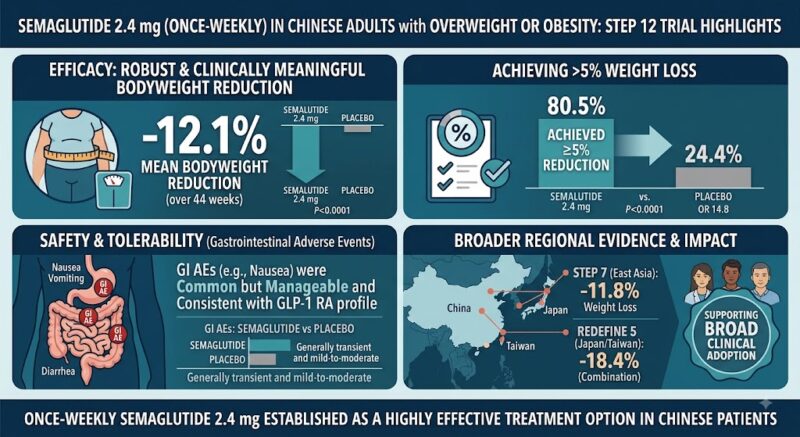
Weekly Semaglutide 2.4 mg Delivers 16% Weight Loss in Asian Adults with BMI ≥25: Results from the STEP 11 Phase 3 Trial
The STEP 11 trial demonstrates that once-weekly semaglutide 2.4 mg significantly reduces bodyweight by 16% in Asian adults with obesity (BMI ≥25 kg/m2), providing robust evidence for population-specific clinical guidelines and reimbursement

Semaglutide Extends Survival in Non-Overweight Type 2 Diabetes Patients: New Evidence Challenges BMI-Centric Treatment Models
A large-scale retrospective study demonstrates that semaglutide reduces all-cause mortality by 46% in non-overweight patients with Type 2 diabetes compared to DPP-4 inhibitors, highlighting cardioprotective benefits independent of weight re

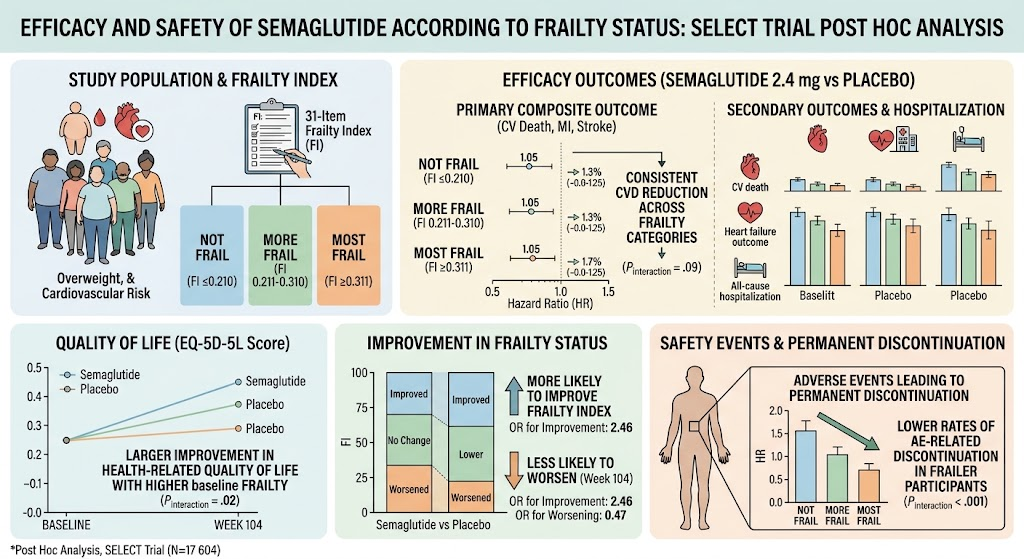
Beyond MACE: Semaglutide Significantly Reduces Hospitalization Burden in Patients with Obesity and Cardiovascular Disease
This exploratory analysis of the SELECT trial demonstrates that semaglutide 2.4 mg reduces total hospital admissions and total days spent in the hospital by approximately 10-11% in patients with established cardiovascular disease and obesit