MMedXYNews
HomeVideos
© 2026 MedXY
Contact usAbout usPrivacy PolicyMedXY story
MedXY AI/MedXY News/Tag: corneal confocal microscopy
MedXY News
EnglishTag

corneal confocal microscopy

Ask MedXY AI
type 2 diabetesclinical trialheart failureimmunotherapyobesitycardiovascular riskatrial fibrillationcritical carebiomarkersartificial intelligencetype 1 diabetesclinical trialsHypertensiononcologyCardiologyMortalitypublic healthcardiovascular diseasediabetesAlzheimer's diseasebreast cancerepidemiology

Latest news

Tag

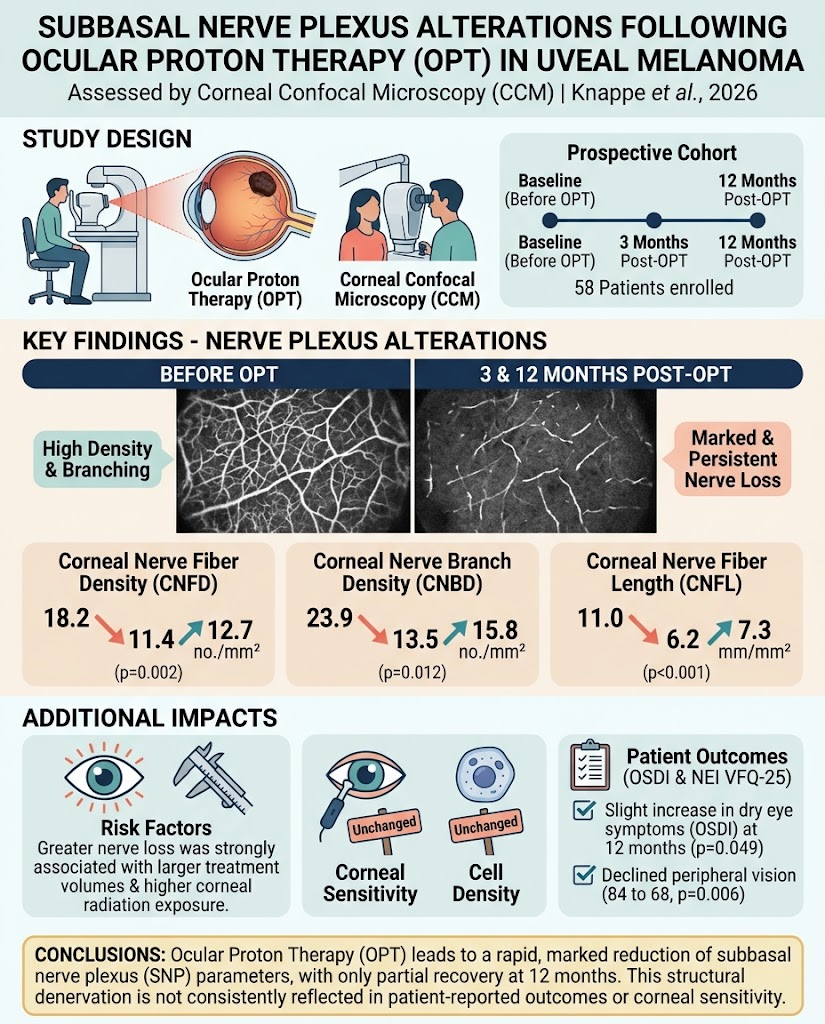
Longitudinal Effects of Ocular Proton Therapy on the Corneal Subbasal Nerve Plexus in Uveal Melanoma Patients
newscorneal confocal microscopyocular proton therapy

Longitudinal Effects of Ocular Proton Therapy on the Corneal Subbasal Nerve Plexus in Uveal Melanoma Patients

By MedXY|Oct 9, 2026

Ocular proton therapy in uveal melanoma induces significant reductions in corneal nerve parameters with partial recovery by 12 months, while corneal sensitivity remains stable and patient-reported symptoms show limited correlation with stru
Impact of Ocular Proton Therapy on Corneal Subbasal Nerve Plexus in Uveal Melanoma: Longitudinal Confocal Microscopy Findings
newscorneal confocal microscopy
corneal nerve fiber density

Impact of Ocular Proton Therapy on Corneal Subbasal Nerve Plexus in Uveal Melanoma: Longitudinal Confocal Microscopy Findings

By MedXY|Oct 8, 2026

Ocular proton therapy causes significant decreases in corneal nerve fiber parameters in uveal melanoma patients, with partial recovery by 12 months and minimal changes in corneal sensitivity and patient-reported outcomes.

Ask MedXY AI

Most popular

Intimate Health
Five Benefits for Women Continuing Sexual Activity After Menopause
Intimate Health
Why Some Women Have a Strong Sex Drive—And Why Men Shouldn't Worry About It
Nursing & care
How often should a couple have sex?
Cardiology
Precision Medicine for Long QT Syndrome Type 2: Lumacaftor Corrects Trafficking Defects and Shortens QT Interval
General Surgery
Optimizing Postoperative Opioid Prescriptions After Intra-Abdominal Cancer Surgery: Comparing the 5x-Multiplier and 3-Tier Models