Methimazole-Associated Neutropenia Common in Pediatric Graves Disease: Chinese Cohort Study
Graves disease (GD) is uncommon in children, but when it occurs, methimazole (MMI) is the recommended first-line medical therapy. Neutropenia and agranulocytosis are known adverse effects of MMI, yet pediatric-specific data on their frequency, timing, and risk factors have been scarce. Without reliable evidence, clinicians must rely on adult data or anecdotal experience to guide monitoring. This study provides pediatric-specific evidence to inform monitoring schedules and identify children at highest risk.
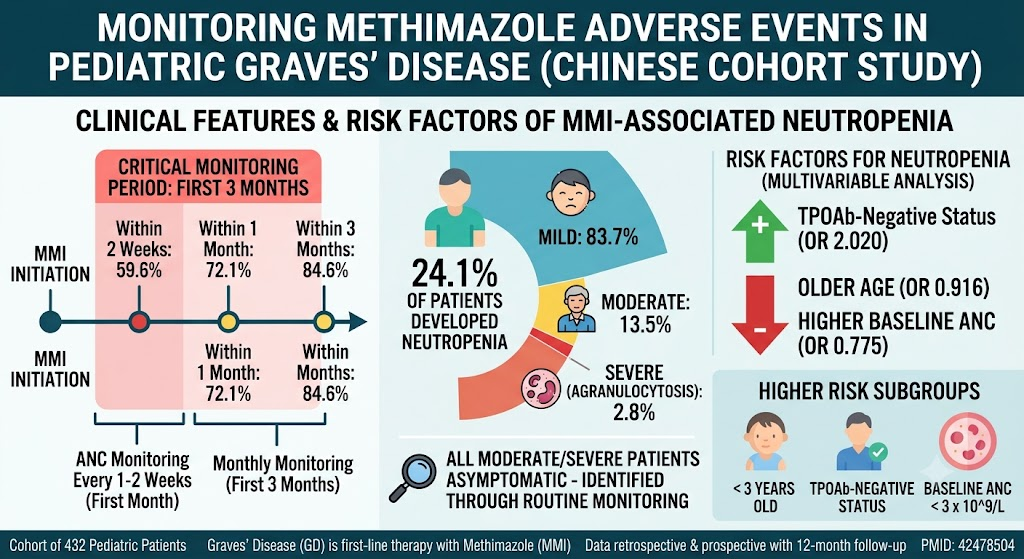
Of 432 pediatric GD patients treated with MMI, 24.1% developed neutropenia over 12 months.
Most cases (84.6%) occurred within the first 3 months; 72.1% appeared within the first month, and 59.6% within the first 2 weeks.
All moderate or severe neutropenia (including agranulocytosis) was asymptomatic and detected through routine blood monitoring in the first month.
Thyroid peroxidase antibody (TPOAb)-negative status was associated with a doubling in the odds of neutropenia (OR 2.02).
Older age and higher baseline absolute neutrophil count (ANC) were protective.
Study Snapshot
Design: Retrospective and prospective cohort study.
Setting: Single center in China.
Population: 432 pediatric patients (aged 0–18 years) with confirmed Graves disease initiating MMI therapy.
Exposure: Methimazole, standard doses per clinical protocol.
Primary Outcome: Neutropenia (ANC < 1.5 × 10⁹/L), subcategorized as mild, moderate, or severe (agranulocytosis).
Key Results: Neutropenia incidence 24.1%; agranulocytosis 0.7%; TPOAb-negative status, younger age, and lower baseline ANC were independent risk factors.
Limitations: Single-center, predominantly Asian population; limited data on adherence; no standardized MMI dose adjustment protocol; relatively short follow-up.
How the Study Was Conducted
The investigators enrolled 432 pediatric patients with GD who were treated with MMI at a Chinese hospital. Data were collected both retrospectively (from medical records) and prospectively. Patients were followed at 0.5, 1, 2, 3, 4, 5, 6, 7–9, and 10–12 months after starting MMI. Neutropenia was defined as an absolute neutrophil count (ANC) below 1.5 × 10⁹/L, with mild (1.0–1.5 × 10⁹/L), moderate (0.5–1.0 × 10⁹/L), and severe (< 0.5 × 10⁹/L, agranulocytosis) categories. Multivariable logistic regression was used to identify independent risk factors associated with neutropenia, adjusting for age, sex, baseline thyroid function, TPOAb status, and baseline ANC.
What the Researchers Found
Over 12 months, 104 patients (24.1%) experienced at least one episode of neutropenia. The majority of cases (84.6%) occurred within the first 3 months, with 72.1% happening in the first month and 59.6% within the first 2 weeks. Among affected patients, 83.7% had mild, 13.5% moderate, and 2.8% severe neutropenia (three cases of agranulocytosis). Notably, all patients with moderate or severe neutropenia were asymptomatic and were identified only through routine blood monitoring, all within the first month of therapy.
Multivariable analysis revealed three independent factors: TPOAb-negative status was associated with a significantly higher risk (odds ratio [OR] 2.020, 95% CI 1.113–3.666). Older age was protective (OR 0.916 per year, 95% CI 0.848–0.989). A higher baseline ANC was also protective (OR 0.775 per 1 × 10⁹/L increase, 95% CI 0.665–0.903). No significant associations were found with sex, baseline thyroid hormone levels, or MMI dose (data not fully shown in abstract).
What the Findings May Mean
This study provides pediatric-specific evidence that MMI-associated neutropenia is common—affecting about one in four children—and that the highest-risk period is the first month of treatment. The fact that all moderate-to-severe cases were asymptomatic underscores the importance of routine ANC monitoring rather than waiting for clinical symptoms. The risk factors identified may help tailor monitoring: younger children (especially those under 3 years, as suggested by the authors), those with TPOAb-negative status, and those with a baseline ANC below 3 × 10⁹/L may benefit from more frequent early checks.
The association with TPOAb-negative status is intriguing. TPOAb positivity is common in autoimmune thyroid disease, and a negative status might indicate a different immune background that increases vulnerability to drug-induced neutropenia. This finding requires replication but could eventually inform risk stratification.
Strengths and Limitations
Strengths: This is one of the largest pediatric cohorts specifically examining MMI-associated neutropenia. The use of both retrospective and prospective data, along with a predefined monitoring schedule, strengthens the reliability of the incidence estimate. Multivariable adjustment and the identification of clinically relevant risk factors add practical value.
Limitations: The study is from a single Chinese center, so generalizability to other populations (especially non-Asian) is uncertain. There was no standardized MMI dose adjustment protocol, which could influence neutropenia risk. Adherence to monitoring and dose changes were not reported. The relatively short follow-up (12 months) may miss late-onset cases. Finally, the number of agranulocytosis events is too small for subgroup analysis, so risk factors for the most severe form remain unclear.
Implications for Practice and Research
For clinicians managing pediatric GD, these findings support a monitoring schedule that is more intensive than what may be routinely used: ANC checks every 1 to 2 weeks during the first month, then monthly for the first three months. Special attention should be given to children under 3 years, those with TPOAb-negative status, or those with a baseline ANC below 3 × 10⁹/L. Since all moderate-to-severe neutropenia was asymptomatic, relying on symptom-based detection would miss these cases.
Future research should aim to validate these risk factors in multicenter, multinational cohorts, examine whether MMI dose individualization can reduce neutropenia without compromising efficacy, and investigate the biological link between TPOAb status and drug-induced neutropenia. Until then, this study offers a practical evidence base for safer use of MMI in children.
References
Tang S, Zhang F, Zhu W, Yang M, Gong M, Dang P, Jiang R, Lu H, Xin Y, Teng X. Methimazole-Associated Neutropenia and Agranulocytosis in Pediatric Patients with Graves' Disease: A Chinese Cohort Study. Thyroid. 2026 Jul 21. doi:10.1089/thy.2026.0147. PMID: 42478504.
This article was created using several editorial tools, including AI, as part of the process. Human editors reviewed this content before publication.