Hemoglobin Levels and Mortality Risk: Insights from a Large UK Cohort Study
Highlight
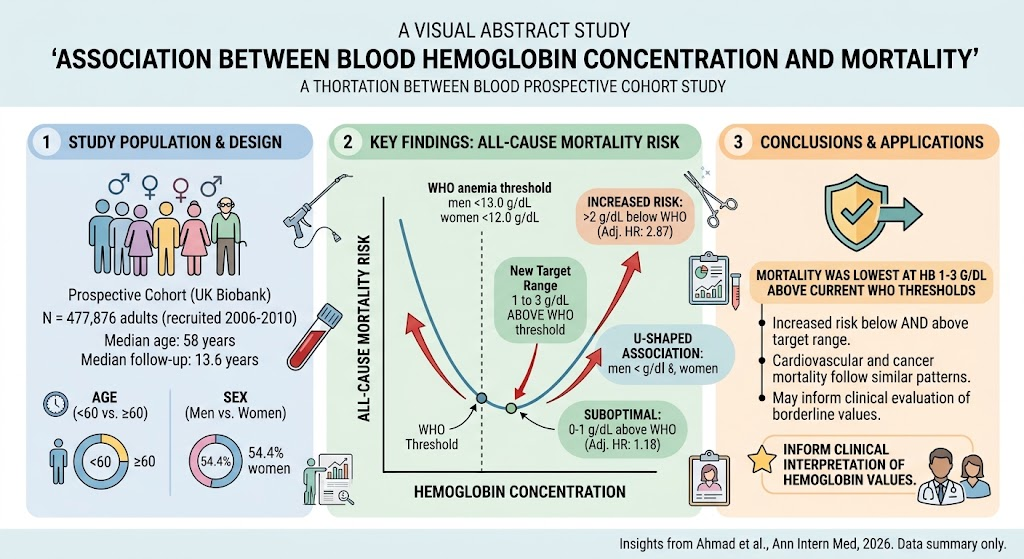
This large prospective cohort study of over 500,000 UK adults demonstrates a U-shaped relationship between blood hemoglobin concentration and long-term mortality risk, with the lowest risk observed at levels 1 to 3 g/dL above current WHO anemia thresholds. Both low and high hemoglobin levels correlate with increased all-cause, cardiovascular, and cancer mortality, particularly in older adults and men. Findings suggest a nuanced interpretation of hemoglobin values beyond the traditional anemia cutoffs.
Study Background
Anemia, commonly defined by the World Health Organization (WHO) thresholds established in 1959 (hemoglobin <13.0 g/dL for men and <12.0 g/dL for women), is a significant global health concern associated with morbidity and mortality. However, the precise relationship between hemoglobin concentration and mortality risk in the general adult population remains uncertain. In clinical practice, borderline hemoglobin values near the anemia thresholds generate diagnostic ambiguity and debate regarding their prognostic relevance. Understanding this association is critical to refining anemia definitions, guiding clinical evaluation, and optimizing patient outcomes.
Study Design
This investigation was a large-scale prospective cohort study conducted in the United Kingdom using population-based data from 2006 to 2010. A total of 502,188 adults (median age 58 years; 54.4% women) were enrolled, with hemoglobin concentration measured in 477,876 (95.2%). The cohort was stratified by sex and age groups (<60 years vs. ≥60 years) for analyses. Hemoglobin was categorized relative to the WHO sex-specific anemia thresholds, and participants were followed for a median of 13.6 years. The primary outcomes were all-cause mortality, as well as mortality from cardiovascular disease and cancer recorded during long-term follow-up.
Key Findings
The study revealed a distinct U-shaped association between hemoglobin concentrations and mortality outcomes.
All-cause mortality was lowest at hemoglobin levels 1 to 3 g/dL above the WHO anemia thresholds for both men and women. Importantly, participants with hemoglobin concentrations more than 2 g/dL below the anemia threshold exhibited a substantially elevated risk: the adjusted hazard ratio (HR) for mortality was 2.87 (95% confidence interval [CI], 2.54 to 3.25), with a 10-year standardized cumulative incidence (SCI) of 12.5% versus 4.5% in the reference group, reflecting an absolute risk difference (ARD) of +8.1 percentage points.
Individuals with hemoglobin concentrations just above the anemia threshold (0 to 1 g/dL higher) also showed increased mortality risk, with an HR of 1.18 (CI, 1.15 to 1.21) and a 10-year SCI of 5.3% (ARD +0.8 percentage points). Conversely, higher-than-optimal hemoglobin concentrations beyond this optimal range were associated with increased mortality, though the effect was less pronounced.
These patterns were most consistent among men and older adults (≥60 years), while associations in women younger than 60 years were less robust. Cardiovascular and cancer mortality trends largely paralleled all-cause mortality findings, showing heightened risk at both low and borderline hemoglobin values, with diminishing excess risk at higher concentrations.
Expert Commentary
This study provides important epidemiological evidence challenging the conventional binary classification of anemia based solely on WHO fixed thresholds. The identified U-shaped mortality pattern suggests that both anemia and elevated hemoglobin carry prognostic significance, potentially reflecting underlying health conditions such as chronic inflammation, nutritional deficiencies, or hematologic disorders at low hemoglobin levels, and risks related to hyperviscosity or cardiovascular strain at elevated levels.
Clinically, borderline hemoglobin concentrations slightly above the anemia cutoffs merit careful interpretation, especially in older individuals and men, rather than automatic reassurance of normalcy. However, the study authors prudently caution that these findings are hypothesis-generating and should not yet prompt revision of WHO anemia definitions but rather inform individualized clinical evaluation and risk stratification.
Limitations include reliance on a single baseline hemoglobin measure and a study population predominantly of White ethnicity, which may limit generalizability. Further research is needed to explore causal mechanisms, potential confounders, and applicability across diverse populations.
Conclusion
The association between hemoglobin concentration and mortality risk is complex, exhibiting a U-shaped curve with minimal mortality at levels modestly above current WHO anemia thresholds. Low hemoglobin markedly increases mortality risk, consistent with the clinical importance of diagnosing and managing anemia. Elevated hemoglobin levels also warrant consideration in clinical assessments due to their associated risks. These data underscore the need for nuanced interpretation of hemoglobin values in clinical practice and support further investigation into optimal hemoglobin targets for health.
Funding and Trial Registration
The study was conducted without external funding and is not registered on clinicaltrials.gov, reflecting its observational design and use of pre-existing population data.
References
- Ahmad M, Cleland JGF, Maffia P, et al. Association Between Blood Hemoglobin Concentration and Mortality by Age and Sex: A Prospective Cohort Study. Annals of Internal Medicine. 2026 Sep 8. PMID: 42704899.
- World Health Organization. Nutritional Anaemias: Report of a WHO Scientific Group. WHO Technical Report Series 405, 1968.
- Goodnough LT, Schrier SL. Evaluation and management of anemia in the elderly. Am J Hematol. 2014 Jun;89(1):88-96.
- Camaschella C. Iron deficiency. Blood. 2019 Jan 10;133(1):30-39.
This article was created using several editorial tools, including AI, as part of the process. Human editors reviewed this content before publication.