Higher Sodium Excretion, Measured by Multiple 24-Hour Urine Samples, Linked to Increased Type 2 Diabetes Risk
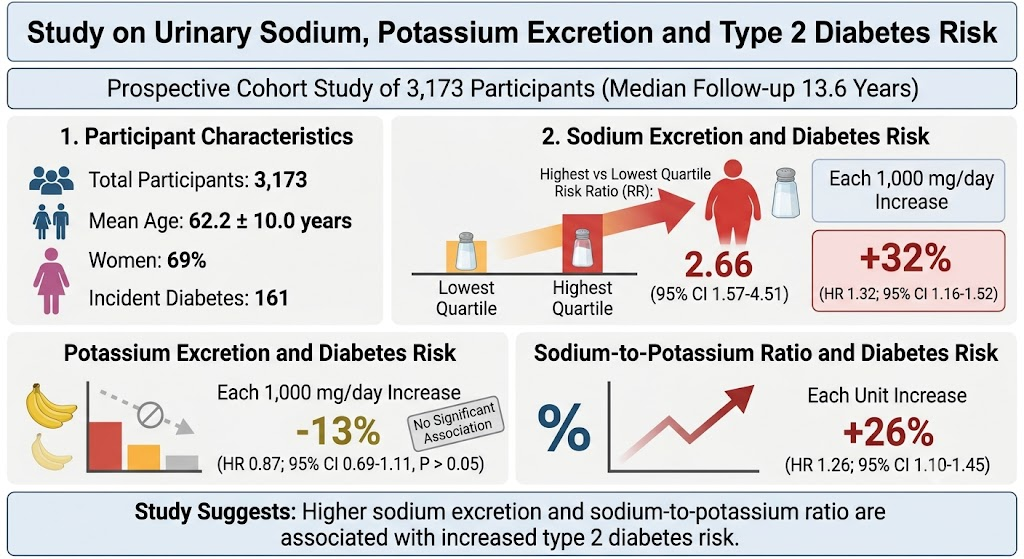
Higher urinary sodium excretion, measured by two to four 24-hour urine collections, was associated with a significantly higher risk of developing type 2 diabetes over a median follow-up of 13.6 years.
Potassium excretion was not significantly associated with diabetes risk in the fully adjusted model.
The sodium-to-potassium ratio was also associated with higher diabetes risk; each unit increase was linked to a 26% higher risk.
Despite comprehensive adjustment, residual confounding may partly explain the associations, and the findings do not prove causation.
Study Design
Prospective cohort study with multiple 24-hour urine collections.
Population
3,173 adults (mean age 62.2 years, 69% women) free of major chronic diseases at baseline, drawn from three prospective cohorts.
Exposure
24-hour urinary sodium and potassium excretion (quartiles, continuous, and sodium-to-potassium ratio).
Primary Outcome
Incident type 2 diabetes (by clinical diagnosis).
Main Findings
Highest vs. lowest sodium quartile: HR 2.66 (95% CI 1.57–4.51). Per 1,000 mg/day sodium increase: HR 1.32 (95% CI 1.16–1.52). Potassium: HR 0.87 (95% CI 0.69–1.11). Sodium-to-potassium ratio per unit: HR 1.26 (95% CI 1.10–1.45). All HRs adjusted for demographics, lifestyle, total energy intake, and BMI.
Limitations
Observational design; possible residual confounding; limited diabetes events (n=161); predominantly older female population; urine collections not repeated during follow-up.
Why This Study Matters
High sodium intake and low potassium intake are well-known risk factors for hypertension and cardiovascular disease, but their relationship with type 2 diabetes has remained unclear. Previous studies relied largely on self-reported dietary data, which can be imprecise. This study used two to four 24-hour urine collections per participant — the gold-standard biomarker for dietary sodium and potassium intake — to examine the prospective association with incident type 2 diabetes in nearly 3,200 adults.
How the Study Was Conducted
The authors, led by Dr. Shanshan Zhu and colleagues from Harvard T.H. Chan School of Public Health and other institutions, analyzed data from 3,173 participants free of major chronic diseases at baseline. Participants were drawn from three ongoing prospective cohorts. Sodium and potassium excretions were measured from two to four 24-hour urine samples collected at baseline. Incident type 2 diabetes was identified during a median follow-up of 13.6 years (161 cases). Cox proportional hazards models were used to estimate hazard ratios, adjusting for age, sex, physical activity, smoking, alcohol, total energy intake, BMI, and other potential confounders.
What the Researchers Found
Participants in the highest quartile of sodium excretion had a 2.66-fold higher risk of developing type 2 diabetes compared with those in the lowest quartile (95% CI 1.57–4.51). Each 1,000 mg/day increment in sodium excretion was associated with a 32% higher risk (HR 1.32; 95% CI 1.16–1.52). Potassium excretion showed no significant association (HR 0.87; 95% CI 0.69–1.11). The sodium-to-potassium ratio was significantly associated with diabetes risk: each unit increase corresponded to a 26% higher risk (HR 1.26; 95% CI 1.10–1.45). All estimates were from fully adjusted models.
What the Findings May Mean
The results suggest that higher sodium intake, independent of potassium intake, is associated with a greater risk of developing type 2 diabetes. The findings align with mechanistic evidence linking high sodium to insulin resistance, possibly through effects on the renin-angiotensin system, oxidative stress, or direct pancreatic beta-cell dysfunction. However, the authors caution that residual confounding cannot be ruled out, and the observational design does not establish causality. The study's use of multiple 24-hour urine collections strengthens the validity of the exposure assessment compared with self-reported dietary data.
Strengths and Limitations
A major strength is the objective measurement of sodium and potassium excretion using multiple 24-hour urine samples, which reduces measurement error. The prospective design, long follow-up (median 13.6 years), and adjustment for a wide range of confounders also add credibility. Limitations include the relatively small number of diabetes events (n = 161), the largely older and female study population, and the fact that urine collections were performed only at baseline, which cannot capture changes in dietary habits over time. Most importantly, despite extensive adjustment, residual confounding (e.g., by overall diet quality, socioeconomic factors, or undiagnosed comorbidities) may still influence the observed associations.
Implications for Practice and Research
Although the study cannot prove that reducing sodium intake will lower diabetes risk, it adds to the growing body of evidence that high sodium intake may have metabolic consequences beyond hypertension. Clinicians may consider discussing sodium reduction as part of a comprehensive diabetes prevention strategy, especially for patients with high dietary sodium intake. Future studies should replicate these findings in more diverse populations, include repeated urine collections over time, and ideally use designs such as target-trial emulation or randomized dietary interventions to better address causality.
Funding, Disclosures, and Registration
The abstract did not include funding sources, conflict-of-interest statements, or trial registration information. The reader should consult the full publication for these details.
References
Zhu S, Zhang X, Hamaya R, Li Y, Zhang Y, Sun Q, Curhan GC, Rimm EB, Willett WC, Hu FB, Ma Y. Multiple 24-Hour Urinary Sodium and Potassium Excretions and Type 2 Diabetes Incidence. Diabetes Care. 2026 Jul 15. doi:10.2337/dc251234. PMID: 42454990.
This article was created using several editorial tools, including AI, as part of the process. Human editors reviewed this content before publication.