Frailty Linked to 2–3 Year Earlier Dementia Diagnosis, Especially in Those With Low Brain Pathology
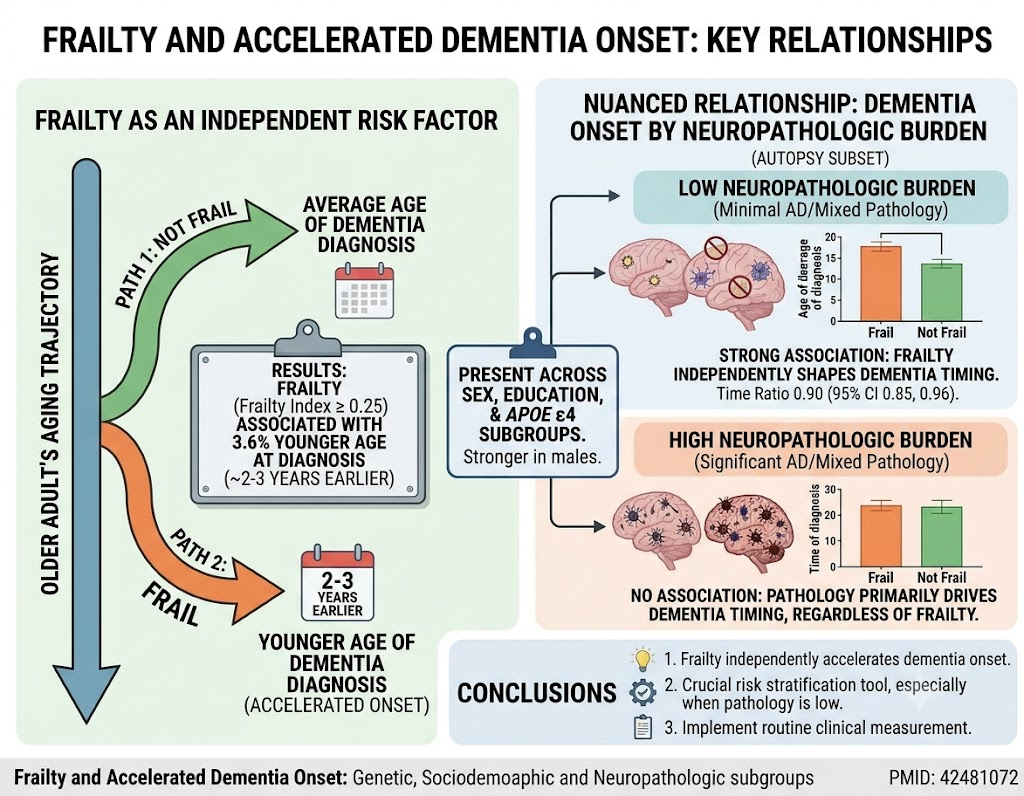
In a 23.9-year community-based study of 1,614 older adults, frailty (frailty index score ≥0.25) was associated with a 3.6% younger age at dementia diagnosis, equivalent to 2–3 years earlier onset.
The association was present across sex, education, and APOE ε4 subgroups, but was stronger in men than in women.
Among 906 autopsied participants, frailty accelerated dementia onset by 9.8% in those with low Alzheimer’s and mixed brain pathology, but had no significant effect in those with intermediate or high neuropathologic burden.
Routine frailty measurement may improve risk stratification and care planning, especially when neuropathology alone does not explain the dementia.
Study Snapshot
Design: Longitudinal cohort (Rush Memory and Aging Project)
Setting: Community-dwelling older adults, Northeastern Illinois
Participants: 1,614 (mean age 79.6 years, 75% female), with 906 in autopsy subset
Exposure: Frailty index (≥0.25 vs. lower)
Primary Outcome: Age at clinical diagnosis of dementia
Key Result: Frailty associated with 3.6% younger age at diagnosis (time ratio 0.96; 95% CI 0.95–0.98)
Subgroup Finding: In low neuropathologic burden group, frailty associated with 9.8% younger age (TR 0.90; 95% CI 0.85–0.96)
Why This Study Matters
Dementia is a growing public health challenge as populations age. While much research focuses on biological markers such as amyloid plaques and tau tangles, the role of physical frailty—a state of decreased physiologic reserve—is less understood. This study examines whether frailty independently shifts the timing of dementia diagnosis and whether its effect varies by sex, education, APOE ε4 status, or burden of brain pathology.
How the Study Was Conducted
Researchers used data from the Rush Memory and Aging Project, an ongoing prospective cohort of community-dwelling older adults in Northeastern Illinois. From 1997 to the end of follow-up (up to 23.9 years), 1,614 participants had complete baseline data on age, education, sex, APOE ε4 genotype, and sufficient health variables to construct a 41-item frailty index. Frailty was defined as an index score of 0.25 or higher. A subset of 906 participants underwent postmortem neuropathologic examination; a 10-item index quantified Alzheimer’s disease and mixed brain pathology (e.g., Lewy bodies, hippocampal sclerosis).
Accelerated failure time models were used to estimate the association between frailty and age at dementia diagnosis, adjusting for age, sex, education, and APOE ε4 status. The time ratio (TR) expresses the proportional change in the time to diagnosis: a TR less than 1 indicates a younger age at diagnosis (accelerated onset). Analyses were repeated in subgroups by sex, education (≤12 vs. >12 years), APOE ε4 carriage, and neuropathologic burden (low, intermediate, high).
What the Researchers Found
Over a median follow-up of more than two decades, frailty was associated with a 3.6% younger age at dementia diagnosis (TR 0.96; 95% CI 0.95–0.98), corresponding to approximately 2 to 3 years earlier onset. The association was present in every subgroup examined but was more pronounced in men (TR 0.94; 95% CI 0.91–0.97) than in women (TR 0.97; 95% CI 0.96–0.99). Education and APOE ε4 status did not significantly modify the frailty–dementia timing relationship.
The most striking finding emerged from the autopsy subset. Among participants who died with low neuropathologic burden—meaning their brains showed minimal Alzheimer’s or mixed pathology—frailty was associated with a 9.8% younger age at dementia diagnosis (TR 0.90; 95% CI 0.85–0.96). In those with intermediate or high neuropathologic burden, the association was not statistically significant, suggesting that frailty’s effect on dementia timing is most apparent when brain pathology alone would not otherwise explain the cognitive decline.
What the Findings May Mean
These results suggest that frailty may act as an independent risk factor that lowers the threshold for clinical dementia to become manifest. The stronger effect in the low-pathology group raises the possibility that factors outside the brain—such as systemic inflammation, metabolic dysregulation, or vascular comorbidity—contribute to the cascade leading to dementia. The sex difference, with a larger effect in men, warrants further investigation; it may reflect differential survival, frailty accumulation patterns, or sex-specific biological pathways.
The study design, while robust for establishing temporal associations, cannot prove causality. Residual confounding by unmeasured factors (e.g., physical activity, social isolation, medication use) and reverse causation—where preclinical dementia leads to increased frailty—remain plausible.
Strengths and Limitations
Major strengths include the long follow-up (nearly 24 years), autopsy confirmation in a large subset, and standardized frailty and neuropathology assessments. The use of accelerated failure time models provides a clinically intuitive measure (years of earlier onset). However, the cohort is largely White, well-educated, and from a single geographic region, limiting generalizability to other populations. The frailty index, though validated, was constructed from self-reported and performance-based measures, and the study did not account for changes in frailty over time. Furthermore, the abstract does not report key covariates such as baseline cognitive status, comorbidities, or medication history, which could confound the association.
Implications for Practice and Research
If confirmed in more diverse populations, these findings support incorporating routine frailty screening into dementia risk assessment. A simple frailty index could identify individuals who may benefit from early intervention to preserve function and possibly delay dementia onset. The differential effect by neuropathologic burden suggests that frailty reduction might be particularly effective in persons without heavy Alzheimer’s pathology—a group for which current amyloid-targeting therapies would not be indicated. Future studies should examine whether interventions that reduce frailty (e.g., exercise, nutritional support, polypharmacy reduction) can shift the trajectory of cognitive decline.
Funding, Disclosures, and Registration
The study was supported by grants from the National Institute on Aging. The authors reported no competing interests. The Rush Memory and Aging Project is registered at ClinicalTrials.gov (NCT03656367).
References
Strating TR, Haapanen MJ, Ma D, et al. Frailty and accelerated dementia onset in genetic, sociodemographic and neuropathologic subgroups. J Neurol Neurosurg Psychiatry. 2026. doi:10.1136/jnnp-2026-338460. PMID: 42481072.