Alzheimer and LATE-NC Pathologies Associated With Timely Dementia Diagnosis in Healthcare Settings
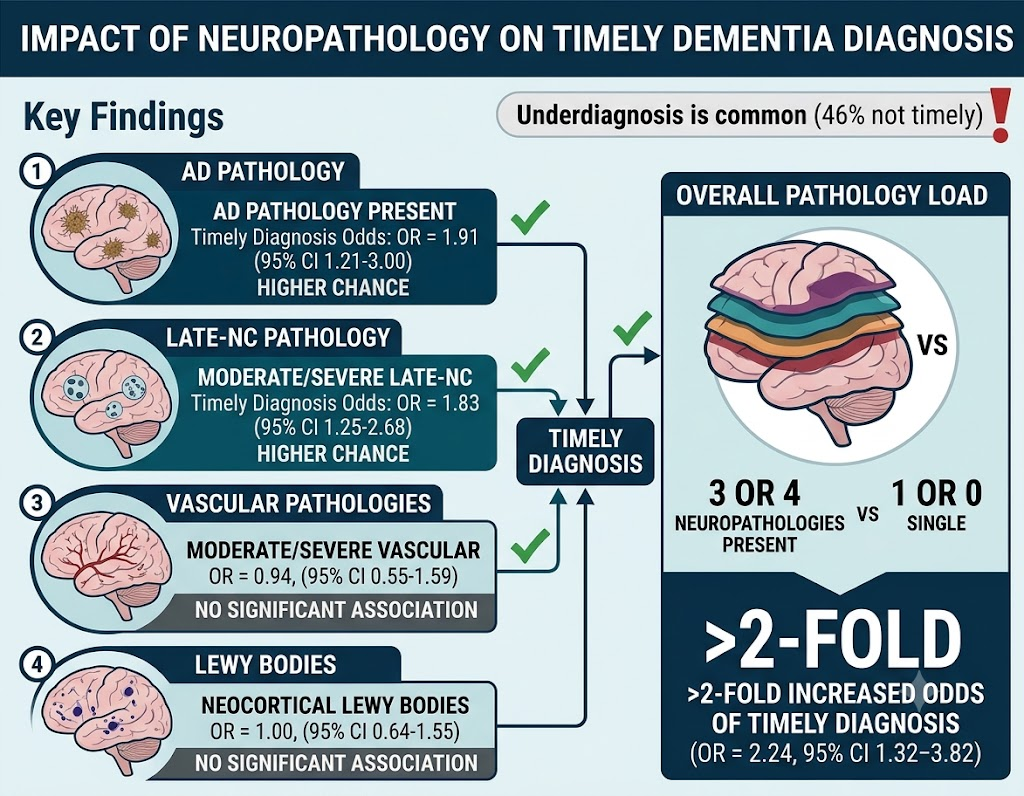
Alzheimer disease pathology and moderate/severe LATE-NC were each independently associated with approximately 1.9-fold higher odds of timely dementia diagnosis.
Dementia with three or more co-occurring neuropathologies had more than 2-fold higher odds of being diagnosed in a timely manner.
More than 45% of participants with research-confirmed incident dementia did not receive a timely diagnosis through healthcare claims.
Findings are from a predominantly White, highly educated cohort and require replication in diverse populations.
Study Snapshot
Design: Retrospective cohort study linking five prospective cohorts to Medicare claims.
Population: 500 participants (71% female, mean age at onset 88 years, 95% non-Latino White) who developed incident dementia during annual assessments and had brain autopsy.
Exposures: Postmortem neuropathology: Alzheimer disease (AD), limbic-predominant age-related TDP-43 encephalopathy neuropathologic change (LATE-NC), moderate/severe vascular pathology, and neocortical Lewy bodies (LBs).
Primary outcome: Timely diagnosis defined as any Medicare claim with a dementia diagnosis within 3 years before or 1 year after cohort-based dementia onset.
Key results: AD pathology (OR 1.91, 95% CI 1.21–3.00) and moderate/severe LATE-NC (OR 1.83, 95% CI 1.25–2.68) were independently associated with timely diagnosis. Vascular pathology (OR 0.94, 95% CI 0.55–1.59) and neocortical LBs (OR 1.00, 95% CI 0.64–1.55) were not significant. Participants with 3–4 pathologies had OR 2.24 (95% CI 1.32–3.82) compared with 0–1 pathology.
Limitations: Retrospective design, limited diversity (mostly White, highly educated), potential confounding by healthcare access and awareness, no available data on time from symptom onset to diagnosis.
Why This Study Matters
Timely diagnosis of dementia gives patients and families a chance to plan care, access support services, and participate in clinical trials. Yet many individuals with dementia remain undiagnosed or are diagnosed late in the disease course. Past research has examined demographic and clinical predictors of underdiagnosis, but little is known about whether specific types of brain pathology influence whether the healthcare system captures a dementia diagnosis in a timely manner. This study by Chen and colleagues, published in Neurology, took advantage of long-running prospective cohort data from the Rush Alzheimer’s Disease Center linked to Medicare claims to explore that question.
How the Study Was Conducted
The investigators identified 500 participants from five Rush cohorts who met research criteria for incident dementia, had available Medicare claims, and completed a brain autopsy after death. The mean age at dementia onset was 88 years, and 71% were female. Autopsy brains were examined for four categories of pathology: Alzheimer disease (based on NIA-Reagan criteria), limbic-predominant age-related TDP-43 encephalopathy neuropathologic change (LATE-NC), moderate to severe vascular pathology (including macroscopic infarcts and microinfarcts), and neocortical Lewy bodies.
Timely diagnosis was defined as the presence of one or more Medicare outpatient, inpatient, or physician claims listing a dementia diagnosis (International Classification of Diseases codes) in a window spanning from 3 years before through 1 year after the cohort-based dementia onset date. Underdiagnosis was defined as the absence of such claims within that window. Logistic regression models adjusted for age at onset, sex, education, time from death to onset, and the presence of other neuropathologies.
What the Researchers Found
Overall, only 54% of participants had a timely diagnosis recorded in Medicare claims. When looking at specific pathologies, the odds of timely diagnosis were significantly higher for those with Alzheimer disease pathology (adjusted OR 1.91, 95% CI 1.21–3.00) and for those with moderate to severe LATE-NC (OR 1.83, 95% CI 1.25–2.68). In contrast, moderate/severe vascular pathology (OR 0.94) and neocortical Lewy bodies (OR 1.00) showed no statistically significant association.
When multiple pathologies co-occurred, the odds of timely diagnosis increased. Participants with three or four neuropathologies were more than twice as likely to receive a timely diagnosis as those with zero or one pathology (OR 2.24, 95% CI 1.32–3.82).
What the Findings May Mean
The results suggest that the healthcare system may be more likely to detect dementia when certain pathologic hallmarks—particularly those of Alzheimer disease and LATE-NC—are present. This could reflect more typical clinical presentations associated with Alzheimer pathology, such as progressive memory loss, which may be more readily recognized by clinicians. LATE-NC, a common co-pathology in older adults, tends to mimic Alzheimer-like symptoms and may similarly prompt diagnostic coding.
By contrast, dementia due to vascular pathology or Lewy body disease can present with more variable features—such as executive dysfunction, fluctuation, or hallucinations—that may be less consistently documented as dementia, especially if clinicians code only for stroke or parkinsonism. Importantly, the absence of a significant association does not mean these pathologies are less clinically significant; it may simply indicate that they are less likely to lead to a documented dementia diagnosis within the claims window.
Strengths and Limitations
A major strength of the study is the use of gold-standard autopsy-confirmed neuropathology rather than clinical diagnoses alone, which can be imprecise. The linkage to Medicare claims provides real-world healthcare utilization data, capturing how dementia is actually documented in practice.
However, several limitations must be considered. The sample was predominantly White (95%) and highly educated, limiting generalizability to other racial, ethnic, or socioeconomic groups. The study is retrospective and cannot establish causation. The use of claims data may miss dementia diagnoses that were discussed but not coded, or patients who received care outside of Medicare. Additionally, the narrow window for timely diagnosis may not fully capture practice patterns. The authors note that these findings should be replicated in more diverse populations.
Implications for Practice and Research
For clinicians, the findings highlight that dementia may be underdiagnosed even when pathologic changes are advanced. A substantial proportion of individuals with confirmed dementia pathology did not have a claims-based diagnosis. Improving recognition of atypical presentations—especially those not driven by Alzheimer or LATE-NC—could help close this gap. For researchers, the study opens a new avenue: understanding how biological features of dementia interact with healthcare system factors to influence diagnosis.
Future work should examine whether these patterns hold in populations with greater racial/ethnic diversity, and whether the apparent underdiagnosis of non-Alzheimer pathologies reflects true clinical differences or variations in coding and healthcare access.
References
Chen Y, Chen A, Power MC, et al. Associations of Alzheimer Disease and Related Dementia Neuropathologies With Timely Diagnosis of Dementia in Healthcare Settings. Neurology. 2026;107(3):e218352. PMID: 42485607. URL: https://pubmed.ncbi.nlm.nih.gov/42485607/
This article was created using several editorial tools, including AI, as part of the process. Human editors reviewed this content before publication.