Metabolomic Clock Links Plasma Metabolites to Ageing, Frailty, and Cognitive Decline
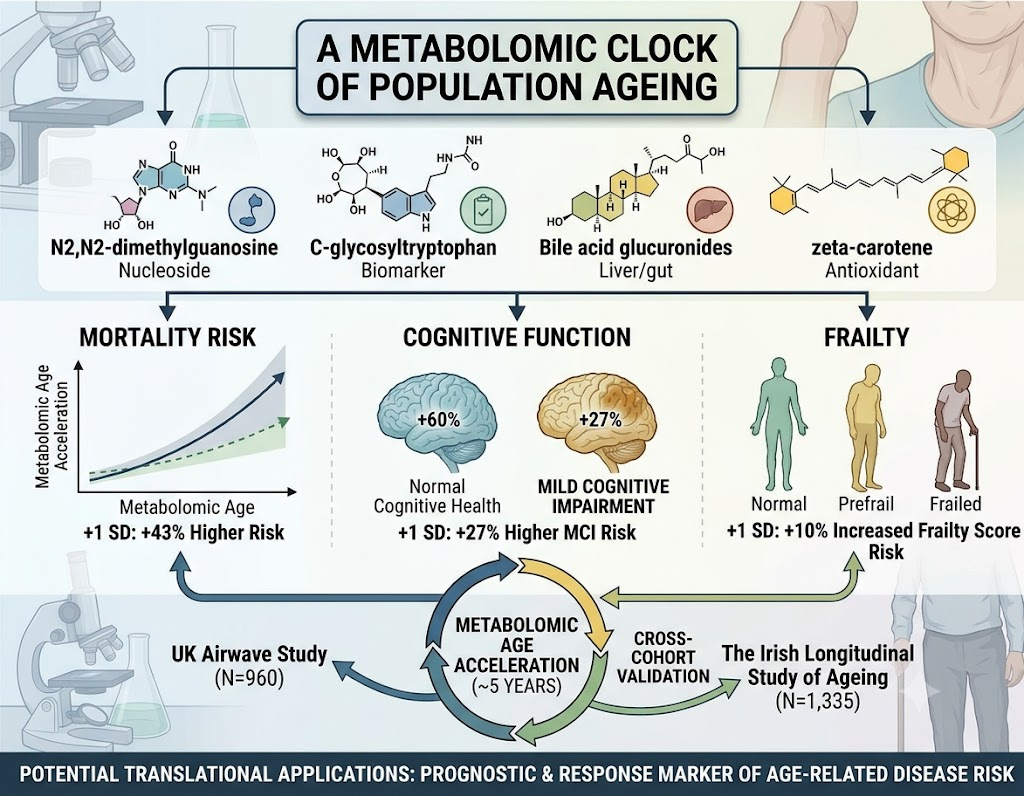
A metabolomic clock using plasma metabolites predicted chronological age with a correlation of r=0.92 in test samples from two independent cohorts.
Each standard deviation increase in metabolomic age acceleration (~5 years) was associated with 43% higher mortality risk, 27% higher risk of mild cognitive impairment, and 10% increased risk of a higher frailty score.
Key metabolites included N2,N2-dimethylguanosine, C-glycosyltryptophan, bile acid glucuronides, zeta-carotene, 3-methoxy-4-hydroxyphenylglycol sulphate, and sialyllactose.
The clock showed strong test-retest reliability (r>0.6) and was validated in the UK Airwave study and The Irish Longitudinal Study on Ageing (TILDA).
Study Snapshot
Design: Cross-cohort metabolomic profiling and development of a biological age prediction model.
Population: 2,295 participants (960 from Airwave study, 1,335 from TILDA), aged 20-89.
Exposure: 3,686 plasma samples analyzed by broad-spectrum LC-MS metabolomics.
Comparator: Chronological age; metabolomic age acceleration (difference between predicted and chronological age).
Primary Outcome: Prediction of chronological age; associations with mortality, frailty (Frailty Index), and mild cognitive impairment.
Key Findings: Metabolomic clock r=0.92. Per SD increase in age acceleration: 43% higher mortality (fully adjusted), 27% higher risk of mild cognitive impairment, 10% increased frailty score.
Limitations: Observational design; residual confounding; need for mechanistic validation and clinical translation studies.
Why This Study Matters
Ageing is the primary risk factor for many chronic diseases, yet measuring biological ageing in individuals remains challenging. Chronological age does not capture the heterogeneity in physiological decline. Metabolomics, the comprehensive analysis of small-molecule metabolites in blood, offers a window into the biochemical state of an organism. In this study, researchers developed and validated a metabolomic clock that not only predicts chronological age with high accuracy but also tracks with mortality, frailty, and cognitive decline. The findings could eventually lead to a blood test that helps assess age-related disease risk and monitor interventions aimed at healthy ageing.
How the Study Was Conducted
Investigators from Imperial College London, University College Dublin, and other institutions analyzed plasma samples from two large observational studies: the UK Airwave study (a cohort of police officers and staff) and The Irish Longitudinal Study on Ageing (TILDA), a nationally representative sample of adults aged 50 and older. In total, 3,686 samples from 2,295 participants (age range 20–89 years) were profiled using liquid chromatography-mass spectrometry (LC-MS) to quantify a wide array of metabolites.
The team first identified metabolites associated with chronological age, frailty (measured by a 32-item Frailty Index), and mortality. Using machine learning, they built a metabolomic clock that predicted chronological age from the metabolite profile. They then calculated “metabolomic age acceleration” — the difference between predicted and actual age — and tested its association with mortality, mild cognitive impairment (MCI), and frailty in adjusted models that included age, sex, smoking, alcohol consumption, and other covariates.
What the Researchers Found
Four metabolites showed strong associations with both age and frailty: the nucleoside N2,N2-dimethylguanosine, C-glycosyltryptophan, bile acid glucuronides, and the antioxidant zeta-carotene. Two additional metabolites — 3-methoxy-4-hydroxyphenylglycol sulphate (a noradrenaline breakdown product) and the oligosaccharide sialyllactose — were strongly associated with both age and mortality.
The final metabolomic clock predicted chronological age with an impressive correlation of r=0.92 in test samples. Metabolomic age acceleration was highly reproducible across repeat visits (r>0.6). In fully adjusted models, each standard deviation increase in metabolomic age acceleration (approximately 5 years) was linked to a 43% higher risk of death from any cause, a 27% higher risk of mild cognitive impairment, and a 10% higher frailty score.
The associations persisted after adjusting for age, sex, lifestyle factors, and chronic conditions, suggesting that the metabolomic signal captures aspects of biological ageing beyond chronological age and known risk factors.
What the Findings May Mean
These results indicate that a set of circulating metabolites can serve as a composite readout of the ageing process and its clinical consequences. The strong correlation with chronological age supports the notion that ageing is accompanied by coordinated metabolic shifts. Importantly, the association of metabolomic age acceleration with mortality and cognitive impairment, even after comprehensive adjustment, suggests that the clock may reflect underlying biological ageing that is not captured by traditional risk factors or chronological age alone.
The identified metabolites implicate several pathways: nucleic acid turnover (N2,N2-dimethylguanosine), tryptophan metabolism (C-glycosyltryptophan), bile acid homeostasis, antioxidant defence (zeta-carotene), catecholamine metabolism, and glycan processing (sialyllactose). These pathways have been linked to inflammation, oxidative stress, and cellular senescence — key hallmarks of ageing.
Strengths and Limitations
Strengths: The study benefits from a large sample size, two independent cohorts covering a wide age range, repeated metabolomic measurements, and comprehensive phenotyping including frailty, cognitive function, and mortality follow-up. The cross-cohort validation strengthens confidence in the robustness of the clock.
Limitations: The observational design means that the associations could be influenced by residual confounding or reverse causation. The study did not include an intervention or prospective testing of clinical utility. The metabolomic clock requires further validation in other populations, especially non-European ancestries, and standardization of the assay before it could be used in clinical practice. Additionally, the biological mechanisms linking these metabolites to ageing are not fully understood — the results are hypothesis-generating rather than mechanistic proof.
Implications for Practice and Research
In research, the metabolomic clock could be used as a surrogate endpoint in trials of anti-ageing interventions or lifestyle modifications. It may also help identify individuals at high risk for age-related decline who could benefit from targeted prevention strategies. In the clinic, a blood-based metabolomic age test could complement existing risk scores for frailty, cognitive decline, and mortality, though prospective studies are needed to demonstrate its added value over simpler measures.
The authors conclude that the metabolomic clock has potential as a prognostic and response marker of generalized age-related disease risk and should be further investigated in mechanistic studies and translational settings.
Funding, Disclosures, and Registration
The study was funded by the UK Medical Research Council and other sources. The authors declared no competing interests. The Airwave study is registered, and TILDA is funded by the Irish Government. No clinical trial registration was required for these observational cohorts.
References
Lau CE, Chekmeneva E, Pinto R, O'Halloran AM, Chu DKH, Dehghan A, Tzoulaki I, Elliott P, Kenny RA, McCrory C, Robinson O. A metabolomic clock of population ageing: cross-cohort validation and associations with frailty and cognitive function. Geroscience. 2026 Jul 21. doi: 10.1007/s11357-026-02412-7. PMID: 42481860.
This article was created using several editorial tools, including AI, as part of the process. Human editors reviewed this content before publication.