Ustekinumab Shows Short-Term Benefit for Fistulising Perianal Crohn's Disease in Small Randomized Trial
This double-blind, placebo-controlled randomized trial enrolled 32 patients with active fistulising perianal Crohn's disease across 10 French centers.
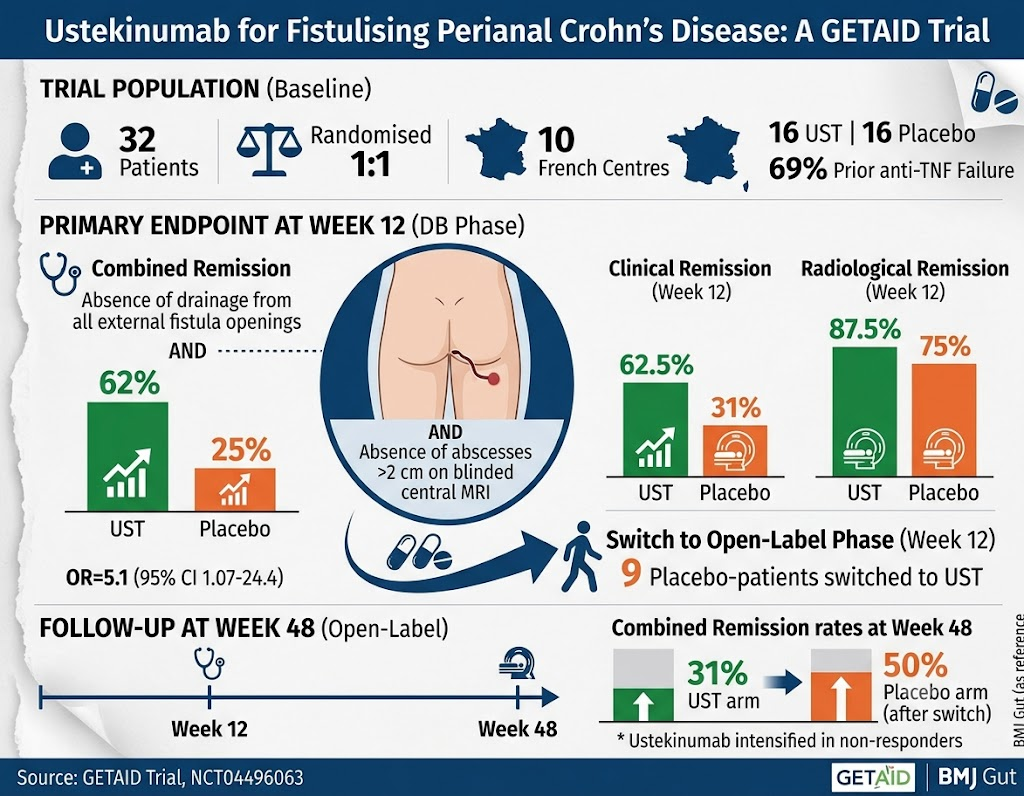
At week 12, combined clinical and radiological remission was significantly higher with ustekinumab (62%) than with placebo (25%); odds ratio 5.1 (95% CI 1.07–24.4).
Clinical remission alone and radiological remission alone did not reach statistical significance individually.
Long-term open-label data at week 48 showed lower combined remission rates in both arms, and safety data were not reported in the abstract.
Study snapshot
Design: Double-blind, placebo-controlled, multicenter randomized trial (GETAID, France).
Population: 32 patients with active fistulising perianal Crohn's disease; 69% had prior anti-TNF failure.
Intervention: Ustekinumab 6 mg/kg IV at baseline, then 90 mg SC at week 8 and every 8 weeks.
Comparator: Placebo IV/SC on same schedule.
Primary endpoint: Combined clinical remission (no drainage from external openings) and radiological remission (no abscess >2 cm on blinded MRI) at week 12.
Key result: Ustekinumab 62% vs placebo 25% (OR 5.1, 95% CI 1.07–24.4; p value not reported).
Limitations: Very small sample; wide CIs; open-label extension; incomplete long-term data; no safety details.
What the trial asked
Fistulising perianal Crohn's disease is a particularly debilitating phenotype, often leading to pain, purulent drainage, abscess formation, and impaired quality of life. Medical therapies are limited; anti-tumour necrosis factor (anti-TNF) agents are the mainstay but many patients lose response or are intolerant. Ustekinumab, an interleukin-12/23 inhibitor, is approved for moderate-to-severe luminal Crohn's disease, but randomized evidence for its effect on perianal fistulas has been scarce. This phase 3-like trial (NCT04496063) asked whether ustekinumab, added after standardized surgical management, could induce combined clinical and radiological fistula remission more effectively than placebo.
Why the question matters
Perianal fistulas affect up to one-third of patients with Crohn's disease and are associated with a chronic relapsing course. Achieving both fistula closure (clinical remission) and resolution of deeper inflammatory tracts or abscesses (radiological remission) is considered a more stringent and potentially durable endpoint. If ustekinumab could improve these outcomes, it might offer a valuable second-line or alternative biologic for a condition with limited proven options.
How the study was conducted
Investigators from the Groupe d'Etudes Thérapeutiques des Affections Inflammatoires Digestives (GETAID) conducted a double-blind, placebo-controlled, randomized trial at 10 French centers. Eligible patients had active Crohn's disease with at least one draining perianal fistula despite or after surgical fistulotomy or seton placement. Prior anti-TNF exposure was allowed but not required. Patients were randomly assigned 1:1 to receive intravenous ustekinumab (6 mg/kg) at baseline followed by subcutaneous ustekinumab 90 mg at week 8 and every 8 weeks thereafter, or matching placebo. All patients underwent standardized surgical management (examination under anesthesia, seton if needed) before randomization. The primary endpoint was the proportion achieving both clinical remission (no drainage from any external opening, even with gentle finger compression) and radiological remission (no fluid collection >2 cm on blinded central read MRI) at week 12. Secondary endpoints included clinical remission alone, radiological remission alone, and changes in fistula drainage. After the 12-week placebo-controlled phase, non-responders in the placebo arm could switch to open-label ustekinumab, and non-responders in the ustekinumab arm could dose intensify (every 4 weeks). A total of 32 patients were enrolled, 16 per arm. Median follow-up for the primary analysis was 12 weeks, with open-label extension to week 48.
What the trial found
At week 12, the primary endpoint of combined clinical and radiological remission was achieved in 10 of 16 patients (62%) receiving ustekinumab compared with 4 of 16 (25%) receiving placebo, yielding an odds ratio of 5.1 (95% confidence interval 1.07 to 24.4). The absolute difference was 37 percentage points. Clinical remission alone occurred in 62.5% of ustekinumab-treated patients versus 31% of placebo patients (OR 3.75, 95% CI 0.84 to 16.8), and radiological remission alone was seen in 87.5% versus 75% (OR 2.7, 95% CI 0.34 to 21.1). Neither of these individual secondary endpoints reached statistical significance, though the study was not powered for them. During the open-label phase, nine placebo patients crossed over to ustekinumab. At week 48, combined remission rates were 50% in the original placebo arm (including those who switched) and 31% in the continuous ustekinumab arm. No p values or confidence intervals were reported for week 48 comparisons. The trial did not report data on individual fistula count, drainage volume, quality of life, or biomarker changes.
Safety and tolerability
The abstract publication does not provide any safety or adverse event data. In previous clinical trials of ustekinumab for luminal Crohn's disease, the safety profile has been generally favorable, with nasopharyngitis, headache, and injection-site reactions being the most common adverse events, and no new safety signals were identified. However, without source-specific safety results for this perianal fistula population, tolerability in this specific context remains unknown.
What the results mean
The trial met its primary endpoint, demonstrating a statistically significant improvement in combined fistula remission with ustekinumab over placebo at 12 weeks. The odds ratio of 5.1 suggests a large effect size, but the wide confidence interval (1.07 to 24.4) reflects the small sample and imprecise estimate. The absolute risk difference of 37 percentage points is clinically notable. However, the lack of statistical significance for individual clinical or radiological remission components tempers interpretation, as the composite may be driven by both components moving in the same direction but neither individually robust. The week 48 open-label data are difficult to interpret: the lower remission rate in the continuous ustekinumab arm (31%) compared with the placebo-crossover arm (50%) suggests possible attrition, non-response, or lack of durability in some patients, but the small numbers and non-randomized comparison preclude conclusions. Importantly, the trial included standardized surgical management in all patients, which is consistent with best practice but means the results reflect a combined medical-surgical approach rather than medical therapy alone.
Important limitations
Several limitations must be considered. First, the total sample of 32 patients is very small for a randomized trial, leading to wide confidence intervals and a high risk of chance findings. Second, p values were not reported for the primary endpoint, though the confidence interval for the odds ratio excludes 1.0. Third, the open-label design after week 12 and the small numbers at week 48 limit long-term interpretation. Fourth, no safety data are available from this abstract. Fifth, the study was conducted only in France, and the population had high prior anti-TNF exposure (69%), potentially limiting generalizability to other settings. Sixth, the composite endpoint, while stringent, has not been validated as a surrogate for long-term fistula healing, and radiological definitions of remission vary. Finally, the trial does not report patient-reported outcomes, quality of life, or functional assessments.
Implications for patients and clinicians
This trial provides some of the highest-quality randomized evidence to date supporting the use of ustekinumab for healing perianal fistulas in Crohn's disease. For clinicians managing patients with active draining fistulas despite adequate surgical drainage, ustekinumab may be a reasonable option, particularly in those who have failed anti-TNF therapy. The short-term benefit at 12 weeks appears promising, but clinicians should be cautious about durability given the week 48 results. Larger confirmatory trials with longer follow-up, validated endpoints, and comprehensive safety reporting are needed. Patients should be counseled that the evidence comes from a small study and that combined medical-surgical management remains standard. The trial underscores the importance of dedicated fistula trials with stringent endpoints in Crohn's disease.
Funding and trial registration
The study was sponsored by the Groupe d'Etudes Thérapeutiques des Affections Inflammatoires Digestives (GETAID). The trial is registered at ClinicalTrials.gov under identifier NCT04496063. No additional funding or conflict-of-interest information was provided in the abstract.
References
Wils P, Nancey S, Messmer E, et al. Ustekinumab for fistulising perianal Crohn's disease: a randomised placebo-controlled trial from the GETAID. Gut. 2026. PMID: 42498622. https://pubmed.ncbi.nlm.nih.gov/42498622/