High-Intensity Resistance Training Improves Lower Limb Strength More Than Low-Moderate Intensity in Older Adults
Highlights
High-intensity resistance training (≥70% 1RM) significantly outperforms low-to-moderate intensity (<70% 1RM) for improving lower limb muscle strength in adults aged 50 years and older.
No significant difference between training intensities was observed for lumbar spine or femoral neck bone mineral density.
Fall incidence and adverse event rates were similar between intensity groups, suggesting comparable safety profiles.
Study Snapshot
Design: Systematic review and meta-analysis of randomized controlled trials.
Population: 1283 older adults (≥50 years) across 18 studies.
Intervention: High-intensity resistance training (≥70% one-repetition maximum) vs low-to-moderate-intensity resistance training (<70% 1RM).
Primary Outcomes: Lower limb muscle strength (leg press, leg extension), lumbar spine BMD, femoral neck BMD.
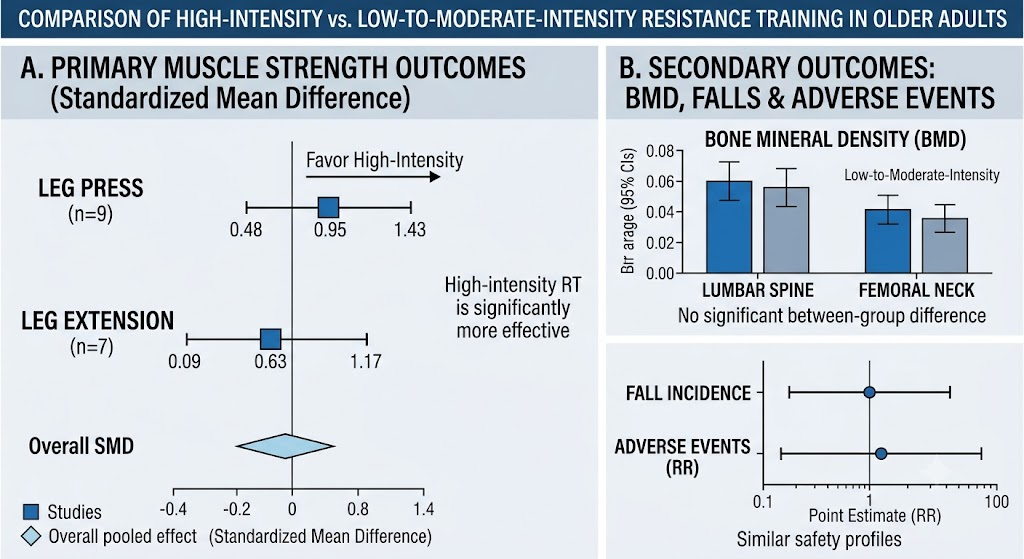
Key Results: High-intensity RT superior for leg press (SMD 0.95; 95% CI 0.48–1.43) and leg extension (SMD 0.63; 95% CI 0.09–1.17). No significant between-group differences for BMD at lumbar spine (SMD 0.28; 95% CI −0.02 to 0.58) or femoral neck (SMD 0.13; 95% CI −0.08 to 0.33).
Limitations: Call for further RCTs with standardized protocols; BMD improvements not statistically significant; wide CIs for fall and adverse event comparisons.
Background
Sarcopenia and osteoporosis are prevalent age-related conditions that contribute to frailty, functional decline, falls, and fracture risk. Resistance training (RT) is widely recommended to counteract these declines, yet the optimal training intensity for older adults remains debated. Low-to-moderate intensity programs are often prescribed due to perceived safety concerns, whereas high-intensity RT may yield greater neuromuscular adaptations. This systematic review and meta-analysis by Shen and colleagues, published in Geriatrics & Gerontology International, provides a comprehensive comparison of high-intensity versus low-to-moderate-intensity RT on muscle strength and bone mineral density in adults aged 50 years and older.
Key Advances
Strength Outcomes
The pooled analysis of 18 randomized controlled trials involving 1283 participants demonstrated statistically significant superiority of high-intensity RT for lower limb strength. The standardized mean difference for leg press was 0.95 (95% CI 0.48–1.43) and for leg extension was 0.63 (95% CI 0.09–1.17), indicating moderate-to-large effect sizes favoring the high-intensity regimen. These findings support the principle that higher mechanical loading drives greater neural and hypertrophic adaptations, even in older populations.
Bone Density and Safety
In contrast to muscle strength, the meta-analysis did not find a statistically significant difference between intensity groups for lumbar spine BMD (SMD 0.28; 95% CI −0.02 to 0.58) or femoral neck BMD (SMD 0.13; 95% CI −0.08 to 0.33). Both intensity modalities appeared similarly effective at maintaining BMD over the study periods. Regarding safety, the risk ratio for falls (RR 2.68; 95% CI 0.65–11.11) and adverse events (RR 2.42; 95% CI 0.66–8.88) showed no significant difference, though confidence intervals were wide due to low event numbers. The authors noted that adverse events were generally mild and did not lead to discontinuation.
Expert Commentary
The clear benefit in lower limb strength has direct clinical relevance, as leg strength is a key determinant of mobility, balance, and fall prevention in older adults. Although the BMD results were not statistically significant, the trends favored high-intensity training, and longer-duration trials may be needed to detect skeletal changes. Importantly, the safety data suggest that appropriately supervised high-intensity RT is not associated with a higher rate of adverse events than lower-intensity programs, addressing a common concern among clinicians. However, the wide confidence intervals for fall incidence preclude definitive conclusions about fall risk, and the review authors appropriately call for further well-designed trials with standardized protocols and larger samples.
Clinical and Translational Implications
These findings support a shift toward prescribing higher-intensity resistance training for older adults who can safely participate, particularly when the goal is to maximize muscle strength. Practitioners should consider individualization based on baseline fitness, comorbidities, and access to supervised settings. The lack of a significant BMD advantage suggests that high-intensity RT alone may not be sufficient to improve bone density beyond lower-intensity training; combined approaches including weight-bearing exercise or pharmacological therapy may be necessary for osteoporosis management. The similar safety profile is reassuring and should encourage more widespread adoption of high-intensity protocols in geriatric exercise programs.
Conclusion
This systematic review and meta-analysis provides robust evidence that high-intensity resistance training is superior to low-to-moderate-intensity training for improving lower limb muscle strength in older adults, with comparable effects on bone mineral density and no apparent increase in falls or adverse events. These results support the inclusion of high-intensity RT in exercise guidelines for older populations, while highlighting the need for additional trials to refine intensity thresholds, optimize protocols, and assess long-term functional outcomes such as fracture prevention.
References
Shen YC, Chen KH, Hou WH, et al. Effectiveness of High-Intensity Versus Low-To-Moderate-Intensity Resistance Training in Improving Muscle Strength and Bone Mineral Density in Older Adults: A Systematic Review and Meta-Analysis of Randomized Controlled Trials. Geriatr Gerontol Int. 2026;26(7):e70607. doi:10.1111/ggi.70607. PMID: 42366614.
This article was created using several editorial tools, including AI, as part of the process. Human editors reviewed this content before publication.