Immediate Endoscopic Necrosectomy Shortens Recovery Time in Necrotizing Pancreatitis Without Increasing Complications
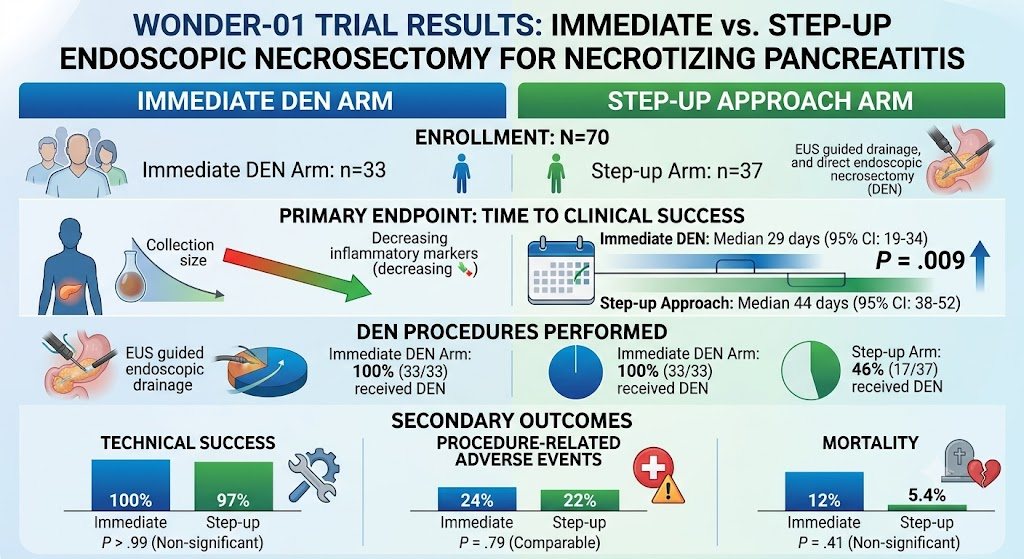
In patients with symptomatic necrotizing pancreatitis undergoing EUS-guided drainage, immediate direct endoscopic necrosectomy (DEN) reduced median time to clinical success to 29 days vs 44 days with a drainage-oriented step-up approach (P=0.009).
All patients in the immediate DEN arm underwent the procedure versus 46% in the step-up arm, yet adverse event rates were similar (24% vs 22%).
Mortality and technical success did not differ significantly between groups, but the immediate approach required more invasive interventions.
Study snapshot
Design: Multicenter, open-label, superiority randomized controlled trial (WONDER-01)
Population: 70 patients with symptomatic necrotizing pancreatitis undergoing EUS-guided transmural drainage
Intervention: Immediate direct endoscopic necrosectomy (DEN) after drainage (n=33)
Comparator: Drainage-oriented step-up approach (DEN performed on demand if needed; n=37)
Primary endpoint: Time from randomization to clinical success (collection ≤3 cm plus improvement in inflammatory markers)
Results: Median time to success: 29 days (95% CI 19–34) vs 44 days (95% CI 38–52); hazard ratio not reported; log-rank P=0.009
Adverse events: Procedure-related: 24% vs 22% (P=0.79); mortality: 12% vs 5.4% (P=0.41)
Registration: ClinicalTrials.gov NCT05451901
What the trial asked
The WONDER-01 randomized controlled trial, conducted by the WONDERFUL study group in Japan, asked whether performing direct endoscopic necrosectomy (DEN) immediately after endoscopic ultrasound (EUS)-guided transmural drainage for symptomatic necrotizing pancreatitis could speed up recovery compared with the conventional step-up approach that reserves DEN for patients who do not respond to drainage alone.
Why the question matters
Necrotizing pancreatitis is a severe complication of acute pancreatitis with high morbidity and mortality. When infected necrosis or persistent symptoms develop, minimally invasive endoscopic drainage is often the first step. However, the optimal timing of necrosectomy—whether to perform it immediately or wait to see if drainage alone suffices—has been debated. A strategy that accelerates resolution without increasing harm could shorten hospital stays, reduce resource use, and improve patient outcomes.
How the study was conducted
This open-label, multicenter trial enrolled 70 adults with symptomatic necrotizing pancreatitis (≥30% necrosis on imaging or at least 5 cm collection on CT) who were eligible for EUS-guided transmural drainage. Patients were randomly assigned 1:1 to either immediate DEN (necrosectomy within 4 days of drainage) or a drainage-oriented step-up approach (DEN only if drainage failed to achieve clinical success). Randomization was stratified by center and necrosis extent. The primary endpoint was time from randomization to clinical success, defined as collection size ≤3 cm on imaging plus improvement in inflammatory markers (C-reactive protein or white blood cell count). Key secondary endpoints included technical success, adverse events, mortality, and number of necrosectomy sessions.
What the trial found
Immediate DEN significantly shortened the median time to clinical success: 29 days (95% CI 19–34) versus 44 days (95% CI 38–52) in the step-up arm (log-rank P=0.009). All patients in the immediate DEN arm underwent the procedure, compared with 46% in the step-up arm. Technical success was high in both groups (100% vs 97%; P>0.99). The number of necrosectomy sessions was greater in the immediate arm (mean not reported, but all received at least one).
Safety and tolerability
Rates of procedure-related adverse events were similar: 24% in the immediate DEN arm vs 22% in the step-up arm (P=0.79). Serious adverse events were not detailed in the abstract but overall mortality was 12% (4/33) vs 5.4% (2/37), a difference that did not reach statistical significance (P=0.41). The trial was not powered to detect differences in mortality or rare adverse events.
What the results mean
The data suggest that for patients who require endoscopic drainage of necrotizing pancreatitis, proceeding directly to necrosectomy without a watchful waiting period can halve the time to collection resolution and clinical improvement. The trade-off is that more patients undergo an invasive procedure—some of whom might have been spared with a step-up approach. The comparable safety profile, however, indicates that performing immediate DEN does not carry excessive risk. Because the trial was open-label and the primary endpoint involves subjective elements (inflammatory marker improvement), some bias is possible, but the imaging criterion (≤3 cm) provides an objective anchor.
Important limitations
First, the sample size is small (70 patients), and the confidence intervals for the primary endpoint are wide (29 vs 44 days), meaning the true effect could be smaller or larger. Second, the open-label design may have influenced clinical decisions about when success was declared. Third, all centers were in Japan, potentially limiting generalizability to other healthcare systems. Fourth, the trial did not report the hazard ratio for the primary endpoint, making it harder to gauge effect size precisely. Finally, longer-term outcomes such as recurrence, quality of life, and pancreatic function were not reported in the abstract.
Implications for patients and clinicians
For interventional endoscopists treating necrotizing pancreatitis, the WONDER-01 trial provides evidence that early necrosectomy is a reasonable strategy that can accelerate clinical improvement. Shared decision-making should weigh the patient's preference for a faster recovery against the desire to avoid an unnecessary procedure. The findings support considering immediate DEN as a first-line approach in eligible patients, but larger, blinded trials are needed to confirm these results and assess longer-term outcomes.
Funding and trial registration
The trial was registered at ClinicalTrials.gov under NCT05451901. Funding details were not provided in the abstract but are expected in the full publication. The study was conducted by the WONDERFUL study group in Japan.
References
Saito T, Fujisawa T, Ogura T, et al. Immediate or On-Demand Endoscopic Necrosectomy for Necrotizing Pancreatitis: A Randomized Controlled Trial (WONDER-01). Gastroenterology. 2026;171(1):140-153. PMID: 41720198.
This article was created using several editorial tools, including AI, as part of the process. Human editors reviewed this content before publication.