MIND Diet Linked to Lower Cancer Risk and Reduced Mortality, With New Genetic Insights
Highlights
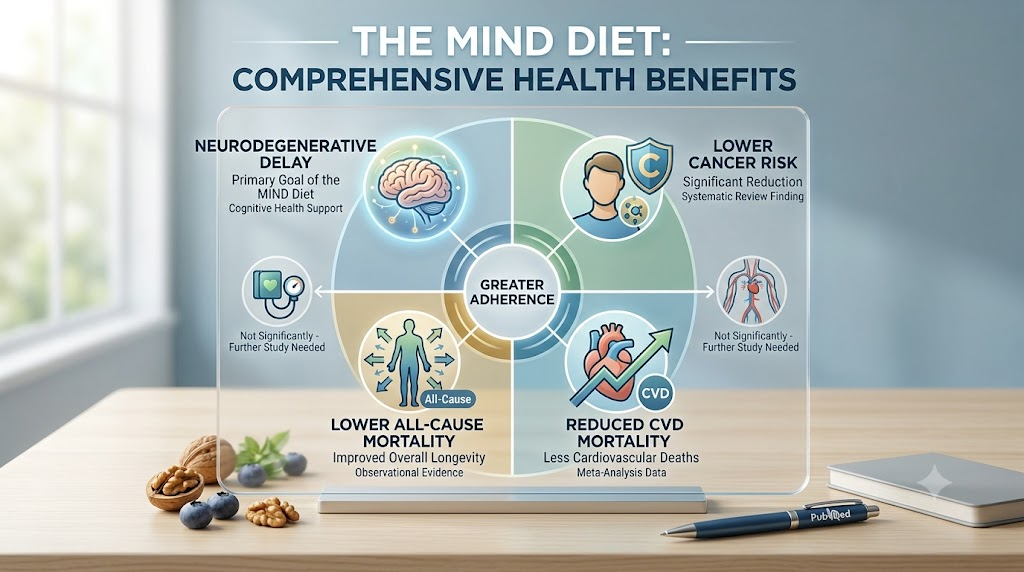
Higher adherence to the MIND diet was associated with a 55% reduced risk of cancer (RR 0.45) in a meta-analysis of observational studies.
All-cause mortality risk fell by 14% (RR 0.86) and CVD mortality by 22% (RR 0.78) with greater MIND diet adherence.
The MIND trial has released a genetic resource enabling studies on gene–diet interactions and cognitive outcomes.
Background
The Mediterranean-DASH Intervention for Neurodegenerative Delay (MIND) diet is a hybrid of the Mediterranean and DASH dietary patterns, emphasizing green leafy vegetables, berries, nuts, whole grains, fish, poultry, and olive oil while limiting red meat, butter, cheese, sweets, and fried foods. Originally designed to protect against cognitive decline, the MIND diet has shown promise in observational studies for broader health outcomes. However, evidence from randomized trials is limited, and the biological mechanisms remain incompletely understood.
Two recently published studies advance the evidence base. The first is a comprehensive meta-analysis examining associations between the MIND diet and the risk of cancer, cardiovascular diseases (CVD), hypertension, and mortality. The second presents the first genetic resource derived from the MIND trial itself, offering tools for precision nutrition research in cognitive health.
Key Advances
MIND Diet and Chronic Disease Risk
Ahmadirad et al. conducted a systematic review and meta-analysis of 23 observational studies, including data on cancer, CVD, hypertension, all-cause mortality, and CVD mortality. Pooled results showed that higher adherence to the MIND diet was significantly associated with a lower risk of cancer (RR 0.45; 95% CI 0.31–0.65; p<0.001), all-cause mortality (RR 0.86; 95% CI 0.81–0.92; p<0.001), and CVD mortality (RR 0.78; 95% CI 0.67–0.90; p=0.001). No significant associations were observed for hypertension (RR 0.88; 95% CI 0.76–1.03) or CVD incidence (RR 0.86; 95% CI 0.68–1.08).
Moderate-to-substantial heterogeneity was present for mortality outcomes (I²=74% for all-cause; I²=71.4% for CVD mortality), and the authors noted a moderate risk of bias across included studies. The results should be interpreted cautiously given the observational nature of the underlying evidence.
The results of individual case-control studies and the pooled effect size are indicated in Fig. 2. In five case-control studies (five publications) with 3,147 participants, 1268 cancer cases were seen. The range of OR across the studies was 0.25–1.32. Of the five included studies, four studies found an inverse association between the MIND diet score and cancer risk; however, just one study did not find a significant association between the MIND-cancer relationship. Greater adherence to the MIND (highest vs. lowest category for MIND diet scores) was associated with a lower risk of cancers (RR: 0.45, 95% CI: 0.31–0.65; P < 0.001), with non-significant heterogeneity (I2 = 43.9%, P-heterogeneity = 0.129). A visual inspection of the funnel plots and Egger’s tests indicated that there was no publication bias in this relationship (P-value = 0.754) (Supplementary Fig. 1). Based on the sensitivity analysis using a random-effects model, after removing each study, no significant change in the pooled effect size of the relationship between MIND diet score and cancer (range: 0.40–0.51) (Supplementary Table 5).
Fig. 2.

The association of Mediterranean-DASH Intervention for Neurodegenerative Delay (MIND) diet score with the risk of cancers in qualified studies
Meta-analysis on the MIND diet score and CVDs
The results of five studies with 1,564 cases of CVDs among 21,620 participants are shown in Fig. 3. The pooled effect size of these studies indicated that there is no significant association between MIND diet score and risk of CVDs (RR: 0.86, 95% CI: 0.68–1.08; P = 0.200); however, there was significant heterogeneity (I2 = 82.4%, P-heterogeneity < 0.001). A visual inspection of the funnel plots and Egger’s test elicited no pronounced publication bias (P-value = 0.163) (Supplementary Fig. 2). Sensitivity analyses after removing any study in the association between MIND diet score and the risk of CVDs indicated that the pooled effect size of this meta-analysis becomes non-significant by omitting each included study except for studies conducted by Livingstone et al. (RR: 0.79, 95% CI: 0.67–0.94) (Supplementary Table 6).
Fig. 3.

The association of Mediterranean-DASH Intervention for Neurodegenerative Delay (MIND) Diet score with the risk of cardiovascular diseases in qualified studies
Genetic Resource From the MIND Trial
Liu et al. described the generation of a genetic dataset from 552 MIND trial participants (494 of European ancestry, 58 of African ancestry). DNA was extracted from blood or serum and genotyped using the Infinium Global Diversity Array. Imputation was performed using 1000 Genomes Phase 3 v5. The imputed APOE genotypes showed 98.2% concordance with gold-standard sequencing, and several known genetic associations were replicated, including variants linked to adiponectin, alpha-linolenic acid, and alpha-tocopherol. This resource is now available for investigating how genetic variation may modify the cognitive response to the MIND diet and for integrative analyses with other omics data.
Expert Commentary
The meta-analysis by Ahmadirad et al. provides the most comprehensive synthesis to date of observational studies on the MIND diet and major chronic outcomes. The strong inverse association with cancer risk (55% reduction) is noteworthy, but this finding is based on a limited number of studies and may be influenced by residual confounding, as individuals with higher MIND diet adherence often have healthier lifestyles overall. The null results for hypertension and CVD incidence highlight a gap between dietary patterns and disease endpoints that requires further investigation.
The genetic resource from the MIND trial is a valuable step toward understanding individual variability in dietary response. By enabling studies of gene–diet interactions, this dataset could help identify subgroups that benefit most from the MIND diet and elucidate biological pathways linking nutrition to cognitive decline. However, the sample size is modest, and ancestry diversity is limited, which may restrict the generalizability of future analyses.
Clinical and Translational Implications
For clinicians, the MIND diet continues to emerge as a dietary pattern associated with reduced risk of cancer and premature mortality. While randomized controlled trial data remain scarce, the consistency of observational evidence supports recommending MIND diet principles to patients as part of a heart-healthy and cancer-preventive lifestyle. The genetic insights from the MIND trial may eventually lead to personalized dietary advice for cognitive health, but such applications are not yet ready for clinical practice. Clinicians should be aware that the MIND diet is generally safe and aligns with existing dietary guidelines.
Conclusion
Current evidence from observational studies suggests that higher adherence to the MIND diet is associated with lower cancer risk and reduced all-cause and CVD mortality, though the data are limited by heterogeneity and potential bias. The MIND trial's genetic resource opens new avenues for precision nutrition research. Future randomized controlled trials with longer follow-up and more diverse populations are needed to confirm these associations and clarify the mechanisms by which the MIND diet may protect against chronic disease and cognitive decline.
References
Shen YC, Chen KH, Hou WH, et al. Effectiveness of high-intensity versus low-to-moderate-intensity resistance training in improving muscle strength and bone mineral density in older adults: a systematic review and meta-analysis of randomized controlled trials. Geriatr Gerontol Int. 2026;26(7):e70607. doi:10.1111/ggi.70607. PMID: 42366614.
Liu Y, Fowler H, Wang DD, Barnes LL, Cornelis MC. Mediterranean-DASH Intervention for Neurodegenerative Delay (MIND) trial: genetic resource for precision nutrition. Nutrients. 2025;17(15):2548. doi:10.3390/nu17152548. PMID: 40806132.
Ahmadirad H, Pasdar Y, Moludi J, et al. The Mediterranean-DASH Intervention for Neurodegenerative Delay (MIND) diet and the risk of cancer, cardiovascular diseases, hypertension, all-cause, and cardiovascular diseases mortality: a systematic review and meta-analysis of observational studies. Nutr Metab (Lond). 2026;23(1):79. doi:10.1186/s12986-026-01135-y. PMID: 42135789.
This article was created using several editorial tools, including AI, as part of the process. Human editors reviewed this content before publication.