Sarcopenic Obesity and Type 2 Diabetes Risk: Insights from the UK Biobank Study
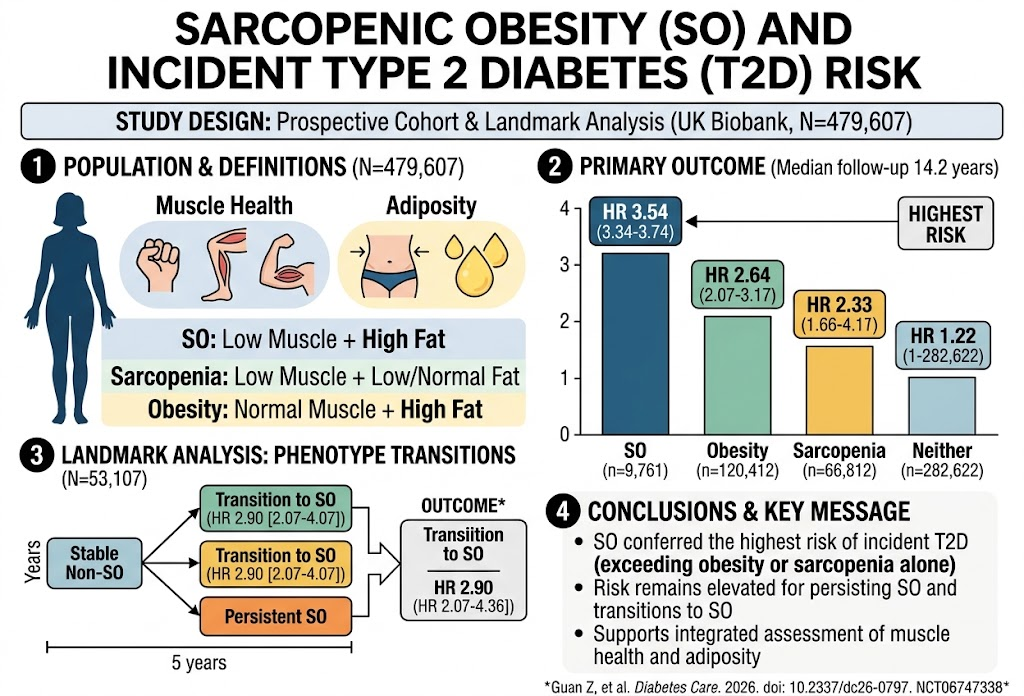
Highlight
- Sarcopenic obesity (SO) notably increases the incidence risk of type 2 diabetes (T2D) beyond that posed by obesity or sarcopenia alone.
- The UK Biobank cohort demonstrated the highest hazard ratio for T2D in participants with SO (HR 3.54), significantly higher than obesity-only or sarcopenia-only groups.
- Transitions into or persistence of SO over time are associated with sustained elevated risk for developing T2D.
- Findings support integrated clinical evaluation of muscle quality alongside adiposity measures for refined diabetes risk stratification.
Study Background
Type 2 diabetes (T2D) represents a major global public health challenge due to its rising prevalence and associated morbidity and mortality. While obesity is a well-established risk factor, the role of muscle mass and function, particularly within the context of sarcopenia (age-related loss of muscle mass and strength), has recently gained attention. Sarcopenic obesity (SO) – the concurrent presence of excess adiposity and reduced muscle mass/function – may synergistically exacerbate metabolic dysfunction, leading to higher T2D risk. However, large prospective cohort data quantifying this risk and its dynamics over time have been limited.
Study Design
This prospective cohort study analyzed 479,607 diabetes-free participants enrolled in the UK Biobank, a large population-based study in the United Kingdom. Sarcopenic obesity was defined using a composite metric including handgrip strength (a validated measure of muscle function), skeletal muscle mass-to-weight ratio, and fat mass percentage, enabling differentiation of muscle and adipose tissue contributions to body composition phenotypes.
Incident T2D was ascertained during a median 14.2 years of follow-up. Cox proportional hazards models were employed to estimate hazard ratios (HRs) for incident diabetes associated with SO compared to obesity or sarcopenia alone. A landmark analysis subset (n=53,107) assessed changes in phenotypes over time, evaluating risk associated with transitions between body composition states.
Key Findings
During follow-up, 32,948 participants developed T2D. The study found that participants with sarcopenic obesity had the highest adjusted risk of developing T2D (HR 3.54; 95% CI, 3.34–3.74), which substantially exceeded risks conferred by obesity alone or sarcopenia alone. This indicates that the co-presence of muscle impairment and adiposity results in multiplicative metabolic risk beyond either condition independently.
The landmark analysis further revealed that participants transitioning into sarcopenic obesity from other phenotypes also exhibited a markedly elevated diabetes risk (HR 2.90; 95% CI, 2.07–4.07). Those with persistent sarcopenic obesity over time maintained a high risk (HR 3.07; 95% CI, 1.63–5.79). These findings underscore the dynamic nature of body composition changes in diabetes pathogenesis.
Sex and age stratified analyses suggested consistent risk elevation associated with SO across demographic subsets, supporting broad applicability of these findings.
Expert Commentary
This study leverages one of the largest prospective cohorts with detailed phenotyping to clarify the combined impact of muscle health and adiposity on T2D risk. The inclusion of both muscle strength and muscle mass assessments strengthens the validity of the sarcopenia definition, avoiding reliance on a single surrogate. The results align with emerging evidence that muscle tissue plays a key role in glucose metabolism, insulin sensitivity, and systemic inflammation—all factors central to diabetes development.
Limitations include potential residual confounding inherent to observational designs and reliance on derived body composition metrics, which might differ in accuracy from gold standard imaging modalities. Nevertheless, the large sample size and length of follow-up confer strong statistical power and generalizability.
Clinical guidelines may consider incorporating assessment of muscle strength and body composition more routinely in metabolic risk evaluation, especially in aging populations where sarcopenia prevalence increases. Interventions targeting both adiposity reduction and muscle preservation/enhancement could be prioritized to mitigate diabetes risk.
Conclusion
This robust prospective evidence confirms that sarcopenic obesity is a potent risk factor for incident type 2 diabetes, surpassing the risks associated with either obesity or sarcopenia alone. Longitudinal changes in body composition further influence these risks, highlighting the need for dynamic clinical assessment approaches. Integrating muscle health evaluation with adiposity measures can enhance risk stratification and inform targeted prevention strategies to reduce the burden of T2D.
Funding and Clinical Trials
The UK Biobank study is supported by multiple public and research institutions, with no specific clinical trial registration applicable to this observational analysis.
References
1. Guan Z, Stephan BCM, Siervo M. Sarcopenic Obesity and Risk of Incident Type 2 Diabetes: A Prospective Cohort Study and Landmark Analysis from the UK Biobank. Diabetes Care. 2026 Sep 1;49(9):1663-1668. PMID: 42439362.
2. Park SW, Goodpaster BH, Lee JS, et al. Excessive loss of skeletal muscle mass in older adults with type 2 diabetes. Diabetes Care. 2009 Jun;32(6):959-64.
3. Srikanthan P, Hevener AL, Karlamangla AS. Sarcopenia exacerbates obesity-associated insulin resistance and dysglycemia. Aging (Albany NY). 2010;2(7): 551-555.
4. Baumgartner RN, Waters DL, Gallagher D, et al. Predictors of skeletal muscle mass in elderly men and women. Mech Ageing Dev. 1999 Aug 1;107(2):123-36.
This article was created using several editorial tools, including AI, as part of the process. Human editors reviewed this content before publication.