Trends in Spending on Corrective Lenses: An Evidence-Based Review on Expenditures, Barriers, and Policy Implications
Highlights
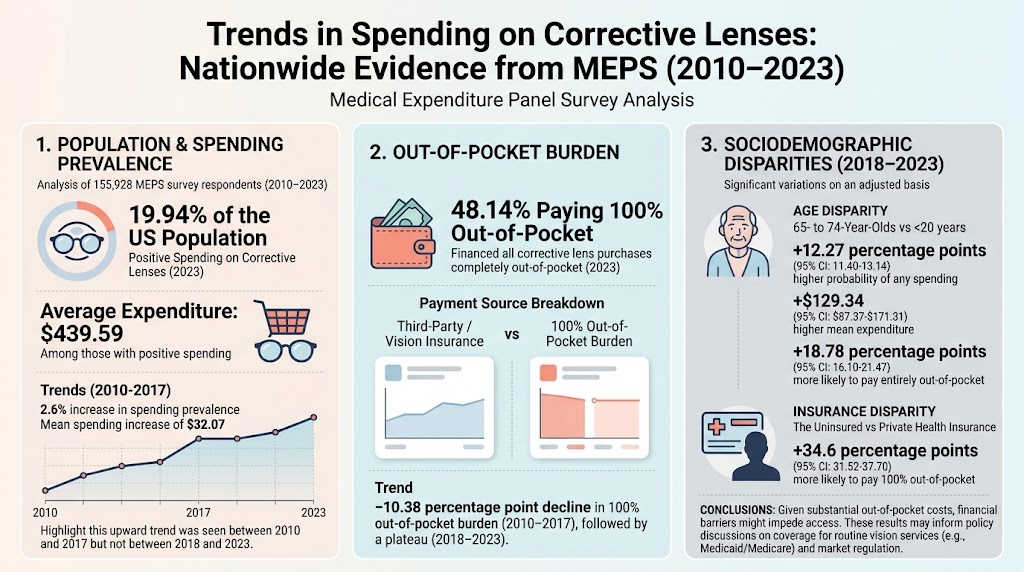
Nearly 20% of the US population incurred corrective lens expenditures in 2023, with an average spending exceeding $400.
Approximately half of individuals with corrective lens costs funded these entirely out-of-pocket, especially among older adults and the uninsured.
Interventions such as ready-made spectacles and subsidized distribution programs have demonstrated cost-effectiveness in improving spectacle uptake, particularly in children from low-resource settings.
Policy efforts targeting coverage of routine vision services and regulating eyewear markets are critical to reducing financial burdens and improving access.
Background
Refractive error affects around 50% of the global population, leading to visual impairment that is largely correctable with lenses. Despite the availability of corrective devices—spectacles, contact lenses, and intraocular lenses after cataract surgery—cost barriers and insurance coverage gaps impede access to proper vision correction. Spending patterns on corrective lenses, particularly in contexts lacking widespread vision insurance, influence usage rates, health outcomes, and quality of life. Understanding temporal trends and sociodemographic disparities in corrective lens expenditures is crucial for informing health policy and vision care service delivery.
Key Content
Temporal Trends in Corrective Lens Spending
Zuluaga et al. (2026) analyzed the Medical Expenditure Panel Survey data spanning 2010–2023 for over 155,000 respondents. They found that the proportion of individuals incurring any spending on corrective lenses rose modestly by about 2.6 percentage points between 2010 and 2017 but plateaued thereafter. The mean expenditure among those with positive spending increased by approximately $32 in the same interval. Nearly 20% of the population had positive expenditures in 2023, averaging $439.59 (SD $390.22), indicating considerable costs associated with corrective lenses.
Sociodemographic Variation in Spending and Payment Sources
Age emerged as a significant factor; adults aged 65–74 had a 12.3% higher likelihood of spending on corrective lenses and spent on average $129 more than younger individuals (≤20 years). Notably, nearly half of those with spending financed all purchases out-of-pocket, with the uninsured group 34.6 percentage points more likely to bear 100% out-of-pocket costs compared to privately insured peers. These findings emphasize that financial burden disproportionately affects older adults and the uninsured.
Cost Components and Comparative Effectiveness of Corrective Devices
Multiple studies evaluated cost and outcomes of corrective options:
Spectacles for children: Randomized controlled trials in India (Lake et al., 2017; 2019) demonstrated that ready-made spectacles, which are less expensive, had similar wear rates compared to custom-made spectacles, offering up to 58.6% cost savings per child in school-based programs. Education interventions (Peek system) facilitated adherence but the effect size on spectacle wear was moderate. Major barriers for spectacle wear included social stigma, bullying, and parental attitudes, especially in girls (Jia et al., 2019; Ramke et al., 2018).
Subsidized eyeglass distribution: A randomized trial in western China (Jia et al., 2022) showed that free school-based distribution with health education improved effective coverage and use of eyeglasses but requiring vouchers for redemption reduced uptake, highlighting the importance of delivery modality.
Low-cost autorefractors: A trial in India (Keel et al., 2021) validated a portable autorefractor device producing eyeglass prescriptions comparable to standard subjective refraction, supporting scalable, cost-efficient refraction in resource-limited settings.
Post-cataract surgery spectacles: Patients often require costly varifocal or reading glasses even after achieving emmetropia with intraocular lenses, with median costs around 980 CHF in Swiss cohorts (Al Ahmad et al., 2023). Better visual acuity and patient satisfaction were reported in multifocal intraocular lens recipients, though with differences in spectacle dependency (Gabrieli et al., 2017).
Cataract surgery techniques: While phacoemulsification yields superior visual outcomes and fewer complications compared to extracapsular cataract extraction (ECCE), its higher initial surgical cost can be offset by reduced social costs and downstream expenses such as eyeglasses and additional treatments (Griffiths et al., 2014; Monteiro et al., 2010).
Global Burden and Unmet Need in Presbyopia Correction
Presbyopia affects approximately 1.8 billion people worldwide, with nearly half lacking adequate vision correction, disproportionately in rural and low-resource settings (Naidoo et al., 2018). Sociodemographic and economic determinants influence correction coverage, with higher Human Development Index and urbanization associated with better spectacle coverage. Cost remains a significant barrier.
Evidence from Vision Screening Programs
Systematic reviews (Gugglberger et al., 2018) show vision screening combined with provision of free spectacles significantly improves spectacle wear among schoolchildren compared to screening with prescription only. However, health education alone adds limited benefits in increasing adherence to spectacle use. Ready-made spectacles represent a cost-saving alternative without compromising wear or vision outcomes.
Expert Commentary
The aggregated evidence underscores the substantial financial burden corrective lenses impose, particularly due to out-of-pocket payments prevalent among older adults and uninsured populations in the United States. Despite incremental increases in spending, no notable progress was observed in reducing out-of-pocket financing from 2018 to 2023.
Cost-minimization strategies such as ready-made spectacles for children demonstrate significant potential to lower program costs globally without adversely impacting compliance or visual outcomes. Nonetheless, social factors like bullying and parental attitudes remain crucial barriers to spectacle wear, requiring integrative educational and community interventions.
Innovations like portable autorefractors and school-based voucher or free distribution programs have demonstrated efficacy in enhancing access and cost-effectiveness in diverse settings. Conversely, post-cataract surgical patients still bear high spectacle-related costs, indicating an unmet need for more affordable and accessible corrective solutions after surgery.
Policy discussions should consider extending routine vision service coverage under public insurance schemes (e.g., Medicaid, Medicare) and developing regulatory frameworks to enhance affordability and transparency within the vision care and eyewear markets. Surveillance of spending trends via national surveys remains critical for monitoring progress and informing targeted interventions.
Conclusion
Corrective lens expenditures affect a significant segment of the population, with financial barriers rooted in high out-of-pocket costs limiting access, especially among elderly and uninsured groups. Evidence supports cost-saving interventions such as ready-made spectacles in school-based programs and technological innovations to broaden refractive services. However, social determinants of adherence and the substantial costs of vision correction post-cataract surgery warrant ongoing attention.
Future research should focus on longitudinal assessments of spending trends, comprehensive cost-effectiveness analyses of emerging technologies and distribution models, and policy impact evaluations on coverage and equity in vision care. Addressing these gaps is essential for mitigating the financial burden of refractive error correction and improving visual health outcomes at population scale.
References
Zuluaga SL et al. Trends in Spending on Corrective Lenses. JAMA Ophthalmol. 2026; PMID: 42848386.
Lake JC et al. Spectacle wear among children in a school-based program for ready-made vs custom-made spectacles in India: A randomized clinical trial. JAMA Ophthalmol. 2017;135(6):527-533. PMID: 28426857.
Jia P et al. Ordeal mechanisms, information, and the cost-effectiveness of strategies to provide subsidized eyeglasses. J Health Econ. 2022;82:102594. PMID: 35193056.
Keel S et al. Investigation of the accuracy of a low-cost portable autorefractor to provide well-tolerated eyeglass prescriptions: A randomized crossover trial. Ophthalmology. 2021;128(12):1672-1680. PMID: 34111444.
Naidoo KS et al. Global prevalence of presbyopia and vision impairment from uncorrected presbyopia: systematic review, meta-analysis, and modelling. Ophthalmology. 2018;125(10):1492-1499. PMID: 29753495.
Al Ahmad A et al. Use of spectacles after cataract surgery. Klin Monbl Augenheilkd. 2023;240(4):408-414. PMID: 37164399.
Griffiths U et al. Phacoemulsification with posterior chamber intraocular lens vs extracapsular cataract extraction for age-related cataract. Cochrane Database Syst Rev. 2014;CD008812. PMID: 24474622.
Monteiro J et al. Social costs of two cataract surgical techniques in Brazil. Rev Saude Publica. 2010;44(5):957-62. PMID: 20802899.
Ramke J et al. Vision screening for correctable visual acuity deficits in school-age children and adolescents. Cochrane Database Syst Rev. 2018;2(2):CD005023. PMID: 29446439.
This article was created using several editorial tools, including AI, as part of the process. Human editors reviewed this content before publication.