Dynamic Immune Modulation by Pegylated Interferon-Alpha Post-NUC Withdrawal in Chronic Hepatitis B
Highlight
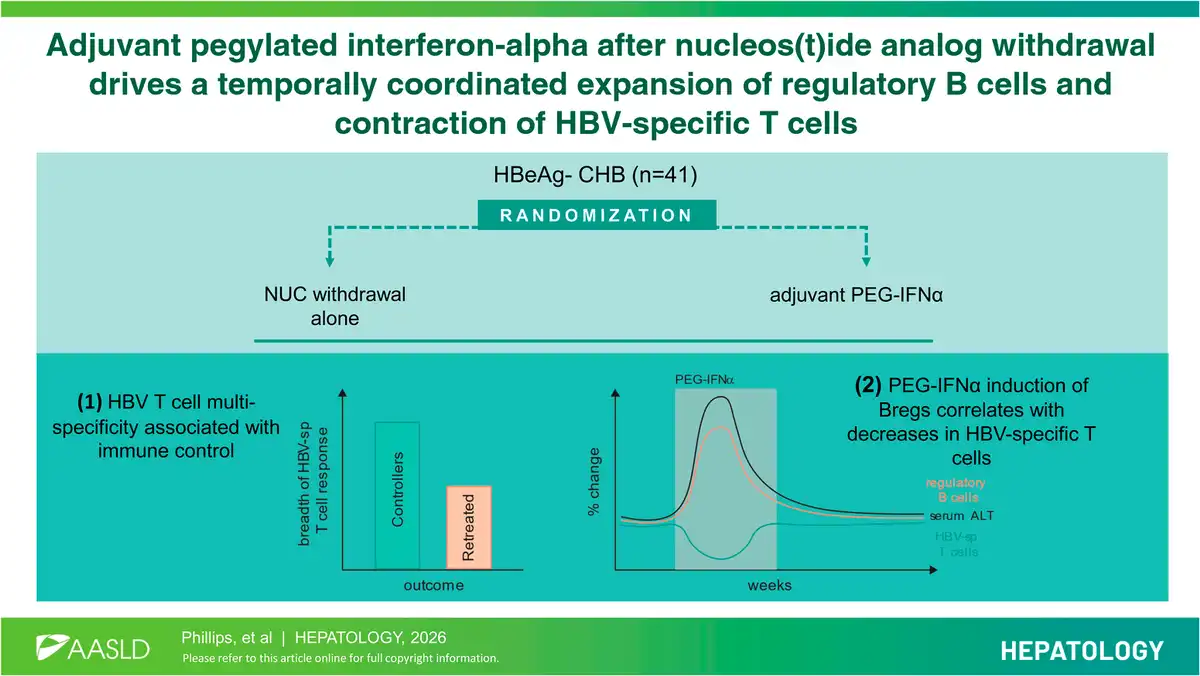
This study highlights the immunological consequences of adding pegylated interferon-alpha (PEG-IFNα) after nucleos(t)ide analog (NUC) withdrawal in HBeAg-negative chronic hepatitis B (CHB). Key findings include a broad baseline HBV-specific T cell response predicting better viral control and reduced flares, a transient contraction of HBV-specific T cells induced by PEG-IFNα, and a significant expansion of IL-10-producing regulatory B cells (Breg) temporally correlated with liver flares and inversely with HBV-specific T cells.
Study Background
Chronic hepatitis B virus (HBV) infection remains a global health challenge with considerable morbidity and mortality due to progressive liver disease and hepatocellular carcinoma. The current standard antiviral therapies, namely nucleos(t)ide analogs (NUCs), effectively suppress viral replication but require long-term administration with associated costs, potential side effects, and issues with patient adherence. NUC withdrawal strategies have been investigated to potentially induce sustained viral control without continuous therapy, but risk hepatic flares which may lead to liver damage.
Adjuvant immunomodulatory approaches, such as pegylated interferon-alpha (PEG-IFNα), have shown promise in improving outcomes after NUC discontinuation by enhancing antiviral immunity. However, the underlying immune mechanisms driving these effects require clarification, especially regarding the balance between protective virus-specific T cells and regulatory immune cells that modulate inflammation.
Study Design
The NUC-B study enrolled 41 representative patients with HBeAg-negative CHB undergoing NUC withdrawal, randomized to receive a 4-month course of adjuvant PEG-IFNα or observation. This substudy investigated the kinetics and interplay between HBV-specific T cells and regulatory B cells before and during treatment. HBV-specific T cells were analyzed using IFN-γ ELISpot assays with genotype-matched HBV core and small surface peptide pools and validated by multiparameter flow cytometry. Regulatory B cells (Breg) were quantified by flow cytometry, focusing on IL-10 production, a key immunosuppressive cytokine. Viral control, hepatic flare incidence, and immune correlates were examined longitudinally.
Key Findings
Baseline HBV-specific T cell breadth predicts favorable outcomes: Patients demonstrating a broader and stronger IFN-γ-producing HBV-specific T cell repertoire at baseline had higher rates of sustained virologic control off-treatment and lower risk of hepatic flares. This underscores the importance of robust cellular immunity in maintaining control following NUC cessation.
Pegylated IFNα transiently contracts HBV-specific T cell responses: Introduction of PEG-IFNα induced a notable but transient reduction in the frequency of HBV-specific T cells, which persisted beyond 1 month after treatment ended. This contraction might reflect immune regulation or functional modulation during interferon exposure rather than permanent loss of antiviral T cell responses.
Regulatory B cells expand substantially with PEG-IFNα: A more than five-fold expansion of IL-10-producing Breg was observed during PEG-IFNα therapy. The kinetic profile of Breg induction correlated temporally with hepatic flares in both PEG-IFNα and control arms. Notably, there was a significant inverse correlation over time between Breg expansion and HBV-specific T cell frequencies, suggesting Breg may exert suppressive effects on antiviral T cells to modulate inflammation and tissue injury.
Clinical implications: These findings suggest that baseline characterization of HBV-specific T cell immunity could guide patient selection for NUC withdrawal with or without PEG-IFNα. The expansion of regulatory B cells identifies a homeostatic feedback mechanism limiting immune-mediated hepatic damage but at the cost of transiently dampening virus-specific T cell activity.
Expert Commentary
The interplay between virus-specific cellular immunity and regulatory pathways plays a critical role in controlling HBV infection while minimizing liver inflammation. This study provides valuable insights into how pegylated interferon modulates immune subsets after antiviral withdrawal, an area of considerable interest for functional cure strategies.
The observed transient contraction of HBV-specific T cells post-PEG-IFNα may represent a window of immune exhaustion or regulatory suppression that clinicians should consider when timing therapy and monitoring response. The marked expansion of IL-10-producing Breg reinforces the importance of regulatory networks in balancing antiviral immunity and inflammatory damage, hinting at potential targets for adjunctive therapies to optimize therapeutic outcomes.
Limitations include the relatively small sample size and the focus on HBeAg-negative patients, which may limit direct generalizability to other CHB populations. Future larger studies should validate the predictive value of baseline T cell profiling and explore mechanistic interventions to modulate Breg activity favorably.
Conclusion
Adjuvant pegylated interferon-alpha after NUC withdrawal orchestrates a temporally coordinated immune response with expansion of IL-10-producing regulatory B cells and a transient lack of HBV-specific T cells. Baseline breadth of virus-specific T cell responses appears to predict successful off-treatment viral control. Understanding this immune balance offers pathways to improve management strategies aiming for finite, effective therapy and safe NUC discontinuation in chronic HBV.
Funding and ClinicalTrials.gov
The study was conducted by the NUC-B Study Group with funding sources and trial registration details presumably reported in the original publication. For further clinical trial information, refer to the cited PMID 42853556 and associated registry records.
References
Phillips S, Burton A, Cooksley H, Davies J, Harris N, Devshi D, Zope D, Raj N, Suveizdyte K, Falaschetti E, Box H, Habib M, Nastouli E, Kennedy PFL, Agarwal K, Message J, Thursz M, Chokshi S, Maini MK, NUC-B Study Group. Adjuvant pegylated interferon-alpha after nucleos(t)ide analog withdrawal drives a temporally coordinated expansion of regulatory B cells and contraction of HBV-specific T cells. Hepatology (Baltimore, Md.). 2026-10-09. PMID: 42853556. Available at: https://pubmed.ncbi.nlm.nih.gov/42853556/
This article was created using several editorial tools, including AI, as part of the process. Human editors reviewed this content before publication.