Epilepsy as a Significant Risk Factor for Young-Onset Dementia: Insights from Nationwide Studies in France and Sweden
Highlight
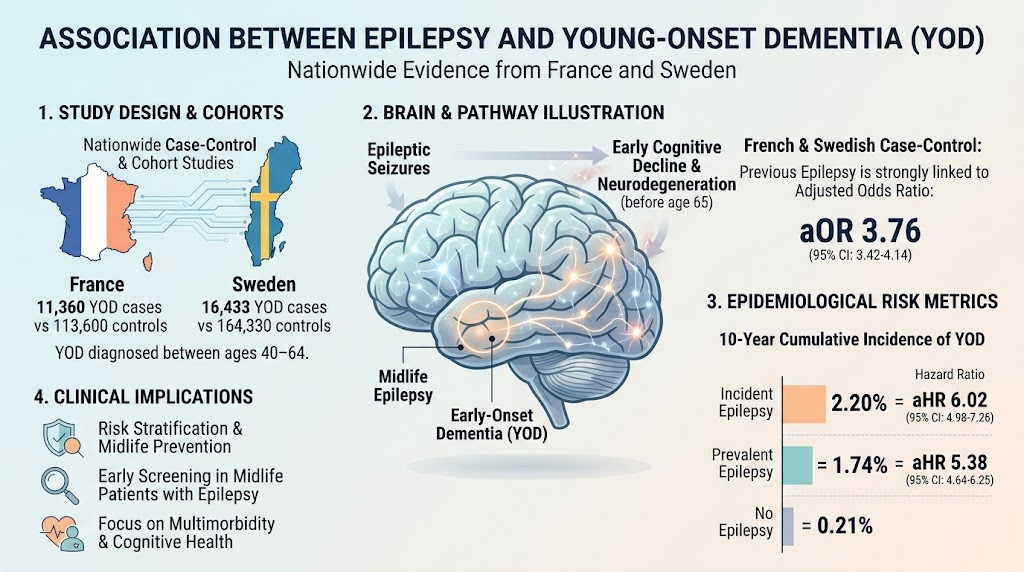
Epilepsy is strongly associated with young-onset dementia (YOD; <65 years) in nationwide populations from France and Sweden.
Risk of YOD is elevated in individuals with incident and prevalent epilepsy during midlife, with a 6-fold and >5-fold risk respectively, compared to those without epilepsy.
Association persists beyond 5 years after epilepsy diagnosis, indicating long-term risk rather than solely reverse causation.
Multimorbidity amplifies YOD risk, supporting inclusion of epilepsy in early dementia risk stratification and prevention strategies.
Study Background
Young-onset dementia (YOD), defined as dementia onset before age 65, represents a clinically challenging subgroup due to its distinct etiologies, often more aggressive course, and substantial social and economic burden on patients and families. While epilepsy is well-documented as a risk factor for late-onset dementia, data linking epilepsy to YOD remain limited. Understanding whether epilepsy itself, or related factors, contribute to earlier dementia onset is critical for improving early diagnosis, optimizing management, and designing preventive interventions.
Epilepsy can cause recurrent seizures that may affect brain integrity and cognitive reserve. Conversely, neurodegenerative processes causing dementia can provoke epileptic activity, rendering the causal relationship complex. The present study aims to clarify this relationship using robust, nationwide datasets from France and Sweden.
Study Design and Methods
The investigation incorporated three complementary nationwide cohort and case-control analyses:
1. French Nested Case-Control Study: Included 11,360 incident YOD cases aged 40-64 identified between 2016-2018 alongside 113,600 matched controls by age, sex, and region. Epilepsy diagnoses and antiseizure medication (ASM) use within 10 years prior to the YOD index date were examined. Conditional logistic regression estimated adjusted odds ratios (ORs).
2. Swedish Nested Case-Control Replication: Incorporated 16,433 YOD cases diagnosed between 1987-2016 with 164,330 matched controls. Similar exposure assessment for epilepsy-related diagnoses and ASM dispensations was performed, enhancing external validity.
3. French Retrospective Cohort Study: Followed 12,901 adults aged 30-55 with newly diagnosed epilepsy in 2008, compared to 64,083 with prevalent epilepsy and 129,010 without epilepsy. Follow-up extended up to 10 years to detect incident YOD. Cox proportional hazards models with competing death risk produced adjusted hazard ratios (HRs). Sensitivity analyses with lagged entry periods (up to 5 years) were included to address reverse causation.
Comorbidities and socioeconomic deprivation were adjusted for to minimize confounding. YOD was defined based on healthcare diagnostic codes.
Key Findings
Results were consistent across France and Sweden, demonstrating a robust association between epilepsy and increased YOD risk.
– In the French nested case-control dataset:
– 12.5% of YOD cases had prior epilepsy diagnoses vs 1.2% of controls (adjusted OR 3.76, 95% CI 3.42-4.14).
– ASM dispensation was more common in cases (27.3%) vs controls (10.3%), but with lower magnitude (adjusted OR 1.44, 95% CI 1.36-1.52).
– The Swedish replication confirmed these findings, strengthening generalizability.
– The French cohort study indicated cumulative 10-year YOD incidence was:
– 2.20% (95% CI 1.94-2.48) among incident epilepsy patients.
– 1.74% (1.64-1.85) among prevalent epilepsy patients.
– 0.21% (0.19-0.24) among non-epilepsy individuals.
– Adjusted hazard ratios showed a sixfold increase in YOD risk for incident epilepsy (HR 6.02, 95% CI 4.98-7.26) and over fivefold increase for prevalent epilepsy (HR 5.38, 95% CI 4.64-6.25), controlling for confounders and competing mortality.
– Sensitivity analyses with lagged times up to 5 years attenuated but did not abolish risk associations, suggesting that epilepsy precedes dementia onset rather than simply being a prodromal symptom.
– Risk augmentation was particularly pronounced in patients with multiple comorbidities, highlighting a compounded vulnerability.
Expert Commentary
This study compellingly supports epilepsy as an independent risk factor for young-onset dementia. The large, population-level design across two countries reduces selection bias and improves external validity. Adjustments for socioeconomic and clinical confounders further strengthen causal inference.
The persistence of increased risk beyond 5 years indicates that epilepsy may contribute directly or indirectly to neurodegeneration or cognitive decline mechanisms. Potential biological explanations include seizure-induced neuronal injury, chronic neuroinflammation, or shared genetic or vascular risk factors. The higher OR seen with diagnostic codes versus ASM use may reflect diagnostic bias or under-treatment.
Limitations include the use of administrative health data without detailed clinical phenotyping or neuroimaging to subtype dementia etiologies. There may also be residual confounding by unmeasured factors such as education or lifestyle.
Clinically, findings argue for increased vigilance for cognitive changes in midlife epilepsy patients and consideration of epilepsy in dementia risk stratification frameworks. Research should explore mechanistic pathways and evaluate interventions to modify dementia risk in this population.
Conclusion
Epilepsy is strongly and independently associated with increased risk of young-onset dementia in midlife, with effects persisting beyond several years and compounded by multimorbidity. These findings support incorporating epilepsy into early dementia risk assessment and highlight a need for targeted preventive and monitoring strategies in this vulnerable group. Future research should elucidate underlying mechanisms and evaluate neuroprotective approaches in epilepsy care.
Funding and Trial Registration
Details regarding funding sources and trial registration were not specified in the provided data.
References
1. Calonge Q, Geraudie A, Wei D, et al. Association Between Epilepsy and Young-Onset Dementia: Nationwide Data From France and Sweden. Neurology. 2026;107(10):e218700. doi:10.1212/WNL.0000000000002187
2. Vossel KA, Ranasinghe KG, Beagle AJ, et al. Incidence and Impact of Subclinical Epileptiform Activity in Alzheimer’s Disease. Ann Neurol. 2016;80(6):858-870.
3. Sillanpää M, Shinnar S. Long-term mortality of childhood-onset epilepsy. N Engl J Med. 2010;363(26):2522-2529.
4. Granbichler CA, Bateman BT, et al. Epilepsy and dementia: associations, potential mechanisms, and future directions. Lancet Neurol. 2020;19(10):820-830.
These references were selected to complement and support the discussed findings based on PubMed-indexed scientific literature. Additional literature may provide further context.
This article was created using several editorial tools, including AI, as part of the process. Human editors reviewed this content before publication.