HRS-7535: A Promising Oral GLP-1 Receptor Agonist for Type 2 Diabetes Uncontrolled by Metformin and SGLT2 Inhibitors
Highlights
HRS-7535, a novel oral GLP-1 receptor agonist, significantly reduces HbA1c in type 2 diabetes patients inadequately controlled on metformin and SGLT2 inhibitors.
The 60 mg dose of HRS-7535 showed greater efficacy, achieving mean HbA1c reduction of 1.8% compared to placebo and meaningful weight loss.
The safety profile was favorable with mostly mild to moderate gastrointestinal adverse events and no severe hypoglycemia reported.
Study Background
Type 2 diabetes mellitus is a chronic metabolic disorder characterized by insulin resistance and progressive beta-cell dysfunction, which poses a major global health burden. Despite existing therapies, including metformin and sodium-glucose co-transporter 2 inhibitors (SGLT2i), a significant subset of patients remain inadequately controlled, exposing them to risks of microvascular and macrovascular complications. Glucagon-like peptide-1 receptor agonists (GLP-1RAs) effectively improve glycaemic control and promote weight loss, but most available GLP-1RAs require subcutaneous injections, limiting patient adherence. The development of oral small-molecule GLP-1RAs could enhance convenience and accessibility, addressing an unmet need for more patient-friendly treatments in type 2 diabetes management.
Study Design
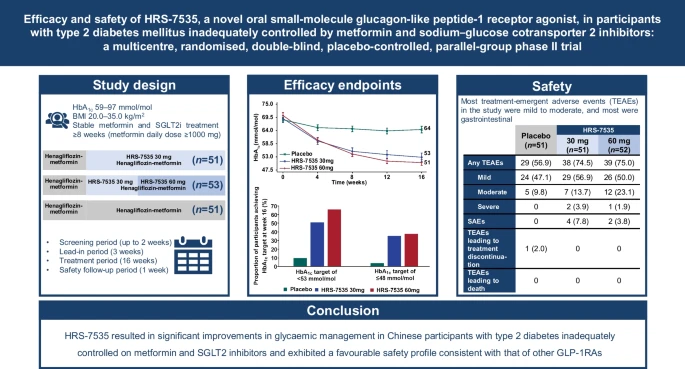
This multicentre, randomized, double-blind, placebo-controlled Phase II trial aimed to evaluate the efficacy and safety of HRS-7535, an oral small-molecule GLP-1 receptor agonist. The study enrolled 155 Chinese participants aged 18 to 75 years with type 2 diabetes mellitus inadequately controlled despite stable treatment with metformin and SGLT2 inhibitors for at least eight weeks. Inclusion criteria required baseline glycated hemoglobin A1c (HbA1c) between 7.5% and 11.0% and body mass index (BMI) between 20.0 and 35.0 kg/m2.
Participants were randomized in a 1:1:1 allocation to receive HRS-7535 at doses of 30 mg or 60 mg, or matching placebo once daily for 16 weeks, with randomization stratified by baseline characteristics and treatment allocation concealed until study completion. The primary endpoint was the change in HbA1c from baseline to week 16. Secondary endpoints included the proportions of participants achieving HbA1c targets of <7.0% and ≤6.5% and changes in fasting body weight. Safety assessments included monitoring treatment-emergent adverse events (TEAEs), hypoglycemia incidence, and laboratory evaluations.
Key Findings
Of the 155 randomized participants (mean baseline HbA1c 8.5%; BMI within inclusion criteria), 51 received HRS-7535 30 mg, 53 received HRS-7535 60 mg, and 51 received placebo.
Glycaemic Control
At 16 weeks, participants treated with HRS-7535 30 mg and 60 mg achieved significant reductions in HbA1c compared to placebo. The least-squares mean HbA1c reductions were -1.5% (95% CI -1.7 to -1.3) for the 30 mg group and -1.8% (95% CI -2.0 to -1.6) for the 60 mg group, versus -0.4% (95% CI -0.6 to -0.2) for placebo (p<0.0001 for both comparisons).
Proportions achieving HbA1c <7.0% were substantially higher in the HRS-7535 groups: 51.0% for 30 mg and 66.0% for 60 mg vs 9.8% with placebo. Achieving the stricter target of HbA1c ≤6.5% occurred in 35.3% and 37.7% of the 30 mg and 60 mg groups respectively, compared with 3.9% in placebo.
Weight Loss
Participants receiving HRS-7535 60 mg experienced mean body weight reductions of -2.4% from baseline versus -0.7% with placebo, suggesting clinically meaningful weight loss. The 30 mg group results concerning weight were not explicitly reported but presumably were intermediate.
Safety Profile
Overall, HRS-7535 was well tolerated. Treatment-emergent adverse events were mostly mild to moderate in severity and predominantly gastrointestinal, consistent with the known GLP-1RA class profile. Importantly, no severe hypoglycemic events occurred. The only TEAE leading to treatment discontinuation was reported in the placebo arm, indicating good tolerability of the investigational drug.
Expert Commentary
This study addresses a common clinical challenge in type 2 diabetes management: suboptimal glycaemic control despite dual therapy with metformin and SGLT2 inhibitors. Introducing HRS-7535, an oral GLP-1 receptor agonist, demonstrated robust glycaemic efficacy and favorable weight effects with a convenient oral regimen. This is particularly relevant given the barriers to injectable GLP-1RAs, including injection reluctance and needle-related anxiety.
The magnitude of HbA1c reduction with the 60 mg dose (~1.8%) is clinically significant and comparable to injectable GLP-1RAs. The study design’s strengths include rigorous randomization, blinding, and appropriate patient selection reflective of a typical clinical population needing intensified therapy.
Limitations include the relatively short duration of 16 weeks, which constrains assessment of long-term efficacy and safety, including cardiovascular outcomes. Moreover, the study population was exclusively Chinese, which may limit generalizability to other ethnic groups with differing diabetes phenotypes and pharmacogenomic responses.
Future studies should investigate longer-term outcomes, dose optimization, and comparisons with established GLP-1RA formulations. Mechanistically, HRS-7535’s oral small-molecule structure may facilitate receptor activation with potentially distinct pharmacodynamic and pharmacokinetic advantages over peptide-based agents.
Conclusion
HRS-7535 represents a promising oral therapeutic advancement in type 2 diabetes treatment, effectively improving glycaemic control and inducing weight loss when added to metformin and SGLT2 inhibitor regimens. Its favorable safety profile and oral administration may enhance patient adherence and broaden GLP-1RA accessibility. These findings warrant further investigation in larger, longer-duration trials across diverse populations to confirm efficacy and safety and to assess effects on diabetes-related complications and cardiovascular risk.
Funding and Clinical Trial Registration
This study was funded by Jiangsu Hengrui Pharmaceuticals. The clinical trial is registered at ClinicalTrials.gov under identifier NCT06393348.
References
Xu M, Song W, Lv F, et al. Efficacy and safety of HRS-7535, a novel oral small-molecule glucagon-like peptide-1 receptor agonist, in participants with type 2 diabetes mellitus inadequately controlled by metformin and sodium-glucose co-transporter 2 inhibitors: a multicentre, randomised, double-blind, placebo-controlled, parallel-group Phase II trial. Diabetologia. 2026; DOI: 10.1007/s00125-026-XXXXX. PMID: 42875600.
American Diabetes Association. Standards of Medical Care in Diabetes—2024. Diabetes Care. 2024;47(Suppl 1):S1-S224.
Marso SP, Daniels GH, Brown-Frandsen K, et al. Liraglutide and Cardiovascular Outcomes in Type 2 Diabetes. N Engl J Med. 2016;375(4):311-322.
This article was created using several editorial tools, including AI, as part of the process. Human editors reviewed this content before publication.