Physical Activity and Organ Health After COVID-19: Insights from a Survivor Cohort Study
Highlight
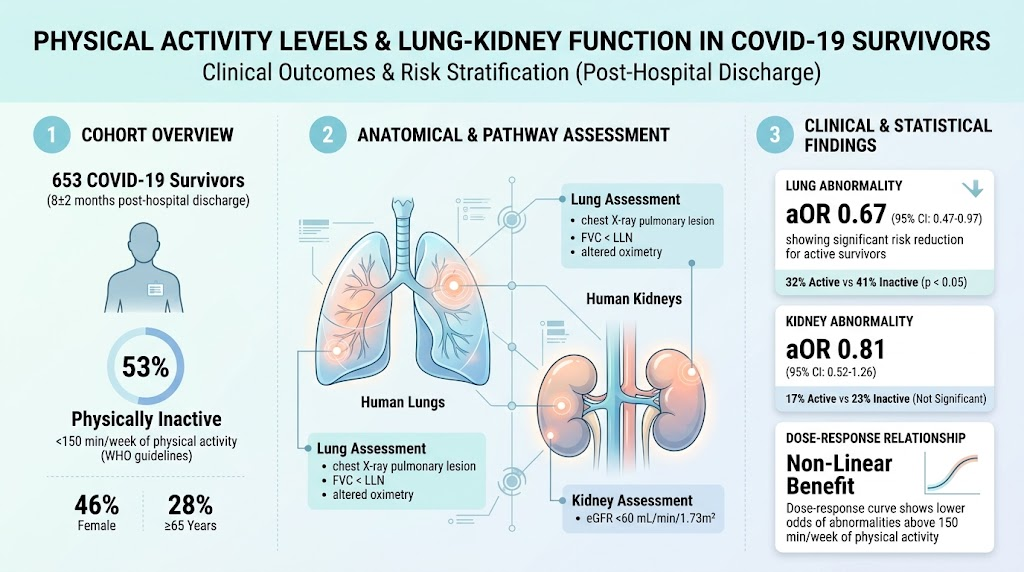
Among COVID-19 survivors, 53% were physically inactive eight months after hospitalization.
Physical activity was significantly associated with lower odds of lung abnormalities but not kidney or combined lung-kidney abnormalities.
The beneficial association with lung function was modified by age and baseline clinical severity.
A nonlinear dose-response relationship indicated protective effects at physical activity levels above 150 minutes per week.
Study Background
The coronavirus disease 2019 (COVID-19) pandemic has left a substantial population of survivors who continue to experience long-term sequelae. Among the organs involved, pulmonary and renal systems are notably vulnerable to both the acute infection and post-acute complications. Persistent lung abnormalities, including impaired respiratory function and radiographic changes, alongside compromised kidney function, have been documented months after recovery. Physical activity is widely known to confer broad health benefits including improved cardiovascular and pulmonary function; however, its role in recovery and organ function among COVID-19 survivors remains insufficiently characterized. Understanding this relationship may guide rehabilitation strategies and improve long-term outcomes for affected individuals.
Study Design
This investigation was a cross-sectional analysis nested within a prospective cohort of 653 survivors of moderate to severe COVID-19 following hospitalization. Participants were evaluated approximately eight months post-discharge. Physical activity levels were measured using the International Physical Activity Questionnaire (short form), with inactivity defined per World Health Organization guidelines as less than 150 minutes per week of physical activity. Outcomes assessed included lung and kidney function: abnormal lung function was identified by any chest X-ray pulmonary lesions, forced vital capacity below the lower limit of normal, or altered pulse oximetry; abnormal kidney function was defined by estimated glomerular filtration rate (eGFR) below 60 mL/min/1.73 m2. Logistic regression models assessed associations between physical activity categories and organ abnormalities, adjusting for relevant confounders.
Key Findings
The cohort was 46% female, with 28% aged 65 years or older. Approximately 53% of survivors were physically inactive at follow-up. Lung abnormalities were present in 36%, kidney abnormalities in 20%, and coexistent lung-kidney abnormalities in 7% of participants. Physically active survivors exhibited significantly lower odds of lung abnormalities (32% vs 41%; adjusted odds ratio [aOR] = 0.67, 95% confidence interval [CI] 0.47 to 0.97) compared to inactive individuals. However, no significant associations were observed for kidney abnormalities (17% vs 23%; aOR = 0.81, 95% CI 0.52 to 1.26) or combined lung-kidney abnormalities (6% vs 9%; aOR = 0.58, 95% CI 0.29 to 1.20).
Subgroup analyses revealed that the protective association of physical activity with lung function was more pronounced among younger survivors and those without severe oxygen desaturation or markedly reduced kidney function at baseline. Dose-response analyses utilizing restricted cubic spline curves demonstrated a nonlinear relationship, with higher lung-kidney abnormality odds below 150 minutes per week of activity and lower odds above this threshold, supporting WHO physical activity guidelines.
Expert Commentary
The findings underscore the importance of physical activity in respiratory rehabilitation after COVID-19 hospitalization. The observed association between physical activity and improved lung outcomes aligns with known benefits of exercise on respiratory muscle strength, lung capacity, and systemic inflammation modulation. The lack of a significant relationship with kidney function may reflect the multifactorial and less reversible nature of COVID-19-related renal injury or the more limited capacity of physical activity to influence renal repair directly.
Limitations include the cross-sectional design precluding causal inference, reliance on self-reported physical activity measures, and potential residual confounding from unmeasured variables such as socioeconomic status or preexisting comorbidities. Longitudinal studies incorporating objective physical activity monitoring and detailed kidney biomarkers are warranted to elucidate these associations further.
Conclusion
This study contributes to the growing evidence base on post-COVID-19 recovery, highlighting that physical activity is associated with better lung function outcomes in survivors of moderate to severe disease. The findings support promoting physical activity at or above 150 minutes per week as a component of rehabilitation programs to optimize pulmonary recovery. However, kidney function appears less responsive to activity level changes, indicating the need for focused nephrological evaluation and management in this population. Tailored rehabilitation approaches considering age and baseline clinical severity may enhance recovery trajectories and quality of life for COVID-19 survivors.
Funding and ClinicalTrials.gov
The study was conducted by the HCFMUSP COVID-19 Study Group. Specific funding sources and clinical trial registrations were not detailed in the publication.
References
Ribeiro HS, Mondini DR, Mattedi FZ, Gil S, Marçal L, Antonângelo L, et al. Physical Activity Levels and Lung-Kidney Function in a Cohort of COVID-19 Survivors. Med Sci Sports Exerc. 2026 Nov;58(11):2375-2383. doi: 10.1249/MSS.0000000000003235. PMID: 42870357.
World Health Organization. WHO Guidelines on Physical Activity and Sedentary Behaviour. 2020. Available from: https://www.who.int/publications/i/item/9789240015128
Herridge MS, Azoulay É. Long-term outcomes after critical illness. UpToDate. 2024.
Ganesh R, Weber N, Williamson C, Sawhney M. COVID-19 and kidney injury: mechanisms and management. Nat Rev Nephrol. 2022;18(4):249-259.
This article was created using several editorial tools, including AI, as part of the process. Human editors reviewed this content before publication.