Temporary Mechanical Circulatory Support in Cardiogenic Shock: Key Recommendations from the 2026 EAPCI–ACVC Consensus
Introduction and Context
Cardiogenic shock (CS) remains one of the most lethal complications of acute myocardial infarction (AMI) and other cardiac insults. Despite advances in reperfusion, critical care, and temporary mechanical circulatory support (tMCS), mortality remains high and management varies widely across centers. In response to new trial data and evolving practice, the European Association of Percutaneous Cardiovascular Interventions (EAPCI) together with the Association for Acute CardioVascular Care (ACVC) of the European Society of Cardiology (ESC) published an updated clinical consensus statement (Chieffo et al., European Heart Journal, 2026) focused on the use of tMCS in AMI complicated by cardiogenic shock. This 2026 update replaces and expands the previous 2020 expert document and aims to translate recent evidence into practical, patient-centered recommendations.
Why this update matters now
– New randomized and observational data have clarified benefits and harms of different tMCS strategies in defined patient groups. Notably, a recent randomized trial reported a mortality benefit for a percutaneous microaxial flow pump (referred to generically here as microaxial LV support) in a selected cohort of ST-elevation myocardial infarction complicated by CS (AMI-CS). By contrast, routine use of veno-arterial extracorporeal membrane oxygenation (VA-ECMO) in AMI-CS populations has not shown survival benefit and is associated with higher complication rates in several series.
– These mixed results underscore the need to tailor device selection to the shock phenotype, timing of support, and realistic treatment goals. The 2026 consensus promotes structured decision-making using established staging systems and organized systems of care.
New Guideline Highlights
Major themes of the 2026 EAPCI–ACVC consensus statement
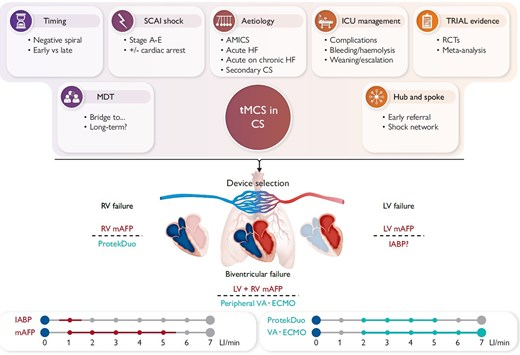
– Phenotype-driven strategy: Match device type to the dominant pathophysiology (left ventricular pump failure, right ventricular failure, biventricular failure, or circulatory collapse with hypoxia/cardiac arrest).
– Early stratification: Incorporate SCAI and Shock Academic Research Consortium (SHARC) classifications to guide timing for support, escalation, and withdrawal decisions.
– Selective use of microaxial LV support: Evidence now supports consideration of early percutaneous microaxial LV unloading in a defined subset of patients with AMI-CS (particularly early presenters with predominant LV failure), while stressing careful patient selection.
– Cautious use of VA-ECMO: Reserve veno-arterial ECMO for refractory biventricular failure, profound cardiopulmonary collapse, or extracorporeal cardiopulmonary resuscitation (ECPR) in centers with expertise; routine upfront ECMO for all AMI-CS is discouraged due to complication risks.
– System-level integration: Recommend multidisciplinary shock teams, hub-and-spoke regionalization, rapid transfer protocols, and standardized escalation/de-escalation pathways.
Key takeaways for clinicians
– Rapidly phenotype CS using clinical exam, hemodynamics, and imaging.
– Use SCAI shock stages (A–E) and SHARC phenotype descriptors to inform device choice.
– Early microaxial LV support is an option in selected AMI-CS patients; VA-ECMO is for refractory or special scenarios.
– Establish local protocols and participate in regional systems to ensure timely, appropriate device deployment and post-device care.
Updated Recommendations and Key Changes (Compared with prior guidance)
What changed in 2026 vs. earlier guidance (summary)
– New evidence-based endorsement of phenotype-guided device selection rather than one-size-fits-all escalation.
– Explicit support for considering microaxial LV support in a defined AMI-CS subgroup, reflecting the recent randomized data summarized in the consensus statement.
– Stronger cautions about routine VA-ECMO use in AMI-CS, with clearer guidance on indications, careful patient selection, and mandatory LV unloading strategies when ECMO is used.
– Greater emphasis on regionalized systems-of-care and formal shock teams, including minimum structural and personnel expectations.
Representative table (changes at a glance)
– Prior (2020): Broad expert guidance on MCS options; less prescriptive about phenotype selection.
– 2026 update: Prescriptive, phenotype-based recommendations; integrates SCAI/SHARC staging; endorses selective microaxial LV support; limits routine VA-ECMO.
Evidence driving the updates
– Randomized trial evidence supporting benefit of microaxial LV support in a selected AMI-CS population informed the new conditional recommendation.
– Large observational cohorts and registry data showing high complication rates with routine VA-ECMO, and mixed survival outcomes, shaped the more circumscribed recommendations.
– Ongoing and planned trials were acknowledged; the consensus balances current trial evidence with pragmatic considerations of center capabilities and patient heterogeneity.
Topic-by-Topic Recommendations
1. Diagnostic criteria and early evaluation
– Rapid identification of CS should use a combination of: hypotension (SBP <90 mmHg or need for vasopressors to maintain SBP ≥90 mmHg), signs of end-organ hypoperfusion (altered mentation, oliguria, lactic acidosis), and objective evidence of cardiac dysfunction (echocardiography, hemodynamics).
– Immediate assessments: bedside echocardiography (RV vs LV function, pericardial effusion), arterial lactate, mixed venous oxygen saturation or central venous oxygen saturation where available, and invasive arterial/venous access for hemodynamic monitoring when appropriate.
2. Staging and phenotype classification
– Use the SCAI shock stages (A ‘At risk’ to E ‘Extremis’) to document severity and monitor trajectory. These stages should inform urgency and the threshold for mechanical support.
– Apply SHARC or similar phenotype descriptors (predominant LV failure, predominant RV failure, mixed/biventricular failure, refractory electrical/mechanical instability) to guide device choice.
3. Device selection: principles
– Match device to pathophysiology:
– Predominant LV failure without refractory cardiac arrest: consider percutaneous microaxial LV unloading (early) or less-invasive devices for hemodynamic augmentation.
– Refractory biventricular failure, profound hypoxemia, or ECPR: consider VA-ECMO as bridge to decision, with a plan for LV unloading.
– Isolated RV failure: consider percutaneous right-sided support (e.g., RV assist devices) or targeted pharmacologic therapy.
– Avoid routine IABP use for AMI-CS: the IABP-SHOCK II randomized trial previously showed no mortality benefit; IABP may be considered in select scenarios (e.g., mechanical complications or as adjunct to other devices) but is not routine.
4. Microaxial (percutaneous LV) pumps
– Recommendation (conditional): Consider early percutaneous microaxial LV support in selected patients with AMI-CS characterized by early presentation, dominant LV pump failure, and absence of prohibitive comorbidities. The consensus highlights a recent randomized trial suggesting mortality benefit in a defined STEMI-CS cohort; selection and timing are critical.
– Practical points: insertion at experienced centers, skilled vascular access management, and careful monitoring for hemolysis, vascular complications, and device malfunction.
5. VA-ECMO
– Recommendation (restrictive): VA-ECMO is favored for patients with refractory cardiogenic shock with severe biventricular dysfunction, profound hypoxemia, or as ECPR, but routine first-line use in all AMI-CS patients is discouraged.
– When ECMO is used, proactive strategies to decompress the left ventricle are recommended (concomitant percutaneous LV venting, atrial septostomy, or direct surgical venting) to reduce pulmonary edema and LV distension.
– Anticoagulation, limb perfusion monitoring, and infection prevention are emphasized.
6. Escalation and de-escalation pathways
– Follow structured protocols that define objective triggers for escalation (worsening SCAI stage, rising lactate, escalating vasopressor/inotrope requirements, declining urine output) and for de-escalation (hemodynamic stability, improved end-organ perfusion, decreasing vasopressor dependence).
– Duration on tMCS without recovery should prompt early candidacy evaluation for durable mechanical circulatory support, ventricular assist devices, or transplantation, or initiation of palliative pathways if futility criteria are met.
7. Special populations
– Cardiac arrest/ECPR: VA-ECMO may be lifesaving when instituted rapidly in appropriate candidates; careful patient selection and post-ECMO prognostication are critical.
– Elderly and those with severe comorbidity: weigh the probability of recovery and goals of care; tMCS may be inappropriate when recovery is unlikely.
Expert Commentary and Insights
Consensus committee perspectives
– The consensus authors emphasize that tMCS is not a substitute for rapid diagnosis and definitive therapy (e.g., timely coronary revascularization in AMI-CS) but rather a temporizing or bridging tool when used appropriately.
– Multidisciplinary shock teams are a central recommendation: ideally comprising interventional cardiology, heart failure/transplant specialists, cardiac surgery, critical care, perfusion, and nursing, to support rapid, consensus-based decisions.
Areas of consensus
– Individualize device selection based on phenotype, not protocolized device hierarchy.
– Prefer microaxial LV support selectively in AMI-CS with predominant LV failure and early presentation.
– Reserve VA-ECMO for refractory scenarios and always plan for LV unloading when ECMO is used.
– Implement regionalized systems and standardized protocols to ensure timely support and minimize device-related complications.
Key controversies and knowledge gaps
– Which specific patient subgroups derive the greatest absolute benefit from microaxial LV support remains debated; larger, multicenter randomized trials are still needed to expand or narrow indications.
– Optimal timing of device insertion—pre-PCI versus post-PCI—in AMI-CS is an active area of research and discussion.
– The balance between aggressive escalation to ECMO and the risk of complications underscores the need for standardized futility criteria and shared decision-making frameworks.
Future research priorities
– Definitive randomized trials comparing microaxial pumps versus conservative care or alternative tMCS strategies across well-defined phenotypes.
– Trials assessing combined strategies (e.g., ECMO plus LV unloading) and their timing.
– Implementation science studies on regional shock systems, transfer protocols, and their impact on population-level outcomes.
Practical Implications for Clinical Practice
How these recommendations should change practice
– Establish or strengthen local shock teams and standardized pathways that integrate SCAI staging and phenotype assessment into electronic workflows.
– Create rapid-decision checklists: patient phenotype, SCAI stage, comorbidities, candidacy for durable therapies, goals of care, and chosen device with planned strategy for unloading and anticoagulation.
– Ensure competence in device insertion, vascular access techniques, limb perfusion monitoring, and management of device-specific complications through training and proctoring.
– Participate in regional networks to optimize triage and transfer, ensuring that patients receive the right device at the right center.
A patient vignette (illustrative)
– John, a 62-year-old man with anterior STEMI, arrives 90 minutes after symptom onset. He is hypotensive (SBP 82 mmHg), tachycardic, oliguric, with rising lactate. Echocardiography shows severely reduced LV function and no RV failure. He is SCAI stage C (classic CS) and meets criteria for AMI-CS with predominant LV failure. After expedited coronary angiography and PCI, the local shock team elects early percutaneous microaxial LV support because of continuing low output despite initial pharmacologic support and the absence of contraindications. John is managed in an experienced center, monitored for hemolysis and vascular complications, and weaned after myocardial recovery over several days. The vignette illustrates phenotype-driven device choice, team-based decision-making, and the importance of center expertise.
References
1. Chieffo A, Iannaccone M, Hassager C, Dudek D, Combes A, Gramegna M, Halvorsen S, Huber K, Kunadian V, Maly J, Møller JE, Pappalardo F, Tarantini G, Tavazzi G, Thiele H, Vandenbriele C, Van Mieghem NM, Vranckx P, Desch S, Werner N, Price S. Temporary mechanical circulatory support in cardiogenic shock. European Heart Journal. 2026 Oct 14. PMID: 42870411. https://pubmed.ncbi.nlm.nih.gov/42870411/
2. Thiele H, Zeymer U, Neumann F-J, Ferenc M, Olbrich HG, Hausleiter J, Richardt G, Hennersdorf M, Empen K, Fuernau G, Hambrecht R, Rehders T, Schuler G, Witzenbichler B, Witzenburg R, Roesner E; IABP-SHOCK II Trial Investigators. Intraaortic balloon support for myocardial infarction with cardiogenic shock. New England Journal of Medicine. 2012;367:1287–1296.
3. Hochman JS, Sleeper LA, Webb JG, et al.; SHOCK Investigators. Early revascularization in acute myocardial infarction complicated by cardiogenic shock. New England Journal of Medicine. 1999;341:625–634.
4. Baran DA, Grines CL, Bailey S, et al. SCAI clinical expert consensus statement on the classification of cardiogenic shock: This statement was endorsed by the American College of Cardiology. Catheterization and Cardiovascular Interventions. 2019;94(1):29–37.
5. Ibáñez B, James S, Agewall S, et al.; Task Force for the management of acute myocardial infarction in patients presenting with ST-segment elevation of the European Society of Cardiology (ESC). 2017 ESC Guidelines for the management of acute myocardial infarction in patients presenting with ST-segment elevation. European Heart Journal. 2018;39:119–177.
6. Extracorporeal Life Support Organization (ELSO). ELSO Guidelines for Cardiopulmonary Support. ELSO, updated guidance documents (access relevant guidance at https://www.elso.org).
Note: The 2026 EAPCI–ACVC consensus paper (Chieffo et al., 2026) synthesizes newer randomized and registry data that informed the updated recommendations summarized here. Clinicians should consult the full consensus document for detailed algorithms, device-specific technical recommendations, and region-specific implementation guidance.
Conclusion
The 2026 EAPCI–ACVC consensus represents a pragmatic, evidence-informed shift toward phenotype-driven use of temporary mechanical circulatory support in AMI complicated by cardiogenic shock. The statement balances encouraging trial results for microaxial LV support in selected patients with caution about routine VA-ECMO use, and it calls for organized systems—shock teams and regional networks—to deliver timely, appropriate care. As more trial data accrue, these recommendations will continue to evolve, but the current guidance provides a clear framework to improve decision-making and patient outcomes in this high-risk population.
This article was created using several editorial tools, including AI, as part of the process. Human editors reviewed this content before publication.