Revolutionizing Hypertension Management: Machine Learning to Decode Multiorgan Damage and New Disease Phenotypes
Highlight
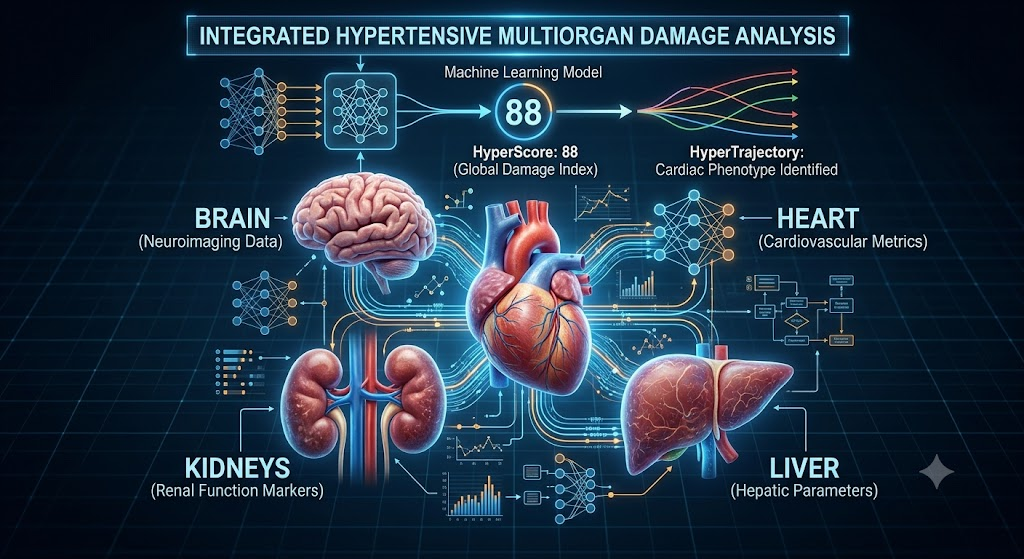
This unprecedented large-scale multinational study developed a semisupervised contrastive machine learning framework that generates a global multiorgan damage score, termed HyperScore, accurately quantifying hypertensive damage across heart, brain, kidneys, vasculature, lungs, liver, and metabolism. It identified six distinct hypertensive disease phenotypes (HyperTrajectory), enabling personalized risk stratification beyond blood pressure measurement alone. Validated in two large cohorts, this approach predicts survival and incident multiorgan disease over 7 years, heralding new clinical tools for monitoring and phenotype-specific hypertension management.
Background: The Challenge of Detecting Multiorgan Damage in Hypertension
Hypertension, a major modifiable cardiovascular risk factor, is known to induce structural and functional injury in multiple organs, including the heart, brain, kidneys, vasculature, liver, and lungs. These damages often commence subclinically, preceding overt cardiovascular events such as stroke, heart failure, and renal failure. Despite their clinical importance—subclinical organ damage elevates risks of vascular events and mortality—detection remains challenging in routine practice. Current assessments largely rely on isolated organ-specific tests or blood pressure metrics, which inadequately capture the multidimensional disease burden or complex organ interplay. This gap hampers early intervention tailored to individual disease trajectories. Modern medical imaging and biomarkers yield vast multidomain data, but integrating these into actionable clinical insights requires novel computational methods. The study by Alkhodari et al. introduces an innovative machine learning approach addressing these unmet needs by quantifying hypertensive multiorgan damage and identifying new disease phenotypes with prognostic relevance.
Study Design and Methods
This multinational observational study analyzed a total of 33,606 participants from two major cohorts: 27,099 individuals from the UK Biobank imaging substudy and 5,507 from the Atherosclerosis Risk in Communities (ARIC) study. The dataset comprised 566 multimodal variables encompassing advanced cardiovascular, neuroimaging, renal, hepatic, pulmonary imaging, and metabolic parameters, combined with conventional clinical metrics.
The authors developed a semisupervised contrastive trajectory inference (cTI) machine learning framework to model multiorgan alterations associated with hypertension exposure. This approach enabled pseudotemporal mapping of disease progression, quantifying global hypertensive organ damage through a comprehensive composite score named HyperScore, and identifying trajectories that represent distinct disease phenotypes (HyperTrajectory). Model stability was established through robust cross-validation within UK Biobank, while external validity was confirmed in the independent ARIC cohort.
Clinical relevance was assessed by comparing HyperScore’s predictive performance with existing risk scores and traditional blood pressure measures. Outcomes included survival over up to 7 years and incident multiorgan disease development.
Key Findings
HyperScore accuracy and reliability: Within UK Biobank (mean age 63.3 years, 53.4% women), HyperScore distinguished individuals with severe end-organ damage with an outstanding area under the receiver operating characteristic curve (AUC) of 0.964 (95% CI 0.941-0.987). Cross-validation revealed excellent stability, with a mean root mean square error of 0.104±0.084. Notably, survival odds varied significantly across HyperScore stages (P<0.001), unlike stratification by blood pressure, which did not predict survival differences significantly.
Identification of six hypertensive phenotypes: The model delineated six distinct HyperTrajectories characterized predominantly by cardiac, lipoprotein, atherothrombosis, brain, cardiorenal, and liver features respectively. Each phenotype encompassed specific organ involvement patterns, enabling nuanced patient stratification beyond classical blood pressure levels. This phenotyping offers insights into diverse pathophysiological pathways underpinning hypertensive organ damage.
External validation and clinical implications: Testing in the ARIC cohort confirmed the model’s generalizability, with minimal discrepancy in HyperScore distributions (Jensen-Shannon distance as low as 0.10) and consistent organ damage progression patterns (P>0.05). Outcome characteristics aligned across cohorts within HyperTrajectory groups, reinforcing the framework’s robustness and translational potential.
Expert Commentary
The integration of multimodal imaging data and sophisticated contrastive machine learning models represents a paradigm shift in hypertension research and management. The HyperScore provides a global perspective on hypertensive organ damage, transcending limitations of conventional approaches focused on isolated organ assessments or blood pressure values alone. Identification of distinct disease phenotypes aligns with emerging concepts of personalized medicine, suggesting potential tailoring of treatment based on predominant organ involvement and pathophysiology.
However, incorporation of such complex models into clinical workflows poses challenges, including accessibility to advanced imaging modalities and computational infrastructure, as well as need for prospective interventional studies to demonstrate improved patient outcomes through phenotype-guided management.
Furthermore, while the large sample size and external validation are major strengths, the study predominantly involved middle-aged to older adults from developed Western populations, which may limit generalizability to younger or ethnically diverse cohorts. The cross-sectional nature of imaging assessments and pseudotemporal modeling require further longitudinal validation to firmly establish causal progression pathways.
Conclusion
This pioneering work demonstrates that machine learning–derived global organ damage scores are feasible and highly predictive in hypertensive populations. By quantifying multiorgan injury and uncovering novel disease phenotypes, this approach offers refined risk stratification and opens avenues for personalized intervention strategies. Future research should focus on integrating these tools into routine clinical care, validating impact on clinical decision-making, and exploring intervention efficacy tailored to phenotype-specific pathophysiology. Ultimately, such innovations hold promise to transform hypertension assessment from a simplistic blood pressure measurement to a multidimensional, organ-centric evaluation crucial for precision cardiovascular medicine.
Funding and Clinical Trials
The study was funded and conducted under large-scale national and multinational consortium frameworks including UK Biobank and ARIC. Specific grant numbers and funding sources were not detailed in the publication. No registered clinical trials were reported associated with the study.
References
Alkhodari M, Lapidaire W, Kart T, et al. Contrastive Machine Learning to Quantify Hypertensive Multiorgan Damage and Identify New Disease Phenotypes: A Multinational Multimodal Study. Circulation. 2026 Jul 28;154(4):316-333. doi:10.1161/CIRCULATIONAHA.125.077394. Epub 2026 Jun 21. PMID: 42323953; PMCID: PMC13399729.
Whelton PK, Carey RM, Aronow WS, et al. 2017 ACC/AHA Guideline for the Prevention, Detection, Evaluation, and Management of High Blood Pressure in Adults. Hypertension. 2018;71(6):e13-e115.
Levey AS, Stevens LA, Schmid CH, et al. A new equation to estimate glomerular filtration rate. Ann Intern Med. 2009;150(9):604-612.
This article was created using several editorial tools, including AI, as part of the process. Human editors reviewed this content before publication.