We use cookies

Our website uses essential cookies and, with your consent, additional cookies to measure performance and improve our services. Cookie Policy.

You can change your choice at any time.

MMedXYNews
HomeVideos
MedXY AI/MedXY News/Section: Cardiology

Intestinal Serotonergic Vagal Signaling: A Novel Link Between Gut Microbiota and Hypertension Management
MedXY Editorial Team•Sep 17, 2026•Cardiology
gut microbiotaHypertensionserotoninVagal Signaling

Highlight

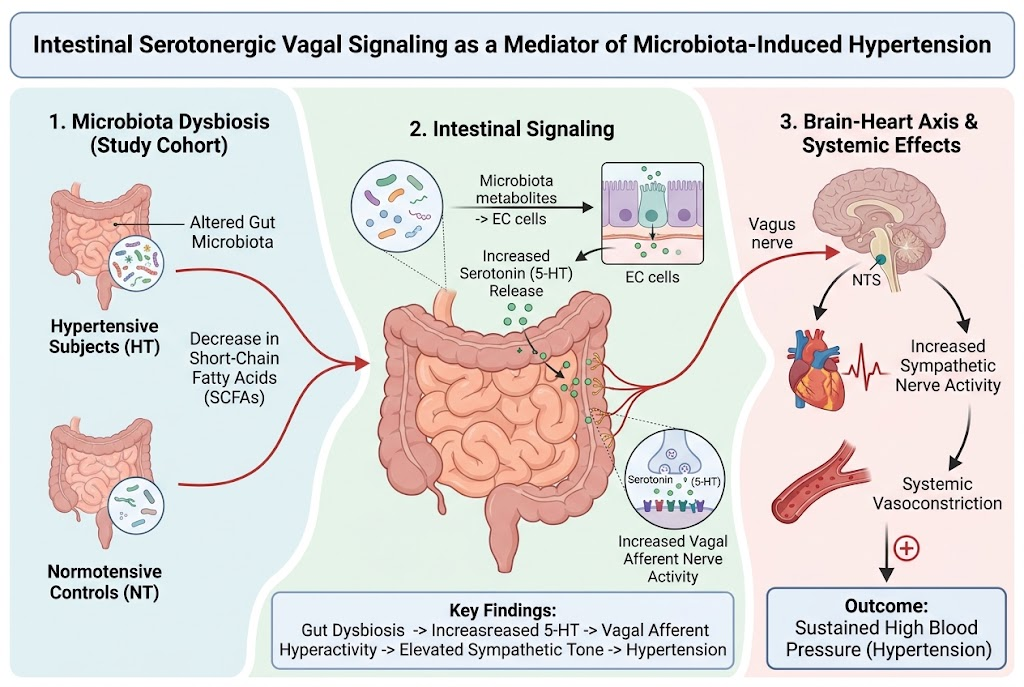
  • Hypertension is influenced not only by cardiac and renal factors but also by gut microbiota through intestinal serotonergic signaling.
  • Hypertensive rats and humans exhibit decreased intestinal serotonin (5-HT) levels and vagal 5HT3a receptor signaling activity.
  • Fecal microbiota transplantation (FMT) from hypertensive rats decreases intestinal 5-HT and vagal signaling in normotensive rats, suggesting microbiota-driven modulation.
  • Restoring 5HT3a receptor signaling in colonic vagal neurons alleviates hypertension, indicating a potential therapeutic target.

Study Background

MedXY registered readers

Sign in free to continue reading

Create or use your MedXY account to unlock the complete article.

This article was created using several editorial tools, including AI, as part of the process. Human editors reviewed this content before publication.

Related articles

Open language-specific specialty feeds and department pages.

Impact of an AI-Powered Gamified Mobile Health Application on Blood Pressure Control in a Matched Patient CohortStudy found that use of an AI-driven gamified mobile app integrating home blood pressure monitoring significantly improved blood pressure control compared to usual care in hypertensive patients.Sep 17, 2026Sustained Reduction of Severe Maternal Morbidity and Racial Disparities Through a Statewide Perinatal Quality CollaborativeA Louisiana statewide perinatal quality collaborative significantly reduced severe maternal morbidity related to hemorrhage and hypertension, sustained improvements across initiatives, and narrowed racial disparities, demonstrating durableSep 8, 2026Sustained Cardiovascular Benefits of Intensive Blood Pressure Management Led by Nonphysician Providers: 7-Year Follow-Up of the CRHCP TrialLong-term intensive BP control led by trained nonphysician community providers significantly lowers cardiovascular risk over 7 years, with benefits persisting 3 years post-intervention in rural China.Aug 29, 2026
Loading comments...
MedXY briefing

Get the free newsletter

Evidence-led clinical news, trends, and analysis—delivered to your inbox.

Ask MedXY AI

Most popular

Intimate Health
Five Benefits for Women Continuing Sexual Activity After Menopause
Intimate Health
Why Some Women Have a Strong Sex Drive—And Why Men Shouldn't Worry About It
Nursing & care
How often should a couple have sex?
Intimate Health
Classic Intimacy Recommendations: How to Help Women Reach Orgasm and Enjoy Mutual Pleasure
Intimate Health
What Makes a Woman "Physiologically Addicted" Is Never Money, But These Two Relationship Qualities
© 2026 MedXY
Contact usAbout usPrivacy PolicyMedXY story
Impact of a Community- and Family-Based Intervention on Blood Pressure Reduction in Rural China: Insights from a Cluster-Randomized Trial
This cluster-randomized trial in rural China demonstrates that a coordinated community- and family-based intervention effectively lowers systolic blood pressure at the population level, highlighting the importance of sustained community eng
Aug 28, 2026
Gut Microbiota and Metabolomic Signatures as Predictors of Immunotherapy Outcomes in MASLD and Viral HCCDistinct gut microbial profiles but shared metabolomic markers, especially fecal acetate, predict response and survival with combination immunotherapy in metabolic dysfunction-associated and viral hepatitis-related hepatocellular carcinoma.Aug 22, 2026
Gut Microbiota-Derived Imidazole Propionate as a Predictor of Cardiometabolic Risk in Coronary Artery Disease: Evidence and Clinical ImplicationsEmerging evidence identifies circulating imidazole propionate, a gut microbiota-derived metabolite, as an independent predictor of major adverse cardiovascular events in patients with coronary artery disease, offering novel insights into peAug 18, 2026