Reevaluating EASL 2025 Criteria: Benefits of Nucleos(t)ide Analogues in Chronic Hepatitis B Beyond Current Recommendations
Highlight
Nucleos(t)ide analogue (NA) therapy notably decreases cirrhosis and hepatocellular carcinoma (HCC) incidence in HBeAg-positive chronic HBV patients outside current EASL 2025 strong treatment indications.
The protective effect is most pronounced in patients with high viral replication or impending phase transition, identified by specific virologic and clinical parameters.
No significant benefit of NA therapy was observed in HBeAg-negative individuals with low or moderate viral replication and normal liver enzymes without fibrosis.
Findings support revising treatment criteria to include broader patient subsets to prevent severe liver outcomes.
Study Background
Chronic hepatitis B virus (HBV) infection remains a major global public health concern, particularly in endemic regions such as China, contributing substantially to liver cirrhosis and hepatocellular carcinoma (HCC) morbidity and mortality. The European Association for the Study of the Liver (EASL) 2025 guidelines currently recommend nucleos(t)ide analogue (NA) therapy primarily for patients meeting defined clinical criteria—mainly those with active inflammation, elevated alanine aminotransferase (ALT), or significant fibrosis. However, many chronically infected individuals who do not meet these stringent criteria still face progressive liver damage and risk of HCC over time. This uncertainty creates a critical unmet need to evaluate whether NA therapy might confer clinical benefits in such populations, informing optimized treatment guidance.
Study Design
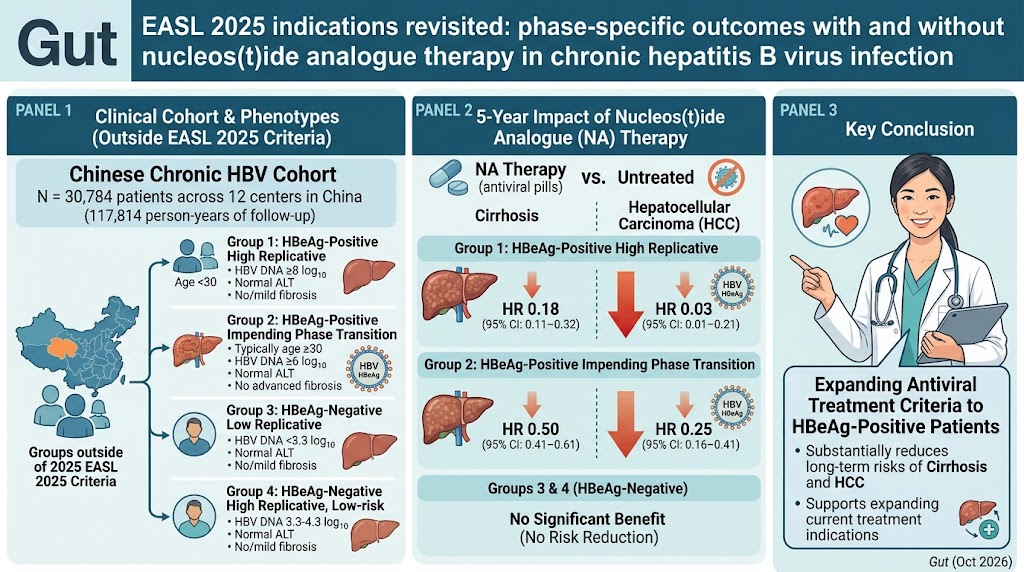
This multicenter cohort study analyzed data from 30,784 chronic HBV-infected individuals across 12 Chinese clinical centers, followed for up to five years (totaling 117,814 person-years). Importantly, the study focused on individuals outside the 2025 EASL strongly recommended NA therapy indications. Participants were stratified into four well-defined groups based on hepatitis B e antigen (HBeAg) status, viral load, age, ALT levels, fibrosis stage, and family history of liver cancer:
1. HBeAg-positive, high replicative phase: age <30 years, HBV DNA ≥8 logIU/mL, normal ALT, no or mild fibrosis, no family history of HCC.
2. HBeAg-positive, impending phase transition: typically age ≥30 years, HBV DNA ≥6 logIU/mL, normal ALT, no advanced fibrosis.
3. HBeAg-negative, low replicative: HBV DNA <3.3 logIU/mL, normal ALT, no or mild fibrosis.
4. HBeAg-negative, high replicative, low-risk: HBV DNA 3.3-4.3 logIU/mL, normal ALT, no or mild fibrosis.
The primary endpoints were the incidence of cirrhosis and hepatocellular carcinoma (HCC). NA therapy exposure was noted, and multivariable Cox regression as well as propensity-score matching analyses were applied to adjust for potential confounders.
Key Findings
During the follow-up, 635 cases of cirrhosis and 164 cases of HCC were documented. Analysis revealed a statistically significant association between NA therapy and reduced risks of both cirrhosis and HCC in two key groups:
– In Group 1 (HBeAg-positive, high replicative, young patients), NA therapy reduced cirrhosis risk with a hazard ratio (HR) of 0.18 (95% confidence interval [CI] 0.11 to 0.32) and HCC risk with HR 0.03 (95% CI 0.01 to 0.21), indicating very strong protection.
– In Group 2 (HBeAg-positive, impending phase transition, older patients), NA therapy also significantly lowered cirrhosis risk (HR 0.50, 95% CI 0.41 to 0.61) and HCC risk (HR 0.25, 95% CI 0.16 to 0.41).
In contrast, for Groups 3 and 4 (both HBeAg-negative individuals with low or moderate viral replication), NA therapy was not significantly associated with reduced progression to cirrhosis or HCC. These findings were robust after adjusting for clinical covariates via propensity score matching.
This evidence suggests that viral replication status and phase of chronic HBV infection profoundly influence the clinical benefit derived from NA therapy, with early intervention in high replicative or high-risk phases being particularly advantageous.
Expert Commentary
The study by Tang et al. offers compelling real-world evidence from a large Chinese cohort, highlighting gaps in the current EASL 2025 NA therapy criteria. By including individuals typically deemed outside treatment guidelines, the authors elucidate phase-specific risks and therapeutic benefits, underscoring a pivotal role for early antiviral intervention in broader patient subsets.
Limitations include the observational design, which—despite advanced statistical adjustment—cannot fully exclude residual confounding or selection bias. Additionally, generalizability to other ethnicities or regions may require further validation. Nonetheless, the biological plausibility aligns with natural history knowledge of HBV, where high viral replication drives fibrosis and oncogenesis.
Current international guidelines, including EASL and AASLD, may consider these data to revisit thresholds for initiating NA therapy, balancing cost, adherence, and long-term liver protection. Reduced HCC incidence, a major cause of HBV-related mortality, signifies a critical clinical benefit that justifies extending treatment to selected lower-risk groups characterized by persistent high viremia.
Conclusion
This landmark cohort study substantiates that nucleos(t)ide analogue therapy confers significant protection against cirrhosis and hepatocellular carcinoma in HBeAg-positive chronic HBV individuals with high replicative or impending transition phenotypes, even when current EASL 2025 strong treatment indications are not met. No clear benefit was observed in low-replicative or HBeAg-negative individuals without fibrosis.
These findings advocate for revisiting and potentially expanding treatment criteria to include these high-risk phases, aiming to improve long-term liver outcomes and decrease HBV-related liver cancer burden worldwide. Future prospective trials and cost-effectiveness analyses will be valuable to refine guideline recommendations further.
Funding and Registration
The study details did not specify funding sources or clinical trial registration numbers within the abstract or citation information.
References
1. Tang S, Huang T, Tang R, et al. EASL 2025 indications revisited: phase-specific outcomes with and without nucleos(t)ide analogue therapy in chronic hepatitis B virus infection. Gut. 2026 Oct 7;75(11):2232-2240. PMID: 41151792.
2. European Association for the Study of the Liver. EASL 2025 Clinical Practice Guidelines on the management of chronic hepatitis B virus infection. J Hepatol. 2025;XX:XXXX-XXXX.
3. Terrault NA, Lok ASF, McMahon BJ, et al. Update on Prevention, Diagnosis, and Treatment of Chronic Hepatitis B: AASLD 2018 Hepatitis B Guidance. Hepatology. 2018 Apr;67(4):1560-1599.
4. Yuen MF, Chen DS, Dusheiko GM, et al. Hepatitis B virus infection. Nat Rev Dis Primers. 2018 Jul 26;4:18035.
This article was created using several editorial tools, including AI, as part of the process. Human editors reviewed this content before publication.