We use cookies

Our website uses essential cookies and, with your consent, additional cookies to measure performance and improve our services. Cookie Policy.

You can change your choice at any time.

MMedXYNews
HomeVideos
MedXY AI/MedXY News/Section: news

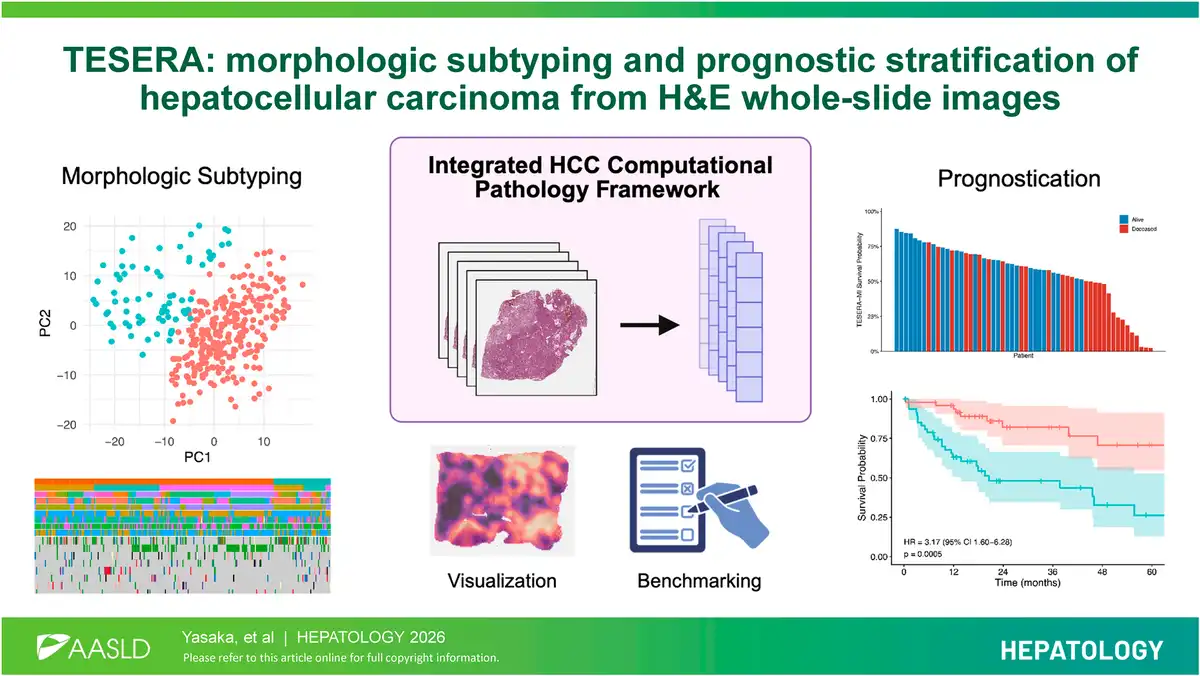
TESERA: Advancing Morphologic Subtyping and Prognostic Stratification in Hepatocellular Carcinoma Using H&E Whole-Slide Images
MedXY Editorial Team•Oct 5, 2026•news
Computational Pathologyhepatocellular carcinomaMorphologic Subtypingprognostic stratification

Highlight

This article introduces TESERA, a novel computational pathology framework that extracts prognostically significant morphologic subtypes from hematoxylin and eosin (H&E) stained slides of hepatocellular carcinoma (HCC). TESERA identifies two distinct tumor subtypes linked to key molecular pathways and mutations, and provides a prognostic morphologic index predictive of overall and disease-free survival, validated across multiple cohorts.

TESERA’s approach utilizes routinely acquired histologic images, enabling low-cost and widespread biology-aware risk stratification, potentially guiding clinical management and therapeutic decisions in HCC.

MedXY registered readers

Sign in free to continue reading

Create or use your MedXY account to unlock the complete article.

This article was created using several editorial tools, including AI, as part of the process. Human editors reviewed this content before publication.

Related articles

Open language-specific specialty feeds and department pages.

Liver Transplantation for Hepatocellular Carcinoma: Prognostic Impact of Complete Pathologic Response and Influence of Treatment Modality—A US National Database StudyComplete pathologic response (cPR) after locoregional therapies notably improves survival in hepatocellular carcinoma (HCC) patients undergoing liver transplantation. Yttrium-90 radioembolization shows superior cPR rates, particularly when Oct 5, 2026Immune Checkpoint Inhibitor-Based Downstaging Therapy for Hepatocellular Carcinoma: Evidence, Outcomes, and Clinical PerspectivesThis review synthesizes recent evidence on immune checkpoint inhibitor (ICI)-based downstaging therapy for hepatocellular carcinoma (HCC) beyond Milan criteria prior to liver transplantation, highlighting improved oncologic outcomes alongsiOct 3, 2026Designing Rigorous Trials of Systemic Therapy with Surgery and Locoregional Treatment in Hepatocellular Carcinoma: Key Recommendations from an HCC-Live Expert ConsensusA multidisciplinary consensus provides practical, trial-design focused recommendations for testing systemic therapies around surgery or combined with locoregional treatment in hepatocellular carcinoma, emphasizing patient selection, endpoinSep 29, 2026
Loading comments...
MedXY briefing

Get the free newsletter

Evidence-led clinical news, trends, and analysis—delivered to your inbox.

Ask MedXY AI

Most popular

Intimate Health
Five Benefits for Women Continuing Sexual Activity After Menopause
Intimate Health
Why Some Women Have a Strong Sex Drive—And Why Men Shouldn't Worry About It
Nursing & care
How often should a couple have sex?
Cardiology
Precision Medicine for Long QT Syndrome Type 2: Lumacaftor Corrects Trafficking Defects and Shortens QT Interval
General Surgery
Optimizing Postoperative Opioid Prescriptions After Intra-Abdominal Cancer Surgery: Comparing the 5x-Multiplier and 3-Tier Models
© 2026 MedXY
Contact usAbout usPrivacy PolicyMedXY story
Steatotic Liver Disease Risk Scores for Predicting Cirrhosis and Hepatocellular Carcinoma: A Comprehensive Clinical ReviewThis review assesses the clinical utility of steatotic liver disease risk scores in predicting cirrhosis and hepatocellular carcinoma, highlighting the superior performance of the SAFE score for cirrhosis and challenges in HCC risk predictiSep 24, 2026
Reevaluating Immune Tolerant Phase in Chronic Hepatitis B: High Transition Rates to Immune Active Disease and Clinical Implications from the RADICAL ConsortiumThe RADICAL consortium’s large-scale study reveals a high long-term transition rate from immune tolerant to immune active chronic hepatitis B, especially in patients with high-normal ALT, suggesting the need for closer monitoring andSep 23, 2026
Unraveling the S1P-TREM2 Axis: A Novel Ferroptosis-Resistance Mechanism Driving Immunosuppressive Neutrophils and Tumour Progression in Hepatocellular CarcinomaThis study reveals how the S1P-TREM2-NRF2 signaling pathway protects tumor-associated neutrophils from ferroptosis, sustaining immunosuppression and promoting hepatocellular carcinoma progression, offering new therapeutic avenues.Sep 12, 2026