Immune Checkpoint Inhibitor-Based Downstaging Therapy for Hepatocellular Carcinoma: Evidence, Outcomes, and Clinical Perspectives
Highlights
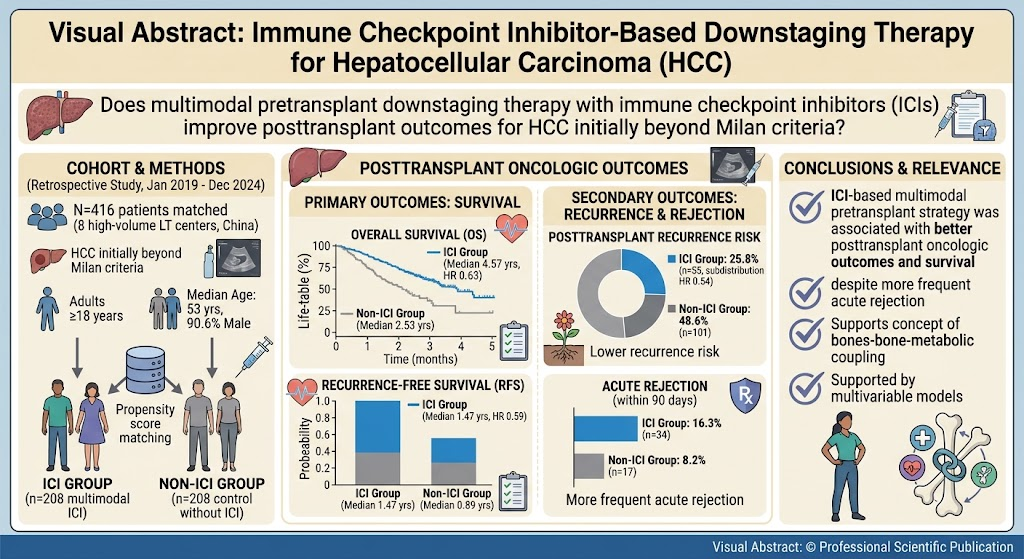
- ICI-based multimodal pretransplant strategies improve overall survival and recurrence-free survival in HCC initially beyond Milan criteria undergoing liver transplantation.
- Optimal ICI treatment duration (>80 days) and adequate washout period (>50-90 days) are critical to balance oncologic benefit and reduce acute allograft rejection risk.
- Posttransplant acute rejection events are more frequent with pre-LT ICI exposure but are generally manageable without substantial graft loss or mortality.
- Tumor burden at downstaging completion and number of ICI cycles influence recurrence risk; precise candidate selection remains essential.
Background
Hepatocellular carcinoma (HCC) is a major global cause of cancer mortality, with liver transplantation (LT) offering a curative option for selected patients. Traditionally, transplant candidacy relies on criteria such as the Milan criteria, which select patients with limited tumor burden to optimize posttransplant outcomes. However, a significant proportion present beyond these criteria and require downstaging therapies to become transplant-eligible. Standard downstaging approaches have included locoregional therapies (LRTs) such as transarterial chemoembolization or ablation, and systemic targeted treatments.
Recently, immune checkpoint inhibitors (ICIs), targeting PD-1/PD-L1 and CTLA-4 pathways, have transformed systemic therapy for advanced HCC with durable responses. Their integration as part of multimodal pretransplant downstaging strategies aims to improve tumor control pre-LT, potentially broadening transplant eligibility and improving oncologic outcomes. However, concerns exist regarding increased risk of immune-mediated allograft rejection post-LT, optimal treatment durations, timing of cessation (washout), and long-term survival benefit.
Key Content
Chronological Development of Evidence
Initial case reports and small retrospective reviews in early 2020s raised awareness of ICI use pre-LT, reporting acceptable short-term outcomes but frequent acute rejection episodes. These observations prompted systematic reviews and meta-analyses published between 2024 and 2026 incorporating individual patient data and multicenter cohorts to elucidate efficacy and safety profiles.
Evidence from Multicenter Matched Cohorts and Meta-Analyses
– Ong et al. (2026, JAMA Oncology) conducted a large multicenter, retrospective, propensity score-matched study of 416 HCC patients beyond Milan criteria undergoing LT, comparing ICI-based multimodal downstaging (combined with locoregional/targeted therapies) versus non-ICI regimens. They reported significantly improved median overall survival (4.57 vs. 2.53 years; P<.001) and recurrence-free survival (1.47 vs. 0.89 years; P=.02) in the ICI group. Multivariable models confirmed ICI use associated with reduced risk of posttransplant recurrence (subdistribution HR 0.54). Acute rejection within 90 days was higher with ICIs (16.3% vs. 8.2%; P=.01) but without accompanying survival detriment.
– Systematic review by Ong et al. (2026, Liver Transplantation) synthesizing 39 studies (261 patients) confirmed a median ICI duration of approximately 63 days and highlighted that treatment durations under 80 days correlated with increased recurrence risk. A washout period under 50 days was independently linked to higher rejection rates. Younger patients (<50 years) had increased rejection risk. These data underscore the importance of sufficient ICI exposure and timing before LT.
– Meta-analysis by Wu et al. (2025, Frontiers in Oncology) pooled data from eight retrospective studies (229 patients) with a post-LT acute rejection incidence of 19%. The highest rejection rates were noted with PD-L1 inhibitors (24%). Importantly, 78% achieved complete recovery from rejection, and graft loss was low (4%), supporting feasible management of ICI-related rejection.
– Individual patient data meta-analysis by Li et al. (2025, Journal of Hepatology) analyzed 91 patients and found a 26.4% rejection rate. Increasing age and longer ICI washout times were protective against rejection. They also identified fewer ICI cycles and post-ICI tumor burden beyond Milan criteria as predictors of HCC recurrence post-LT. A 3-month washout interval was proposed to mitigate rejection risk.
Mechanistic and Translational Insights
ICIs augment antitumor immunity by releasing T cell inhibition, enhancing tumor cell killing. However, this same mechanism can activate alloimmune responses against the transplanted liver. The risk of rejection thus correlates with residual ICI activity at transplant and host immune responsiveness.
Balancing effective tumor control with immune tolerance to the graft requires carefully timed cessation (washout) and immunosuppressive strategies post-LT. Emerging biomarkers like PD-L1 expression, T cell repertoire profiling, and immune checkpoint dynamics may enable personalized regimens to optimize outcomes.
Candidates and Clinical Application
Current evidence favors ICI-based multimodal downstaging in patients with initially unresectable or beyond Milan criteria HCC who do not have contraindications such as autoimmune disease. Patient selection should consider tumor burden, underlying liver function, and immunologic risk.
Protocols now increasingly incorporate:
– ICI treatment duration of >80 days to maximize downstaging response.
– A minimum washout period of 50-90 days before LT to reduce rejection risk.
– Close monitoring for acute rejection and graft function post-LT.
Expert Commentary
Recent robust retrospective data and meta-analyses converge to support ICI-based approaches as a meaningful evolution in downstaging therapy for HCC beyond Milan criteria. Enhanced oncologic outcomes—including prolonged survival and reduced posttransplant recurrence—represent significant advances over prior standard-of-care.
The challenge remains mitigating the increased acute rejection risk, which is substantially influenced by treatment timing and patient factors. Notably, allograft rejection rates, while higher, do not universally translate into graft loss or survival compromise, particularly with prompt recognition and management.
Clinicians should integrate multidisciplinary care including transplant hepatology, oncology, and immunology expertise when implementing ICIs pre-LT. Standardized protocols for duration, washout, and posttransplant immunosuppression need prospective validation.
Despite promising results, current evidence is primarily observational and retrospective. The field urgently requires prospective, controlled trials to define optimal regimens, biomarker stratification, and long-term outcomes. Additionally, the biological mechanisms driving rejection and recurrence need deeper exploration to inform precision medicine.
Conclusion
ICI-based multimodal pretransplant therapies constitute a transformative strategy for downstaging HCC initially beyond the Milan criteria, conveying improved survival and recurrence outcomes after liver transplantation. Appropriate duration of ICI exposure combined with an adequate washout interval is critical to balance enhanced tumor control against risk of acute allograft rejection.
Careful patient selection, rigorous monitoring, and multidisciplinary management are paramount to safely expand transplant candidacy and improve prognosis in this challenging population. Ongoing and future prospective studies will be essential to optimize protocols and confirm long-term benefits.
References
- Ong M, He K, Wang F, et al. Immune Checkpoint Inhibitor-Based Downstaging Therapy for Hepatocellular Carcinoma. JAMA Oncol. 2026; PMCID:42821267. https://pubmed.ncbi.nlm.nih.gov/42821267/
- Ong M, Li G, Ling Q. Beyond rejection risk: Identifying ideal candidates for pretransplant immune checkpoint inhibitors for HCC. Liver Transpl. 2026;32(9):1285-1296. PMID: 41855385. https://pubmed.ncbi.nlm.nih.gov/41855385/
- Wu Q, Chen L, Huang J, et al. Navigating the risks: a systematic review of immune checkpoint inhibitor therapy before liver transplant for hepatocellular carcinoma and its impact on allograft rejection and survival outcomes. Front Oncol. 2025;15:1689820. PMID: 41234720. https://pubmed.ncbi.nlm.nih.gov/41234720/
- Li J, Zhang T, Sun X, et al. Impact of pre-transplant immune checkpoint inhibitor use on post-transplant outcomes in HCC: A systematic review and individual patient data meta-analysis. J Hepatol. 2025;82(1):107-119. PMID: 38996924. https://pubmed.ncbi.nlm.nih.gov/38996924/
This article was created using several editorial tools, including AI, as part of the process. Human editors reviewed this content before publication.