Psychotropic Medication Use After Abortion: No Sustained Increase Seen in Danish Cohort Study
A Danish registry study of 67,390 women found no significant increase in psychotropic medication use after medication or procedural abortion after Bonferroni correction.
Small increased risks in the first year after abortion were observed but did not meet statistical significance after adjusting for multiple comparisons.
Risks of psychotropic medication use were lower more than 5 years after both medication and procedural abortion compared with the year before.
The study's within-person design compared each woman's medication use before and after abortion, controlling for time-invariant confounders.
Design | Population-based Danish registry cohort study |
|---|---|
Setting | Denmark, 2000–2018 |
Population | 67,390 females aged 12–38 years with first-trimester elective abortion |
Exposure | First medication abortion (n=33,793) vs first procedural abortion (n=33,597) |
Primary Outcome | First psychotropic medication prescription redemption (any, antidepressant, antianxiety) |
Main Result | In first year after abortion: adjusted IRR 1.10 (medication) and 1.09 (procedural), not significant after Bonferroni correction. After 5 years: IRR 0.85 (medication) and 0.83 (procedural), both significant. |
Why This Study Matters
Abortion is a common medical procedure, yet concerns persist about its potential impact on mental health. Previous studies have reported mixed findings, often limited by design or small samples. This large population-based cohort study from Denmark used nationwide registry data to examine whether the method of abortion — medication or procedural — is associated with subsequent use of psychotropic medications, a proxy for mild to moderate mental health problems. Understanding this relationship is important for informed patient counseling and clinical care.
How the Study Was Conducted
Researchers linked Danish health registries to identify all females aged 12 to 38 years who had an elective first-trimester abortion between January 1, 2000, and December 31, 2018. The final cohort included 67,390 women, of whom 33,793 had a first medication abortion and 33,597 had a first procedural abortion. The study used a within-person design: each woman served as her own control, with psychotropic medication redemptions compared between the year before abortion and time periods afterward (0–1 year, 1–2 years, 2–5 years, and more than 5 years). This design helps control for stable individual characteristics that might otherwise confound comparisons between different women.
The primary outcome was any first psychotropic medication prescription redemption, with secondary outcomes specific to antidepressant and antianxiety medications. Incidence rate ratios (IRRs) were calculated using adjusted regression models that accounted for age, calendar year, and psychiatric history. Because the study tested multiple outcomes across multiple time points, the researchers applied a Bonferroni correction, setting a more stringent significance threshold of P < .002 to reduce the risk of false-positive findings.
What the Researchers Found
During follow-up, 19,979 women (29.6%) had a first psychotropic medication redemption. In fully adjusted models using the conventional P value of .05, small increased risks were observed in the first year after both medication abortion (IRR, 1.10; 95% CI, 1.02–1.19; P = .01) and procedural abortion (IRR, 1.09; 95% CI, 1.01–1.16; P = .02). No statistically significant associations were seen between 1 and 5 years after abortion. More than 5 years after abortion, risks were lower compared with the year before: for medication abortion (IRR, 0.85; 95% CI, 0.78–0.91; P < .001) and for procedural abortion (IRR, 0.83; 95% CI, 0.78–0.88; P < .001).
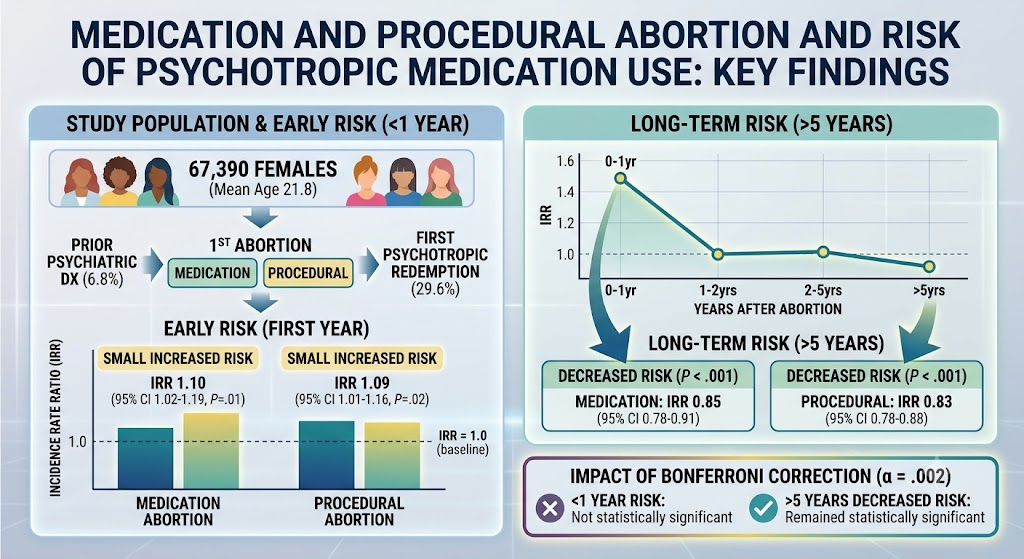
However, when the Bonferroni-corrected threshold of P < .002 was applied, the small increased risks in the first year no longer met statistical significance. The decreased risks beyond 5 years remained significant. The pattern was similar for antidepressant and antianxiety medication outcomes separately.
Figure 1. Line Graph of the Incidence Rate of Any Psychotropic Medication Use in the Year Before and Year After Abortion by Abortion Method.

Figure 2. Line Graphs of Incidence Rate Ratios of Any Psychotropic Medication Use in the Year Before and Year After an Abortion, Adjusted for Calendar Year.

Incidence rate ratios of any psychotropic medication use in the year before and year after an abortion are shown for females having had a first medication abortion (A) and a first procedural abortion (B), adjusted for calendar year. The period of −10 to 0 months refers to the period of 10 months before the abortion. Dotted lines indicate the incidence rate ratio reference of 1.00, which is the incidence rate ratio over the 11th and 12th months before the abortion method. Within each abortion method, there were no consistently higher rates in the 10 months before to the 12 months after abortion relative to the 11th to 12th month before an abortion. Error bars indicate 95% CI. P values listed above data points indicate differences between the respective time point and the 11th and 12th month before an abortion.
What the Findings May Mean
The elevated risks in the first year after abortion, though small, may reflect transient distress or pre-existing mental health conditions that prompt treatment-seeking around the time of the abortion. The fact that these associations weakened after correcting for multiple testing suggests caution in interpreting them as clinically meaningful. The lower risk of psychotropic medication use many years after abortion is consistent with other studies showing that women who have abortions do not experience worse long-term mental health compared with those who carry unwanted pregnancies to term.
Importantly, the within-person design eliminates confounding by stable factors such as personality, socioeconomic background, or family psychiatric history. However, it cannot account for time-varying factors such as relationship changes, subsequent pregnancies, or life stressors that might influence mental health and medication use.
Strengths and Limitations
Strengths include the large, nationwide sample with virtually complete follow-up through Danish registries, minimizing selection and attrition bias. The within-person approach and adjustment for key confounders strengthen the internal validity. The use of prescription redemption as an outcome provides an objective, clinically relevant measure.
Limitations include the inability to capture mental health conditions that do not result in medication use or that are treated with psychotherapy alone. The study population is relatively young and ethnically homogeneous (Danish), limiting generalizability to other settings. The observational design cannot prove causation, and residual confounding by unmeasured time-varying factors is possible. The Bonferroni correction is conservative and may miss small but real effects, though the authors note that the first-year findings were not robust after correction.
Implications for Practice and Research
For clinicians, these findings provide reassurance that neither medication nor procedural abortion is associated with a sustained increase in psychotropic medication use. The small early increase, if real, is likely temporary and may warrant supportive follow-up. Future research should replicate these findings in other populations and examine other mental health outcomes, such as diagnostic codes or use of psychotherapy. Studies could also explore the role of social support, pregnancy intention, and subsequent reproductive events.
References
Steinberg JR, Laursen TM, Lidegaard Ø, Munk-Olsen T. Medication and Procedural Abortion and Risk of Psychotropic Medication Use. JAMA Psychiatry. Published online July 22, 2026. PMID: 42485031.
This article was created using several editorial tools, including AI, as part of the process. Human editors reviewed this content before publication.