We use cookies

Our website uses essential cookies and, with your consent, additional cookies to measure performance and improve our services. Cookie Policy.

You can change your choice at any time.

MMedXYNews
HomeVideos
MedXY AI/MedXY News/Section: news

Real-Life Emotional Support, Social-Media-Based Emotional Support, and Loneliness Among US Adults: A Nationally Representative Study
MedXY Editorial Team•Aug 17, 2026•news
mental healthlonelinessemotional supportUS adultssocial media

Introduction

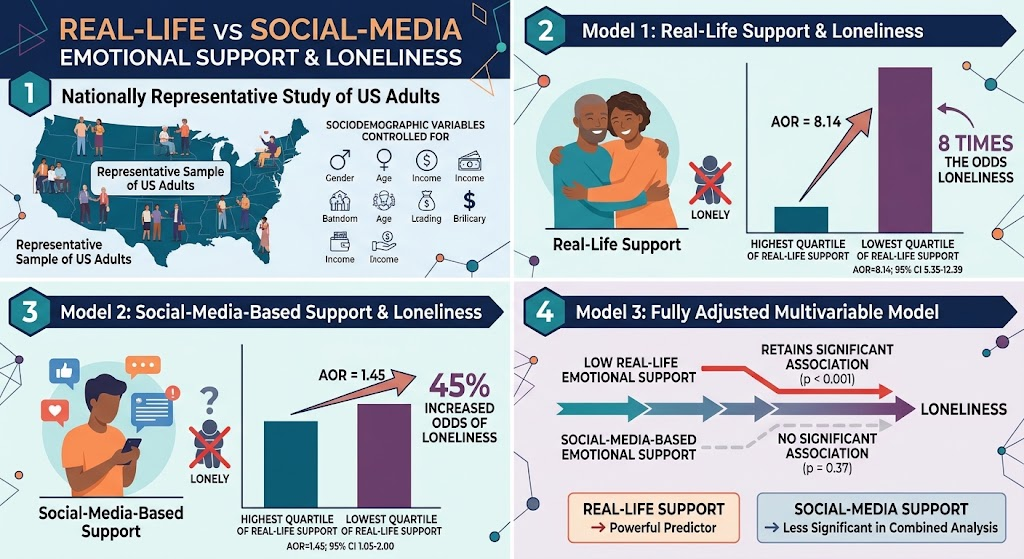
Loneliness, the distressing feeling of social isolation or lack of meaningful social connections, is a significant public health concern linked to increased mortality and adverse health outcomes among adults in the United States. With the growing ubiquity of social media platforms, many adults turn to online communities and digital communication to seek emotional support and alleviate loneliness. However, the comparative effectiveness of emotional support obtained through real-life interpersonal interactions versus that derived from social media remains unclear. This study aims to clarify how these two sources of emotional support relate to loneliness in a nationally representative cohort of US adults.

Background

MedXY registered readers

Sign in free to continue reading

Create or use your MedXY account to unlock the complete article.

This article was created using several editorial tools, including AI, as part of the process. Human editors reviewed this content before publication.

Related articles

Open language-specific specialty feeds and department pages.

Oxytocin’s Role in Modulating Thyroid Function and Mental Health in Obesity: Insights from an 8-Week Clinical TrialAn 8-week trial reveals that intranasal oxytocin increases the free T3/free T4 ratio and correlates with improved mental health-related quality of life in adults with obesity, suggesting thyroid axis modulation as a potential mechanism forSep 17, 2026Long-Term Fatigue in Differentiated Thyroid Cancer Survivors: Early Predictors and the Non-Impact of Thyrotropin SuppressionA nationwide prospective study identifies early fatigue and poor mental health as key predictors of long-term fatigue in differentiated thyroid cancer patients, while thyrotropin suppression shows no association with fatigue.Aug 21, 2026Characteristics of Higher-Education Students in England Who Died by Suspected Suicide: A National Retrospective Case Series StudyThis review synthesizes evidence on individual and institutional factors linked to suspected suicide among higher-education students in England, highlighting risk profiles, service contact patterns, and shortcomings in investigation practicAug 18, 2026
Loading comments...
MedXY briefing

Get the free newsletter

Evidence-led clinical news, trends, and analysis—delivered to your inbox.

Ask MedXY AI

Most popular

Intimate Health
Five Benefits for Women Continuing Sexual Activity After Menopause
Intimate Health
Why Some Women Have a Strong Sex Drive—And Why Men Shouldn't Worry About It
Nursing & care
How often should a couple have sex?
Intimate Health
Classic Intimacy Recommendations: How to Help Women Reach Orgasm and Enjoy Mutual Pleasure
Intimate Health
What Makes a Woman "Physiologically Addicted" Is Never Money, But These Two Relationship Qualities
© 2026 MedXY
Contact usAbout usPrivacy PolicyMedXY story
Bridging the Mental Health Care Gap for Trauma Patients at Risk of PTSD: Insights from Social Workers
This article examines the current gaps and strengths in mental health services for trauma surgery patients at risk of PTSD, highlighting underutilization of guidelines, barriers to care, and opportunities for improving psychosocial support.
Aug 4, 2026
Intramuscular Chemical Sedation in Emergency Mental Health Patients Associated with Black Race, Police Arrival, and Involuntary HoldsA study of over 94,000 ED visits found that intramuscular chemical sedation during mental health consultations was more common among Black patients, those arriving with EMS or law enforcement, and those on involuntary holds.Jul 29, 2026
Psychotropic Medication Use After Abortion: No Sustained Increase Seen in Danish Cohort StudyA Danish cohort study of 67,390 women found no lasting increase in psychotropic medication use after medication or procedural abortion. Small first-year increases were not significant after correction for multiple testing, while long-term use was lower.Jul 27, 2026