Metabolic Signatures and Causal Markers in MRI-Confirmed Lacunar Stroke: Insights from Observational and Mendelian Randomization Analyses
Highlight
- Identification of glycine and cholesterol proportion in medium LDL as causal metabolic markers for distinct lacunar stroke subtypes.
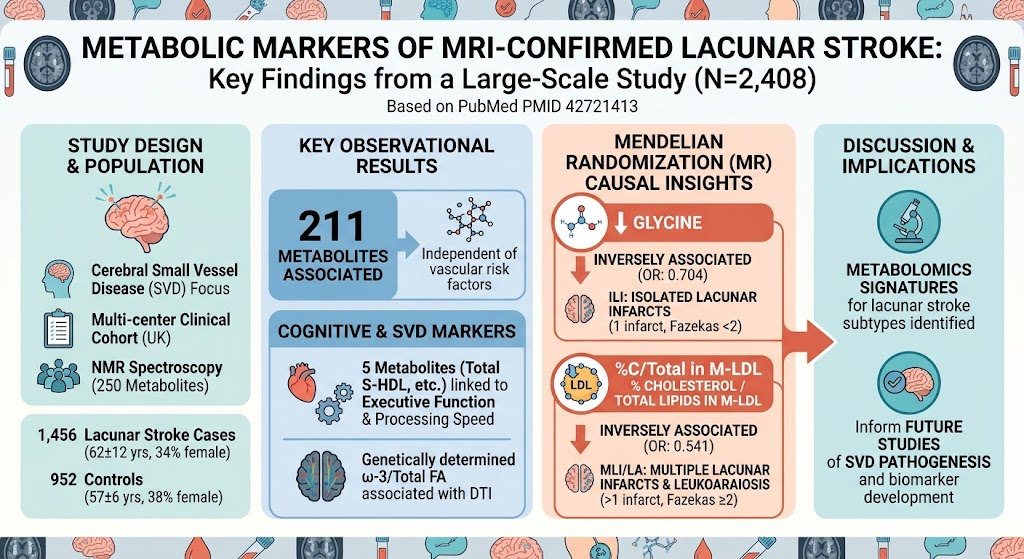
- Comprehensive metabolomic profiling in 1,456 MRI-confirmed lacunar stroke cases and 952 controls revealing 211 metabolites associated with the disease.
- Mendelian randomization analyses provide strong evidence for causal involvement of metabolic variations in cerebral small vessel disease pathogenesis.
- Correlations found between certain metabolites and cognitive impairments in executive function and processing speed, emphasizing clinical relevance.
Study Background
Lacunar stroke, a clinical manifestation of cerebral small vessel disease (SVD), is a significant contributor to vascular dementia and progressive cognitive decline worldwide. Despite advances in neuroimaging, understanding of its pathophysiology remains incomplete. The identification of metabolic disturbances correlating with lacunar stroke could illuminate underlying mechanisms and aid in development of targeted biomarkers and therapies. However, previous studies have been limited by reliance on clinical diagnoses without MRI confirmation or small sample sizes. This study leverages state-of-the-art metabolomic assays alongside neuroimaging and genetic methods to elucidate metabolic markers and assess their causal role in lacunar stroke.
Study Design
This observational study recruited 2,408 participants from stroke centers across the United Kingdom, consisting of 1,456 individuals with MRI-confirmed lacunar stroke and 952 hospital controls. The mean age for cases was 62 years (SD 12), with 34% female, whereas controls had a mean age of 57 (SD 6) and 38% female. Serum samples were assayed using nuclear magnetic resonance (NMR) spectroscopy to quantify 250 metabolites, encompassing amino acids, lipids, and other biochemical intermediates.
The study investigated associations between metabolites and MRI-defined lacunar stroke including subtype classification: isolated lacunar infarcts (ILI) with less extensive white matter changes, and multiple lacunar infarcts and/or leukoaraiosis (MLI/LA) with more extensive involvement. Cognitive assessments focused on domains of executive function and processing speed.
Furthermore, genome-wide association studies (GWAS) were conducted for each metabolite to identify genetic determinants. Mendelian randomization (MR) analyses employed these genetic instruments bidirectionally to infer causality between metabolites and lacunar stroke phenotypes, as well as neuroimaging markers of SVD.
Key Findings
Observational data revealed 211 metabolites significantly associated with MRI-confirmed lacunar stroke, underscoring broad metabolic alterations in this population. Among these, two metabolites—glycine and the ratio of cholesterol to total lipids within medium-sized low-density lipoprotein particles (%C/Total in M-LDL)—emerged with strong causal evidence through MR analysis.
Glycine was inversely associated with isolated lacunar infarcts (ILI), with an odds ratio (OR) of 0.704 (95% CI 0.585–0.848), suggesting a protective effect. Conversely, %C/Total in M-LDL showed an inverse causal association with the more severe MLI/LA subtype (OR: 0.541, 95% CI 0.401–0.730), indicating a distinct lipid profile relevant in advanced SVD.
Five other metabolites including total serum high-density lipoprotein (Total S-HDL), serum HDL concentration (S-HDL), phospholipid content in S-HDL, the cholesterol ester proportion in large LDL particles (%CE/Total in L-LDL), and lactate were observationally related to cognitive deficits in executive function and processing speed. Complementary MR analysis implicated genetically determined omega-3 fatty acid percentages in relation to diffusion tensor imaging measures of white matter integrity, providing mechanistic insight.
Table 1 summarizes the main causal metabolite associations with lacunar stroke subtypes and cognitive metrics:
| Metabolite | Lacunar Stroke Subtype | Association Direction | Odds Ratio (95% CI) | Cognitive Link |
|———————————-|—————————–|———————–|——————–|—————————|
| Glycine | Isolated Lacunar Infarcts (ILI) | Inverse | 0.704 (0.585–0.848) | Not specified |
| %C/Total in Medium LDL | Multiple Lacunar Infarcts/Leukoaraiosis (MLI/LA) | Inverse | 0.541 (0.401–0.730) | Not specified |
| Total S-HDL, S-HDL, PL in S-HDL, %CE/Total in L-LDL, lactate | Cognitive domains (executive function, processing speed) | Observational link only | N/A | Yes |
These findings were consistent across analytic modalities, supporting the biological relevance of the identified metabolomic signatures.
Expert Commentary
This investigation represents one of the most comprehensive efforts to date in linking serum metabolomics with MRI-confirmed lacunar stroke, applying rigorous genetic methods to discern causality rather than correlation alone. Glycine’s inverse association with less advanced lacunar infarcts fits with its known roles as a neurotransmitter and in anti-inflammatory pathways, suggesting potential neuroprotective mechanisms in SVD. The lipid cholesterol proportion in medium LDL particles, inversely linked with extensive SVD manifestations, highlights the importance of lipid metabolism in cerebral microvascular health.
The integration of neuroimaging phenotypes, metabolic profiling, and genetic causality tests strengthens the evidence for these metabolites as meaningful markers or even therapeutic targets. However, generalizability may be constrained by the primarily UK-based and hospital-recruited cohort. Future studies should validate findings in diverse populations and longitudinal designs to establish prognostic value.
Nonetheless, these data stimulate important hypotheses regarding metabolic modulation in SVD pathogenesis. They also suggest the feasibility of developing metabolite-based biomarkers to differentiate lacunar stroke subtypes or to monitor disease progression and cognitive outcomes.
Conclusion
This large-scale study elucidates key metabolic markers with causal roles in lacunar stroke subtypes, enhancing understanding of cerebral small vessel disease pathogenesis. Glycine and cholesterol proportions in medium LDL emerged as robust inverse associations with MRI-confirmed lacunar stroke manifestations. Additional metabolites connected to cognitive decline further highlight the metabolic impact on brain function.
These insights pave the way for future mechanistic research, biomarker development, and potential metabolic-targeted therapies to address the substantial burden of lacunar stroke and vascular cognitive impairment.
Funding and ClinicalTrials.gov
The study was supported by UK stroke research funding bodies; specific grants and trial registrations were not detailed in the abstract.
References
1. Ng WH, Aghakishiyeva E, Markus HS, Harshfield EL. Metabolic Markers of MRI-Confirmed Lacunar Stroke: Observational and Mendelian Randomization Analyses. Neurology. 2026 Sep 10;107(7):e218409. doi: 10.1212/WNL.0000000000203684. PMID: 42721413.
2. Wardlaw JM, Smith C, Dichgans M. Mechanisms underlying sporadic cerebral small vessel disease: insights from neuroimaging. Lancet Neurol. 2013 May;12(5):483-97. doi: 10.1016/S1474-4422(13)70060-7.
3. Traylor M, Markus HS. Genetic and protein biomarkers in cerebral small vessel disease: Potential applications in diagnosis and therapy. Stroke. 2022;53(1):8-16.
This article was created using several editorial tools, including AI, as part of the process. Human editors reviewed this content before publication.