Circulating Metabolites as Emerging Biomarkers for Stroke Risk Prediction: Insights from the BiomarCaRE Project
Highlight
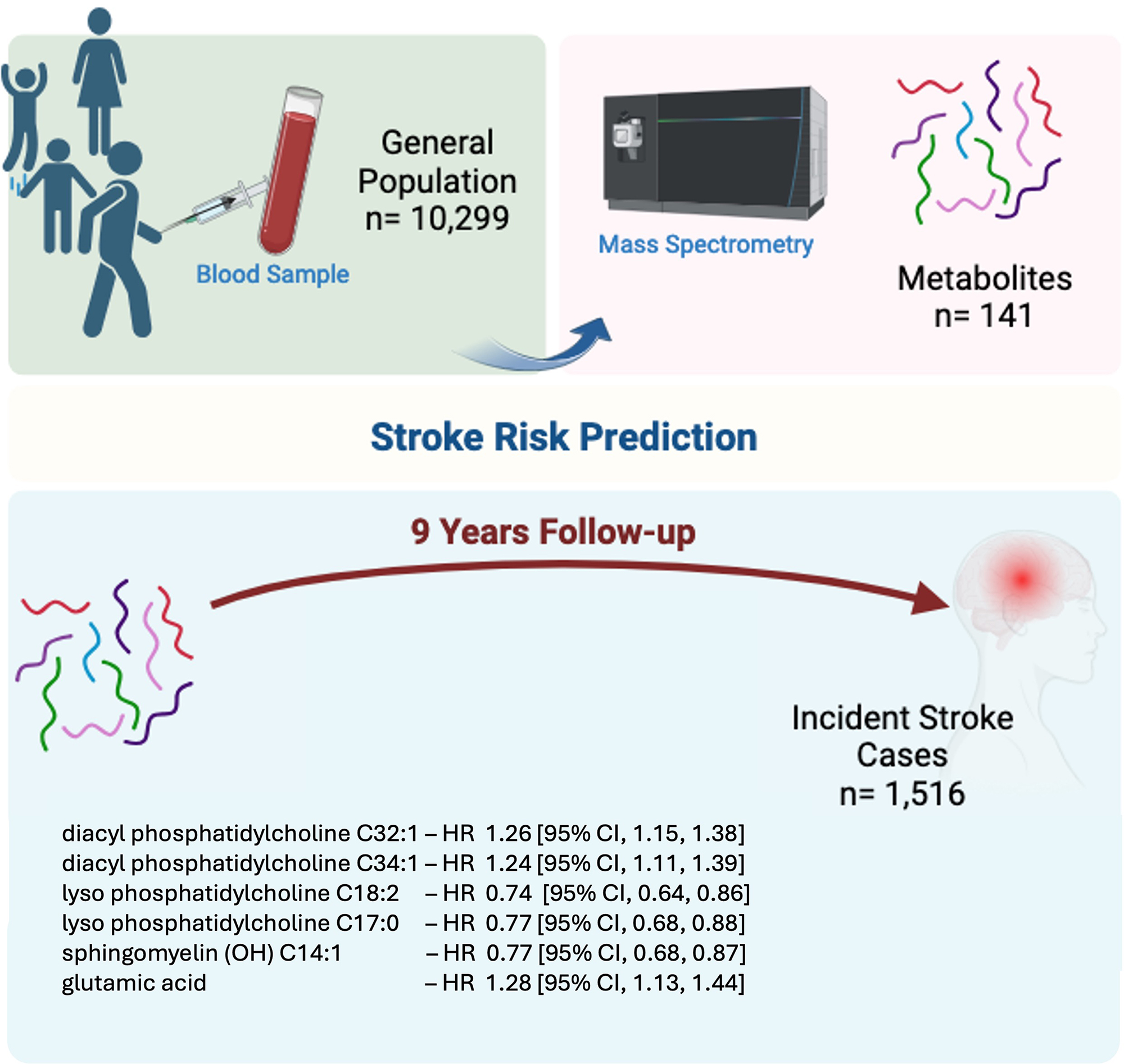
New metabolomic profiling within a large European cohort has identified six circulating metabolites associated with incident stroke. These include phosphatidylcholines, hydroxysphingomyelin, and glutamic acid, which demonstrate predictive power comparable to established cardiovascular risk factors. Such findings pave the way for metabolite-based early stroke risk stratification in clinical practice.
Study Background and Disease Burden
Stroke remains a leading cause of mortality and long-term disability worldwide, with substantial economic and health burdens. Early identification of individuals at high risk is critical for timely preventive measures. Classic risk factors like hypertension, diabetes, smoking, age, and lipid profiles guide current risk stratification but have limitations in accuracy and predictive value. Metabolomics, the systematic study of small molecules in biological fluids, offers a novel avenue to discover biomarkers that reflect underlying pathophysiological states potentially preceding clinical stroke manifestation.
Study Design
The current study is a large-scale case-cohort analysis derived from the BiomarCaRE project, involving over 70,000 individuals from several European population-based cohorts. From this, a subset of 10,299 participants, enriched with all individuals who experienced incident stroke, was selected. Serum samples from these individuals were analyzed for 141 circulating metabolites encompassing multiple biochemical classes. Incident stroke cases were tracked over a median follow-up of 8.9 years. Associations between metabolite levels and time to first stroke event were analyzed using weighted Cox proportional hazards models adjusted for classic cardiovascular risk factors — age, sex, systolic blood pressure, total cholesterol, body mass index, diabetes status, smoking, and antihypertensive treatment. The effect sizes were expressed as hazard ratios (HRs) per one standard deviation increase in log-transformed metabolite concentrations.
Key Findings
Among the 70,195 individuals in the original cohort, 1,516 (2.2%) experienced an incident stroke during follow-up. Median participant age was 56.8 years, with 39.5% female representation. After multiple comparison correction, six metabolites showed statistically significant associations with incident stroke risk:
- Lyso-phosphatidylcholine a C18:2: HR 0.88 (95% CI 0.82–0.93), indicating a protective association.
- Lyso-phosphatidylcholine a C17:0: HR 0.88 (95% CI 0.83–0.94), also inversely associated with stroke risk.
- Hydroxysphingomyelin C14:1: HR 0.90 (95% CI 0.85–0.94), protective effect.
- Diacyl-phosphatidylcholine C34:1: HR 1.10 (95% CI 1.05–1.16), positively associated with stroke risk.
- Diacyl-phosphatidylcholine C32:1: HR 1.14 (95% CI 1.08–1.21), elevated risk association.
- Glutamic acid: HR 1.23 (95% CI 1.11–1.37), the strongest risk-related metabolite discovered.
The magnitude of these associations was broadly similar to those observed for classical cardiovascular risk factors. Predictive modeling with these metabolites yielded C statistics for 10-year stroke prediction ranging from 0.782 to 0.785, closely aligning with models based on established risk factors (0.781 to 0.792). These findings suggest that circulating metabolites can serve as complementary biomarkers for stroke risk stratification.
Expert Commentary
This study robustly demonstrates the utility of metabolomic profiling in identifying specific circulating metabolites linked to future stroke risk. The involvement of phosphatidylcholines and sphingomyelins reflects perturbations in lipid metabolism and membrane integrity potentially tied to cerebrovascular pathology. Elevated glutamic acid levels may indicate excitotoxic pathways relevant to ischemic injury mechanisms. The case-cohort design and large European population size strengthen the validity and generalizability of these results.
Limitations include the observational design precluding causal inference, single-time metabolite measurements without longitudinal assessment, and lack of external validation cohorts beyond Europe. Additionally, the clinical application requires further work integrating metabolite panels into risk algorithms and testing their incremental benefit over established clinical predictors.
Conclusion
This landmark metabolomic study from the BiomarCaRE project identifies six circulating metabolites from distinct biochemical classes associated with incident stroke in a general European population. These metabolites, comparably predictive to classic risk factors, hold promise for refining early stroke risk prediction models. Incorporation of metabolite biomarkers could enhance personalized preventive strategies, allowing interventions before irreversible cerebrovascular damage occurs. Future research should focus on validation, mechanistic understanding, and integration into clinical risk tools to translate these findings into practice.
Funding and Clinical Trial Registration
The BiomarCaRE project was supported by the European Commission and other national funding bodies involved in large cohort studies. The study is registered under the BiomarCaRE consortium protocols but no specific ClinicalTrials.gov identifier was provided.
References
- Schulte C, Ojeda FM, Jensen M, et al. Circulating Metabolites Are Biomarker Candidates for Stroke Risk Prediction: Results From the BiomarCaRE Project. Stroke. 2026 Sep 11. PMID: 42725362. https://pubmed.ncbi.nlm.nih.gov/42725362/
- Benjamin EJ, Muntner P, Alonso A, et al. Heart Disease and Stroke Statistics—2019 Update: A Report From the American Heart Association. Circulation. 2019;139:e56–e528.
- Wishart DS. Emerging applications of metabolomics in drug discovery and precision medicine. Nat Rev Drug Discov. 2016;15(7):473–484.
This article was created using several editorial tools, including AI, as part of the process. Human editors reviewed this content before publication.