Impact of a Community- and Family-Based Intervention on Blood Pressure Reduction in Rural China: Insights from a Cluster-Randomized Trial
Highlight
- A community- and family-centered multifaceted intervention significantly decreased systolic blood pressure (SBP) by 10.7 mm Hg at 6 months compared to usual care in rural Chinese adults aged 40-80 years.
- The intervention increased the proportion of participants achieving BP control (<130/80 mm Hg) from 23.6% to 46.2% at 6 months.
- Blood pressure reductions attenuated by 12 months, underscoring the need for sustained community support and continued monitoring.
- Serious adverse event rates were comparable between intervention and control groups, indicating safety of the approach.
Study Background
Hypertension remains a leading modifiable risk factor for cardiovascular disease worldwide, contributing significantly to morbidity and mortality. In China, particularly in rural areas with limited healthcare resources and less access to continuous medical care, hypertension detection, treatment, and control rates remain suboptimal. Current strategies often prioritize individuals with diagnosed hypertension, overlooking population-wide interventions that can shift the entire blood pressure distribution toward healthier levels. This trial addresses the unmet need to test whether a coordinated, community- and family-based approach can effectively reduce population systolic blood pressure (SBP) in rural China, thereby potentially mitigating the burden of hypertension-related complications on a broader scale.
Study Design
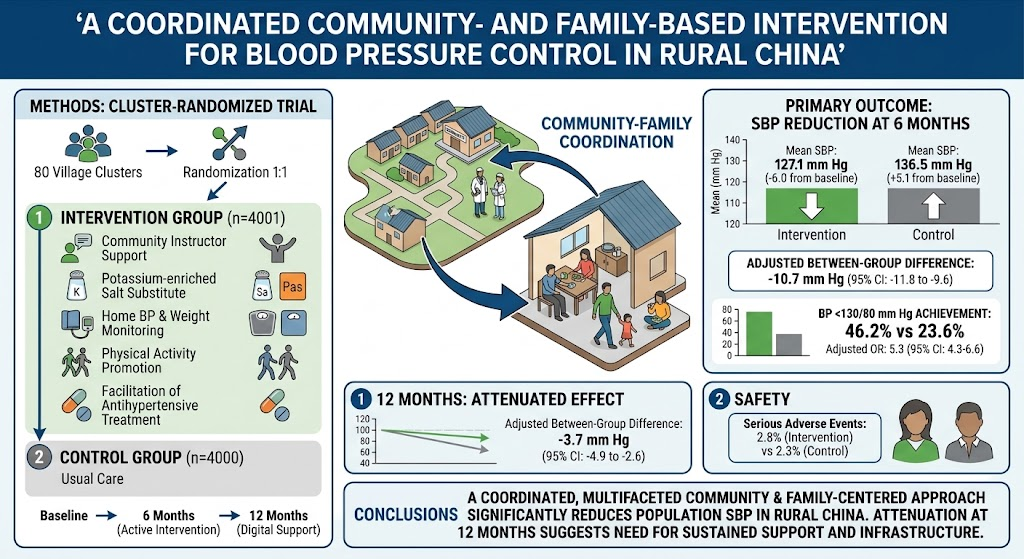
This study was a cluster-randomized controlled trial conducted in rural China involving 80 village clusters with a total of 8,001 adult participants aged 40 to 80 years, regardless of their baseline blood pressure or hypertension status. Clusters were randomized equally (1:1) to either a comprehensive intervention or usual care.
The multifaceted intervention spanned an initial 6-month active phase and a subsequent 6-month continuation phase with digital support, comprising:
- Community instructor support to facilitate engagement and implementation.
- Provision of potassium-enriched, low-sodium salt substitutes to promote healthier dietary sodium intake.
- Home blood pressure and weight monitoring enabling self-management.
- Physical activity promotion to enhance cardiovascular health.
- Facilitation of antihypertensive treatment for those requiring medications.
Trained staff independent of the intervention team measured office blood pressure at baseline, 6 months, and 12 months using standardized protocols. The primary endpoint was the between-group difference in change in SBP from baseline to 6 months, analyzed by intention-to-treat with linear mixed-effects regression models.
Key Findings and Results
At baseline, mean SBP was 133.1 mm Hg in the intervention group and 131.4 mm Hg in the control group. After 6 months, the intervention group experienced a mean reduction of 6.0 mm Hg in SBP, whereas the control group’s mean SBP increased by 5.1 mm Hg, yielding an adjusted between-group difference of -10.7 mm Hg (95% CI: -11.8 to -9.6 mm Hg; p<0.001).
Blood pressure control, defined as achieving a BP <130/80 mm Hg, was markedly higher in the intervention group (46.2%) compared to the control group (23.6%), with an adjusted odds ratio of 5.3 (95% CI: 4.3-6.6).
At 12 months, although still significantly lower than control, the SBP difference narrowed to -3.7 mm Hg (95% CI: -4.9 to -2.6 mm Hg), indicating some attenuation of the intervention effect over time.
Safety outcomes were comparable with serious adverse events occurring in 2.8% of participants in the intervention group versus 2.3% in the control group, showing no excess risk associated with the intervention.
Expert Commentary
This trial provides compelling evidence that a well-coordinated, community- and family-based intervention can shift the population blood pressure distribution towards healthier levels in resource-limited rural settings. The intervention’s multifactorial design—combining lifestyle modifications, dietary salt substitution, home monitoring, and facilitated treatment access—addresses multiple hypertension risk factors simultaneously, which likely contributed to the substantial SBP reduction.
The noted attenuation at 12 months underscores a key challenge in public health interventions: maintaining ongoing community engagement and infrastructure to sustain benefits beyond the initial active phase. Future implementations might benefit from integrating digital tools, community health worker networks, and policy support to ensure durability.
While the overall safety profile was reassuring, the trial did not provide detailed analyses regarding differential responses among subgroups (e.g., by baseline hypertension status, age strata, or comorbidities), which may guide targeted efforts. Additionally, expanding such interventions across diverse rural and urban Chinese contexts will be important to confirm generalizability.
The findings align with current hypertension guidelines emphasizing population health strategies and community involvement to improve blood pressure control rates.
Conclusion
This cluster-randomized trial highlights that scalable, culturally adapted, community- and family-centered interventions can significantly lower SBP in rural populations by shifting the entire population’s blood pressure distribution. The intervention’s success in nearly doubling the proportion of individuals achieving optimal BP control spotlights its public health potential in reducing cardiovascular risk.
Sustained infrastructure and community support are essential to maintain and amplify long-term effects. This model offers a promising framework for hypertension control strategies in other similarly underserved rural settings globally.
Funding and Clinical Trials Registration
The study was registered at ClinicalTrials.gov (NCT06427096). Funding sources were not detailed in the original publication abstract.
References
Du X, Jiang C, Tang Y, Han R, Song Y, Wang C, Lin X, Yi Y, Rodgers A, Dong J, Ma C, Anderson CS, Cai J. A Coordinated Community- and Family-Based Intervention to Control Blood Pressure in Rural China: A Cluster-Randomized Trial. J Am Coll Cardiol. 2026 Aug 10. PMID: 42644782.
Additional references for context:
1. Mills KT, Stefanescu A, He J. The global epidemiology of hypertension. Nat Rev Nephrol. 2020 Apr;16(4):223-237. doi:10.1038/s41581-019-0244-2.
2. He J, Gu D, Wu X, et al. Major causes of death among men and women in China. N Engl J Med. 2005 Nov 17;353(11):1124-34. doi:10.1056/NEJMsa050467.
3. Whelton PK, Carey RM, Aronow WS, et al. 2017 ACC/AHA Hypertension Guideline. J Am Coll Cardiol. 2018 May 7;71(19):e127-e248.
This article was created using several editorial tools, including AI, as part of the process. Human editors reviewed this content before publication.